How LGBTQ+ history was saved, or lost · the erased letter, the court that kept two names, the first archives, and what survived here
Written to punish Plymouth Colony, 1649Written to keep Boston, 1980Still unread South Coast marriage licenses, 2004
Chapter 0
Before you enter
Every piece of LGBTQ+ history you have ever read survived because somebody wrote it down and somebody else kept the paper. This exhibit is about those people. Some of them meant to destroy what they were writing about. Some meant to save it. A few tried to erase it afterward. The history reached us through all of them.
Ten moments, 1649 to 2026, each one told in a chapter of this exhibit. Drawn for this exhibit; the stations are evenly spaced, not to scale.
How we tell this story
We name a person's sexuality only where they named it themselves, in their own words or in a source that quotes them. Several people in this exhibit wrote letters of great tenderness to other women, and scholars disagree about what those letters mean. We print the letters and what happened to them, and we do not decide for anyone.
Where a fact rests on a document we opened, it says so. Where it rests on another writer's report, it says that. Where we could not find out, the chip says unknown, and Chapter VII lists every one of those questions so that someone can answer them.
The court record in Chapter II was written to shame two women, and the language in it is the court's. We quote it because it is the oldest record of its kind and because their names reached us only through it.
Chapter I
Amherst, the early 1850s · Boston, 1911
The name someone erased
The first way history is lost is the quietest. Nobody burns a building. Somebody with a pen goes back through a letter and takes a name out.
Emily Dickinson to her brother Austin, early 1850s
A long letter that begins "Do you want to hear from me, Austin." On its seventh and eighth pages, one name has been erased wherever it appeared. The name was Sue.
Dickinson Electronic Archives, the Dickinson Editing Collective's edition of the letter (manuscript A 608, Johnson letter 128): "Sue's name has been erased throughout on pages seven and eight, indicated in the transcription by brackets." Verified
Sue was Susan Gilbert, who became Susan Dickinson: an essay on the same scholarly archive calls Austin "her husband." That essay is unsigned, written in the first person by one of the editors of the published Emily and Susan correspondence, and it records that someone cut, erased and inked over Emily's writing to and about Susan, including an attempt "to ink over every line" of the poem that begins "One Sister have I in the house." Corroborated
Who did the erasing, and when, is not established by any source we read. Names have been suggested, and we print none of them, because a suggestion is not a record. Who erased it: unknown
What the letters mean is also argued. Some scholars read a love between the two women; others read a friendship in the language of the time. This museum does not settle that argument. What it can say, from the paper itself, is that somebody thought the name was worth removing.
Fields and Jewett: the letters that were cut
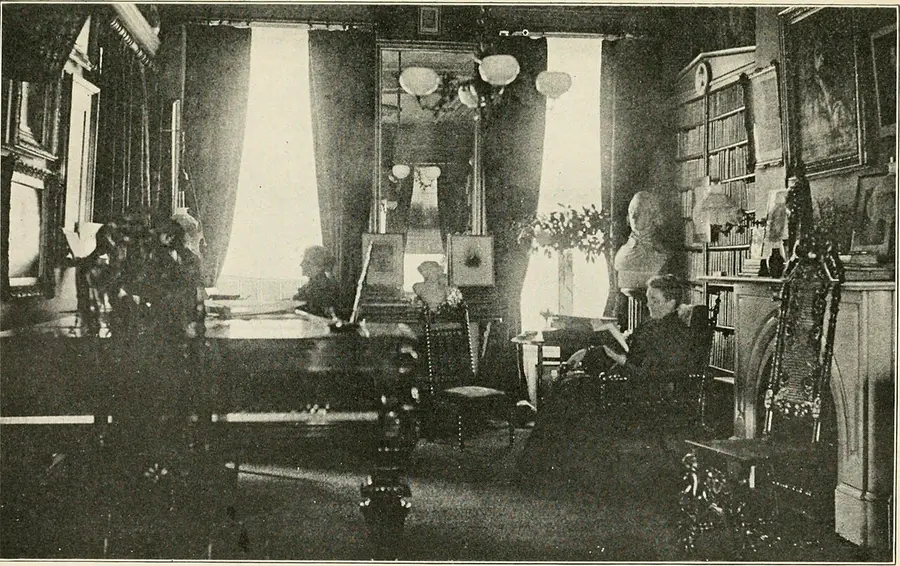
Annie Adams Fields and the writer Sarah Orne Jewett were companions; the archival description of the photograph below calls Jewett Fields's "companion." When they were apart, the Sarah Orne Jewett House says, "Jewett wrote to Fields nearly every day." Corroborated
Annie Adams Fields, by the window, and Sarah Orne Jewett, reading at right, in the library of Fields's house on Charles Street, Boston. Printed in M. A. DeWolfe Howe, Memories of a Hostess (1922). Internet Archive Book Images, via Wikimedia Commons. Public domain. This photograph survives in a book by the man reference works name as the editor of the cuts below. Image and source verified
After Jewett died, Fields edited Letters of Sarah Orne Jewett, published by Houghton Mifflin in 1911. Verified The letters were, in the words of the PBS history series Out of the Past, "full of intimate endearments," and Fields's editor "insisted that readers might 'get the wrong idea.'" Passages were left out. Corroborated
Reference works name that editor as Mark Antony DeWolfe Howe. We have not read that reference ourselves, and we have not found his own words. So the cut is documented, and the reason given for it is documented second-hand, but the conversation itself is not. The editor's exact words: unknown
Sources: Dickinson Electronic Archives, Dickinson Editing Collective (2013), "Do you want to hear from me, Austin" (A 608, JL 128), emilydickinson.org; "Susan and Emily Dickinson: their lives, in letters," archive.emilydickinson.org, unsigned essay by the editors of Open Me Carefully; Letters of Sarah Orne Jewett, ed. Annie Fields (Houghton Mifflin, 1911), HathiTrust; PBS, Out of the Past, "Sarah Orne Jewett"; Sarah Orne Jewett House, jewett.house; Robert L. Gale, A Sarah Orne Jewett Companion (1999), p. 98, as cited by others and not read by us; Wikimedia Commons file description for the photograph.
Chapter II
Plymouth Colony, 6 March 1648/9
The court wrote it down
Some of the oldest LGBTQ+ records in this country were written by the people prosecuting them. Those records were written to punish. Some of them are now the only proof that those lives happened.
Records of the Colony of New Plymouth in New England, volume 2 (printed 1855), page 137: the presentments of the Grand Inquest, 6 March 1648/9. Scan contributed by the Boston Public Library to the Internet Archive; not in copyright. Cropped and toned for this exhibit in Krita. Verified
The Grand Inquest, Plymouth Colony
"Wee present the wife of Hugh Norman, and Mary Hammon, both of Yarmouth, for leude behauior each with other vpon a bed."
Records of the Colony of New Plymouth, vol. 2, p. 137. The museum's exhibit The Long Fight quotes the same entry and the sentence that followed in 1650. Verified
This is the earliest known prosecution of two women for a same-sex act in what is now the United States. Corroborated The Long Fight tells what happened next: Mary Hammon was fifteen and recently married, and at the General Court of 2 October 1650, Sarah Norman was ordered to make a public acknowledgment of her "vnchast behauior." No whipping, no branding, no death.
Look at the margin of the printed page. The clerk wrote her name twice, once as Hammon and once as Hamon, and beside the entry he recorded the outcome for the younger woman: "Mary Hamon cleared with admonision." The same page, a few lines down, presents the way wardens of Taunton for neglecting to mend the highways. Verified, from the page Taunton and Dartmouth were Plymouth Colony towns, so the court that judged two women from Yarmouth was the South Coast's court too. Corroborated
Follow the paper. A colonial clerk wrote the entry to shame two women. The book survived. It was printed in 1855. The Boston Public Library scanned it and gave the scan to the public. That chain, and no other, is how Sarah Norman and Mary Hammon reached you. Nobody in it was trying to save them.
Sources:Records of the Colony of New Plymouth in New England, vol. 2 (Boston, 1855), pp. 137 and 163, Internet Archive item recordsofcolonyo0102newp, contributed by the Boston Public Library; the museum's exhibit No. XVIII, The Long Fight, "1649: Yarmouth, and the first two women," for the 1650 sentence, Mary Hammon's age, and the "earliest known" description, with that exhibit's sources.
Chapter III
New York, 1974 · Boston, 1980
The first community archives
In the 1970s, LGBTQ+ people stopped waiting for courts and families to decide what would be kept, and started keeping it themselves, sometimes in their own homes.
Kept on purpose
1974New YorkThe Lesbian Herstory Archives is founded and housed in an apartment on Manhattan's Upper West Side. In 1991 the group bought a rowhouse in Park Slope, Brooklyn, and reopened there in June 1993.A home, then a house Verified
1976New YorkJonathan Ned Katz publishes Gay American History: Lesbians and Gay Men in the U.S.A. (Crowell). The museum's own exhibit The Long Fight lists it among its sources.A book Verified
1980BostonThe History Project begins as "a small group of volunteers," which Mass History Commons describes as "historians, activists and archivists."Volunteers Verified
1998BostonImproper Bostonians: Lesbian and Gay History from the Puritans to Playland, compiled by the History Project, is published by Beacon Press, with a foreword by Barney Frank, who appears in this museum's Sent to Washington.A book Verified
2025BostonThe History Project becomes Queer History Boston. "For 45 years we operated as The History Project," it writes, and "in 2025 we came out as Queer History Boston."A new name Verified
Sources: NYC LGBT Historic Sites Project; OutHistory; queerhistoryboston.org; Mass History Commons; Library of Congress catalog record 98011928.
The Boston name change is the part of this story we did not expect. The organization says its founders were advised that the words "Gay and Lesbian" in its title "could jeopardize our nonprofit status," "so the safer, quieter choice was made." Verified
When The History Project was founded in 1980, we had to live a little "closeted" ourselves.Queer History Boston, on its own renaming, 2025.
So for forty-five years, the archive that kept Boston's LGBTQ+ history kept it under a name that did not say so. That is not the eraser of Chapter I, but it is a quieter relative of it, at work on the very people trying to save the record.
How much it holds depends on who is counting. Its own site says "over 200 archival collections." Its executive director told The Progressive in June 2026 that it holds "more than 250 collections." We print both. Collection count: two figures
The History Project also mounted an exhibition at the Boston Public Library, Public Faces/Private Lives, which Mass History Commons says "drew tens of thousands of visitors." Corroborated We could not find the year on any page we opened. Year: unknown
Sources: NYC LGBT Historic Sites Project, "Lesbian Herstory Archives," nyclgbtsites.org; OutHistory, "Fifty Years of Jonathan Ned Katz," on Gay American History (1976); Queer History Boston, "About" and "Queer History Boston" (news, September 9); Mass History Commons, entry on The History Project; Improper Bostonians (Beacon Press, 1998), library catalog records; Michaela Brant, The Progressive, June 25, 2026.
Chapter IV
Mehlville High School, Missouri, 1994
One teacher, 1994
LGBTQ+ History Month exists because one history teacher decided that his own subject had left people out, and said so in front of his class.
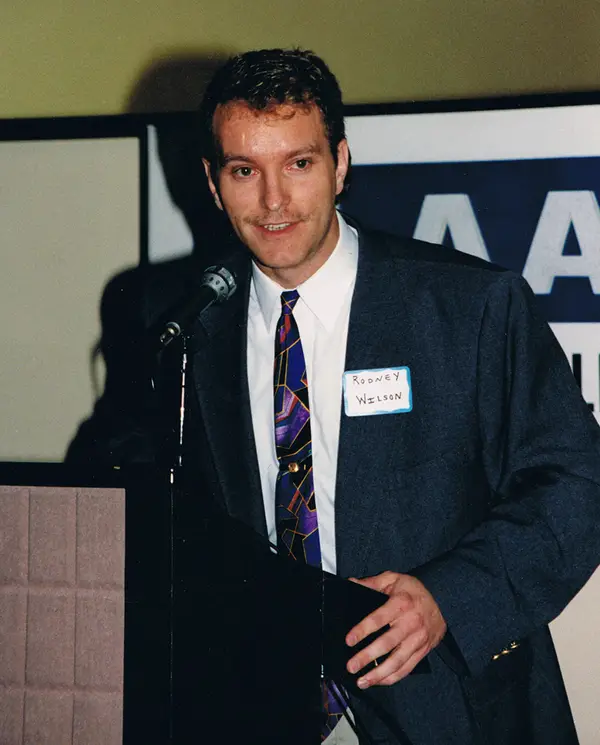
Rodney Wilson speaking about LGBT History Month at a GLAAD event, 1996. Photograph by Msheble, via Wikimedia Commons, uploaded as the uploader's own work. CC BY-SA 4.0. Authorship as stated by the uploader
In 1994, Rodney Wilson was teaching history at Mehlville High School, outside St. Louis. During a lesson on the badges the Nazis forced camp prisoners to wear, he told his students that he would have been made to wear the pink triangle, and he became the first openly gay K-12 teacher in Missouri. That same year he proposed a month for lesbian and gay history. Verified
He chose October because it fit the school calendar, because the 1979 and 1987 marches on Washington had both been held in October, and because National Coming Out Day, first held in 1988, falls in it. According to KCUR in Kansas City, 20 countries now have similar months. Verified
The Missouri Historical Society holds his Mehlville High School name tag. Its record says he wore it from 1995 to 1997, so it is a tag from the years after he came out, not the day itself. VerifiedDated with care
Notice what kind of act this was. Wilson did not find a lost document. He added a page to the calendar, so that every October a teacher, a librarian or a student has a reason to ask what was left out. The South Coast LGBTQ+ Network's History Month blog post tells his story for the Network's readers: History Month started with one teacher.
Sources: Miya Norfleet, "A Missouri teacher founded LGBT History Month 30 years ago. It's now in 20 countries," KCUR, October 9, 2024; Missouri Historical Society, object 2022-093-0002, via the Digital Public Library of America; PBS NewsHour, October 2024, as a second account, not opened by us.
Chapter V
New Bedford · Fall River · Taunton
The South Coast: what survived, and how
This museum's South Coast exhibits rest on a handful of surviving records, and on people. Here is each one, and the thing it rests on.
What each South Coast exhibit stands on
20 Kenyon StreetNew BedfordRests mostly on one exceptional source, the New Bedford Light's 2022 fortieth-anniversary feature, and an obituary. The surviving co-founder, who is living and whom we do not name, is "the keeper of more of this history than any document holds."A newspaper, and a memory Verified
Puzzles, 2006New BedfordThe 2013 documentary Puzzles: When Hate Came to Town, by Tami Gold and David Pavlosky, distributed by New Day Films, is a primary cultural record of the attack and what followed.A film Verified
AIDS on the South Coastthe region"No local death toll survives in any record we have found." The names of the South Coast's dead are not in any document we have read.A gap Unknown
Seven Couplesthe State HouseRests on the printed Journals of the Senate and House at the State Library. The first South Coast marriage licenses of May 2004 sit on microfilm at the New Bedford, Fall River and Taunton public libraries. They are not online, and nobody has read them for this museum yet.The state's own record, and a reel no one has read Licenses: unread
Every row quotes or summarizes the exhibit it links, and each exhibit carries its own sources.
Lay those four rows beside the first four chapters and the same pattern shows. A newspaper story kept one bar's history. A filmmaker kept the record of an attack. The Commonwealth kept its own votes. And where nobody wrote anything down, as with the people this region lost to AIDS, nothing survived but memory.
What this museum does not yet hold for the South Coast
The marriage license records of May 2004, on microfilm in three public libraries.
The names and the number of the South Coast's people lost to AIDS.
The founding date of 20 Kenyon Street, and the date and details of the arson fire its exhibit describes, beyond what one newspaper feature records.
Any South Coast LGBTQ+ archive, newsletter collection or oral history project before this museum. We have not found one. If one existed, we would like to know where its papers went.
Every chapter before this one comes down to the same question: who had the pen. This museum is the South Coast LGBTQ+ Network picking it up.
History disappears when nobody writes it down … That's exactly why we built the South Coast LGBTQ+ Museum: so our history gets written down, documented and kept, and lives on long after the people who lived it.The South Coast LGBTQ+ Network, from its blog post for LGBTQ+ History Month, October 2026.
The rest of this exhibit is about strangers: a clerk in 1649, an unknown person with an eraser, a cautious editor, volunteers in Boston. The South Coast's chapter is still being written, and much of it is in people's closets, drawers and photo albums.
If you have a piece of it
Old photos, flyers, newsletters, matchbooks, a story you remember.
If you have something from the South Coast's LGBTQ+ past, call or text the Network at (774) 775-2656 and tell us what you have, or use the Help Us page.
An exhibit about who wrote history down has to show its own paper. Here is what we could not settle, and where our record is thin.
Care we took with the popular record
Rodney Wilson's museum name tag is not from 1994Dated with care
The Missouri Historical Society dates it 1995 to 1997, so it should not be shown as an object from the year he came out.
We do not name who erased Sue's nameHeld back
Suspicion is not evidence, and no source we read establishes it.
The 1649 record spells Mary Hammon two waysFrom the page
Hammon in the entry, Hamon in the margin. We use the entry's spelling, as The Long Fight does.
Facts we did not resolve, and did not hide
Who erased Sue's name from Emily Dickinson's letter, and whenUnknown
The erasure is documented. The person is not.
What Annie Fields's editor actually saidUnknown
Reported second-hand by PBS. The editor is named as M. A. DeWolfe Howe in a 1999 reference work we have not read.
The year of Public Faces/Private Lives at the Boston Public LibraryUnknown
Another exhibit in this museum, PRISM, used to give 1996 and "over 50,000 visitors." We found no page that supports either, so PRISM now says "tens of thousands," as Mass History Commons does, and gives no year until we find one.
How many collections Queer History Boston holdsTwo figures
"Over 200" on its own site; "more than 250" in The Progressive, June 2026.
Whether the City of Boston gave The History Project an early grantNot confirmed
A 2010 Boston Globe story is cited elsewhere for a small city grant. We have not read it, so the grant is not in this exhibit.
The South Coast's first marriage licenses, May 2004Unread
On microfilm in New Bedford, Fall River and Taunton. Someone has to go and read them.
The South Coast's AIDS dead, by name and numberUnknown
No record we have found holds them.
20 Kenyon Street's founding date and the fireThin
Both rest on one newspaper feature and on the memory of a living co-founder.
Where our own record is thin
Three trips would improve this exhibit. The microfilm reading rooms of the New Bedford, Fall River and Taunton public libraries, for the licenses of May 2004. Queer History Boston's collections, which may hold South Coast newsletters and flyers that nobody has looked for. And the published correspondence of Emily and Susan Dickinson, for the editors' full account of the erasures, which we read only in summary.
This exhibit holds three images, and each carries a license we read on its source page. The 1855 court record is a public domain scan from the Boston Public Library, cropped and toned for the hero and Chapter II in Krita. The photograph of Fields and Jewett is from a 1922 book and is in the public domain. The photograph of Rodney Wilson is shared under CC BY-SA 4.0, with credit to its photographer. The timeline in Chapter 0 was drawn for this exhibit in Inkscape and keeps every word as real text.
Support
If any part of this exhibit has been hard to carry, you can call or text 988, the Suicide and Crisis Lifeline, at any hour. The Trevor Project is at 1-866-488-7386 for LGBTQ+ young people. Trans Lifeline is at 877-565-8860. The South Coast LGBTQ+ Network is at 774-775-2656.
Method: research on October 16, 2026, reading primary pages wherever they could be opened, quoting verbatim, and tagging each fact as verified, corroborated, or unknown. Facts already established in this museum's own exhibits were taken from those exhibits and linked rather than researched again. Every unresolved question is listed above so that someone can resolve it.

 Museum