Where Puzzles Lounge, New Bedford, MAWhen February 2, 2006In memory of Officer James W. Sell & Jennifer Rena Bailey
This exhibit is a memorial to an act of anti-gay violence. It describes a hate crime, weapon and gun violence, and the deaths of two people. Please take it at your own pace.
If you need support right now: call or text 988, the Suicide and Crisis Lifeline, or reach The Trevor Project.
Chapter 0
Before you enter
This exhibit tells the story of an act of anti-gay violence and its long aftermath. It is a memorial first, and a history second.
Content note
What follows describes a hate crime, gun and weapon violence, and the deaths of two people. Take it at your own pace. If you need support, you are not alone, and resources are listed at the end of the exhibit.
A note on the person who did this
An 18-year-old man planned and carried out this attack. You will not find his name featured here, nor his photograph, his beliefs, his writings, or his story. Those things have been recorded elsewhere, and we will not repeat them. A museum chooses what to keep. We choose to keep the people he harmed, and the community that answered. He is in this exhibit only as much as an honest record of events requires, and not one word more.
Chapter I
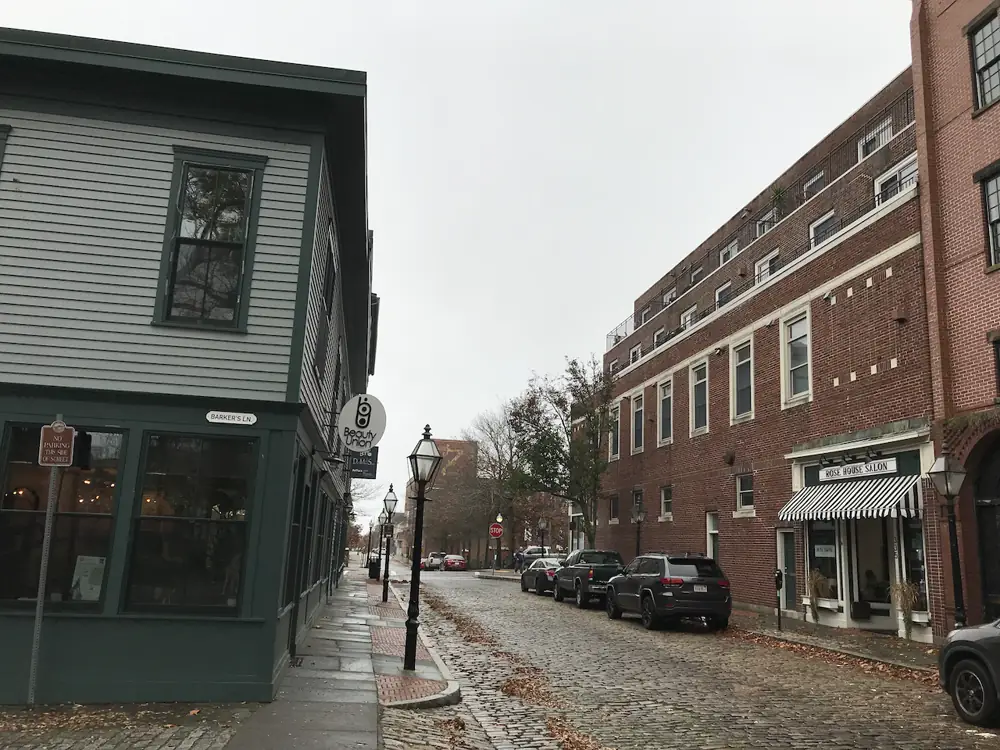
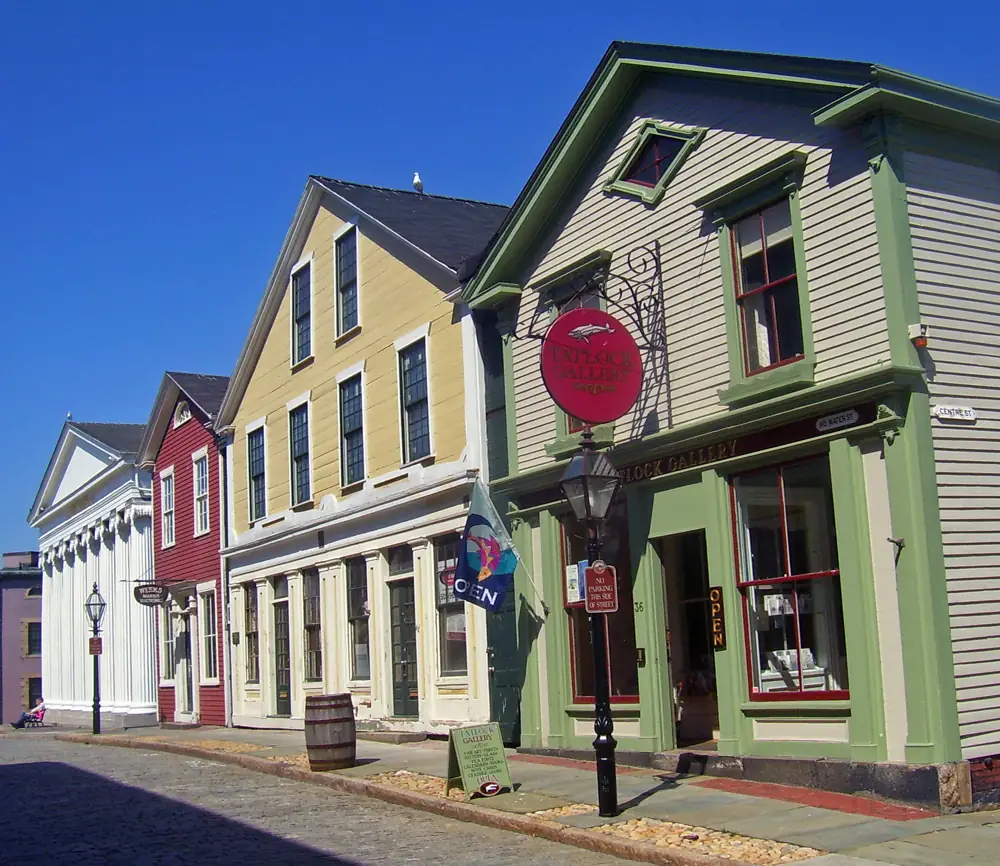
Acushnet Avenue in New Bedford's North End, the neighborhood where Puzzles Lounge stood on Front Street. Photo by M2545, via Wikimedia Commons. CC BY-SA 4.0.Historic buildings along North Water Street in New Bedford, part of the city's National Historic Landmark district. Photo by Daniel Case, via Wikimedia Commons. CC BY-SA 3.0.
The night of February 1 into February 2, 2006
It was a Wednesday, just before midnight, at a small gay bar called Puzzles Lounge at 426 Front Street in the North End of New Bedford. A young man came in on a fake ID, ordered drinks, and asked whether it was a gay bar. Then he took out a hatchet and swung it at a patron.
What happened next is the part that matters most. The people in that bar fought back. Patrons tackled him and stripped the hatchet from his hands. He drew a handgun and opened fire. Three patrons were wounded.
All three survived.
What is established
The attack, its date and place, and that three patrons were wounded and all survived, are documented in contemporaneous reporting and corroborated across multiple later sources. That patrons disarmed the hatchet before the gun was drawn is consistently reported.
Verified
Sources: Wikinews, "Manhunt on for gay bar attacker in Massachusetts," Feb 5 2006; The New Bedford Light, 2026; WBSM. The attack began late on the night of February 1 and is most commonly recorded as February 2, 2006, because events crossed midnight; both refer to the same night.
Chapter II
Five days, four states
From New Bedford, the violence travelled. Over five days it crossed four states and took two more lives before it ended. Select a point on the map, or a moment in the timeline, and the two move together.
Each pin sits at the place named. Several locations (the bar's exact address, the Gassville lot, and others) await precise geocoding and are marked approximate. We never plot a precise pin we have not confirmed.
Chapter III · In memoriam
Officer James Walter Sell
End of Watch
James Walter Sell
Gassville Police Department, Arkansas
June 21, 1942 – February 4, 2006 · U.S. Navy veteran · killed in the line of duty, age 63
On the afternoon of February 4, 2006, Officer James W. Sell, known as Jim, made a traffic stop outside the Brass Door on East Main Street in Gassville, Arkansas. He was shot and killed. He had been a sworn officer of the Gassville Police Department since October 13, 2003.
A Navy veteran and a career lawman.Corroborated
Born in Cedar Falls, Iowa in 1942, he served in the U.S. Navy and then more than thirty years with the Blytheville, Arkansas Police Department, retiring as a captain in 2000 before joining the Gassville force part-time. He was 63.
A widower, and a father.Corroborated
His wife had died of cancer in 2004. He is survived by a daughter, whom we do not name here. We are reaching out to his family and department with care, not extracting detail.
A thousand officers came.Corroborated
His funeral, on February 10, 2006 in Mountain Home, Arkansas, drew more than a thousand officers from over two dozen states, in a procession of some four hundred vehicles. The governor ordered the state's flags lowered to half-staff.
Remembered and honored.Verified
He is listed on the Officer Down Memorial Page (officer #18137) and honored by the City of Gassville. His death is recorded among law-enforcement officers killed by domestic extremists.
Portrait pending
His memorial portrait, the Gassville Police Department's official "Fallen Officer" photograph, will appear here once the department has cleared it for this exhibit. We will not use an image we have not been given permission to use.
Sources: Officer Down Memorial Page #18137; Roller Funeral Homes obituary; TIME (2006); KAIT8; SPLC.
Chapter IV · In memoriam
Jennifer Rena Bailey
In memory
Jennifer Rena Bailey
of Charleston, West Virginia
February 4, 2006 · Norfork, Arkansas
Jennifer Rena Bailey was 33 years old, from Charleston, West Virginia, and reported to be a mother of three. She was killed during the final confrontation in Norfork, Arkansas. She was a person, not a footnote to someone else's crime, and we name her here in her own right.
What we do not claim to know
It was reported that she had previously known the attacker. Whether she travelled with him willingly, or under coercion, is not established by the available record. We will not assert either. To guess would be to risk a second injustice.
Corroborated her age, home, and that she was a mother of three. Unknown the nature of her presence during the flight.
Portrait pending
We hope to honor Jennifer with an approved photograph and, if her family wishes, their words. We are approaching them with care. Her children were young in 2006 and will not be named or sought.
Sources: Wikipedia; TIME (2006); Wikinews. Age and family details to be confirmed against an original record with family sensitivity review.
Chapter V
The wounded and the brave
Three patrons were wounded that night. All three lived. Behind that single sentence is an act of collective courage: in the seconds after the first blow, the people in that bar did not run. They tackled the attacker and took the hatchet from his hands before he could use it again.
An honor we will not get wrong
The specific individuals who tackled and disarmed him are not reliably named in the record. Rather than credit the wrong person, we honor them together, and we keep looking. If you were there, the door at the end of this exhibit is open to you.
The survivors' own words, only with their consent
Survivors of that night, and a member of the bar's staff, have spoken publicly in the years since. Their testimony is among the most important parts of this history. It is also theirs to give.
Consent review required before publication
We will feature survivors here only with their explicit consent, in their own words, with any detail they approve and nothing they do not. We do not republish anyone's account of their own wounding without permission. This section is held open for them.
Verified three wounded, all survived. Corroborated that patrons disarmed the hatchet. Unknown who specifically.
Chapter VI
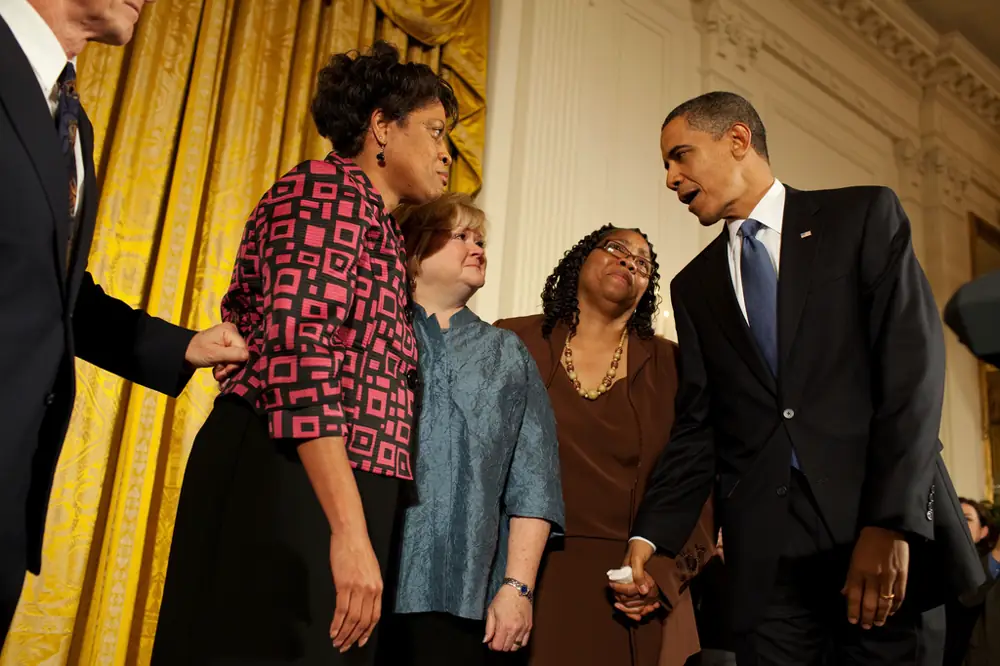
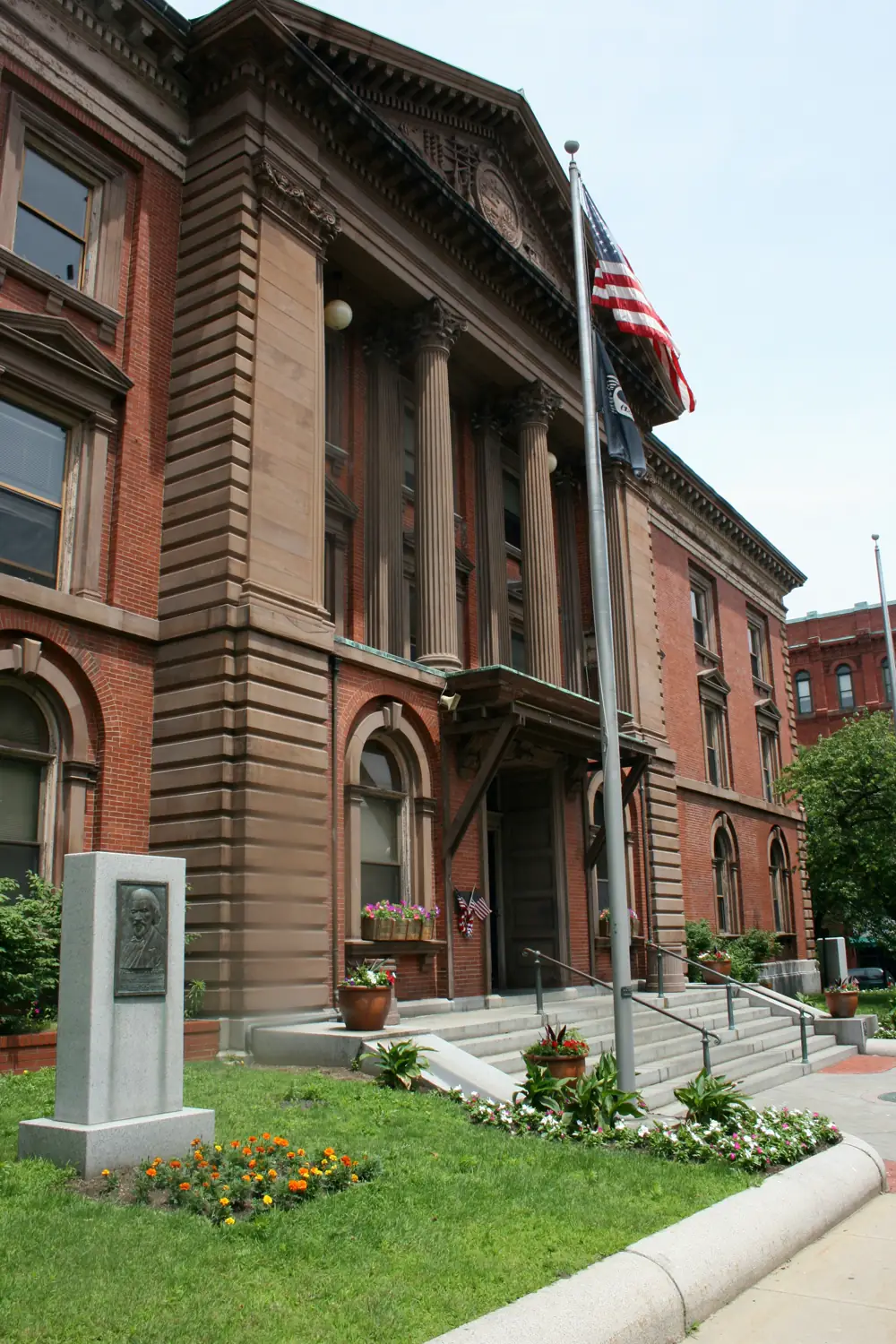
President Obama greets Louvon Harris and Betty Byrd Boatner, sisters of James Byrd Jr., and Judy Shepard at the 2009 enactment of the federal hate-crimes law. Pete Souza / Official White House Photo (PD-USGov). Public domain.New Bedford City Hall, where the city's response to the attack centered in the days that followed. Photo by Pvmoutside, via Wikimedia Commons. CC BY-SA 3.0.
The awakening
For a community that had largely kept itself quiet, the attack changed everything. In the days that followed, New Bedford's then-new mayor held a candlelight vigil and a community town hall. A vigil was organized the very night after the attack. People who had never been public came out, together, into the open.
Advocates describe Puzzles as the watershed, the moment a closeted community became a visible and organized one. Among those who stepped forward were the organizers who had built the region's first marriage-equality and LGBTQ+ alliances, and the advocate who would go on to lead the SCLGBTQ Network, the organization that stewards this museum.
Why this exhibit exists here
This museum is a project of the SCLGBTQ Network. The line from a vigil in 2006 to this archive is not a coincidence. The community that the attack tried to frighten into silence built the very institution now keeping its memory.
The attack was investigated and charged as a hate crime from the outset, and it reached Washington. It renewed calls to broaden a federal hate-crimes law that, at the time, did not clearly cover crimes motivated by sexual orientation. Senator Edward Kennedy called it "a sad reminder of how far we still have to go," and Congressman Barney Frank, whose district then included New Bedford, weighed in. The gap they named was finally closed three years later, in the 2009 Matthew Shepard and James Byrd Jr. Hate Crimes Prevention Act. Barney Frank has his own exhibit here.
Corroborated the vigils and advocates. Verified the hate-crime charge.
A note on the living
The advocates named here are public figures who spoke on the record. Before we feature any living person's words or likeness, we confirm their inclusion and wording with them directly.
Sources: The New Bedford Light, 2026; turnto10 (NBC 10 WJAR), 2026; Wikinews.
Chapter VII
On film, and twenty years on
Puzzles: When Hate Came to Town
In 2013, filmmakers Tami Gold and David Pavlosky released a documentary about the attack and the city around it, distributed by New Day Films. It runs 53 minutes and premiered at UMass Dartmouth on October 16, 2013, before a national festival run. It is a primary cultural record of this history.
Puzzles: When Hate Came to Town (2013, 53 min). Directed by Tami Gold and David Pavlosky. New Day Films. Verified
Twenty years on
On the twentieth anniversary in 2026, the community gathered again, holding a vigil with ten minutes of silence followed by remarks. Among those who took part were the city's mayor, local elected officials, survivors, and the advocates who have carried this memory for two decades. This exhibit is built in that same anniversary window, and in that same spirit.
Corroborated
Sources: New Day Films; The New Bedford Light, 2026; turnto10, 2026. Documentary year and 2026 vigil logistics being confirmed with the filmmakers and organizers.
Chapter VIII
How we know, and what we are still confirming
This exhibit follows the museum's rule: every load-bearing fact is sourced and confidence-tagged, and we show what we do not yet know rather than guessing. The following are open before this exhibit is published.
Exact map coordinatesVerifying
The bar's precise address, the Gassville lot, Arkana, and the Springfield hospital are being geocoded. Town-level pins are placed in the meantime and marked approximate.
Officer Sell's age and Blytheville recordVerifying
From his obituary and department record.
Jennifer Bailey's record and her family's wishesVerifying
Confirmed against an original record, with family sensitivity review.
Survivor and advocate consentIn progress
No living survivor or advocate is featured by name or word until they have agreed.
If you need support
If anything here weighs on you, you are not alone. The Trevor Project offers free, confidential support for LGBTQ+ young people, any time: call 1-866-488-7386, or text START to 678-678. The 988 Suicide & Crisis Lifeline is available to anyone, by call or text to 988. For anti-LGBTQ+ violence, the National Coalition of Anti-Violence Programs connects people to local help.
If this is your story
If you were at Puzzles that night, if you knew Officer Sell or Jennifer Bailey, or if you have a photograph, a memory, or a correction, we would be honored to hear from you.
Key sources: Wikinews (Feb 5 2006); The New Bedford Light (2026); turnto10 / NBC 10 WJAR (2026); WBSM; Officer Down Memorial Page (#18137); TIME (2006); SPLC; New Day Films. Full citations are held in the museum's research record.

 Museum