Where 20 Kenyon Street, New Bedford, MASince 1982Known as Le Place, and today The Gallery Bar
Chapter 0
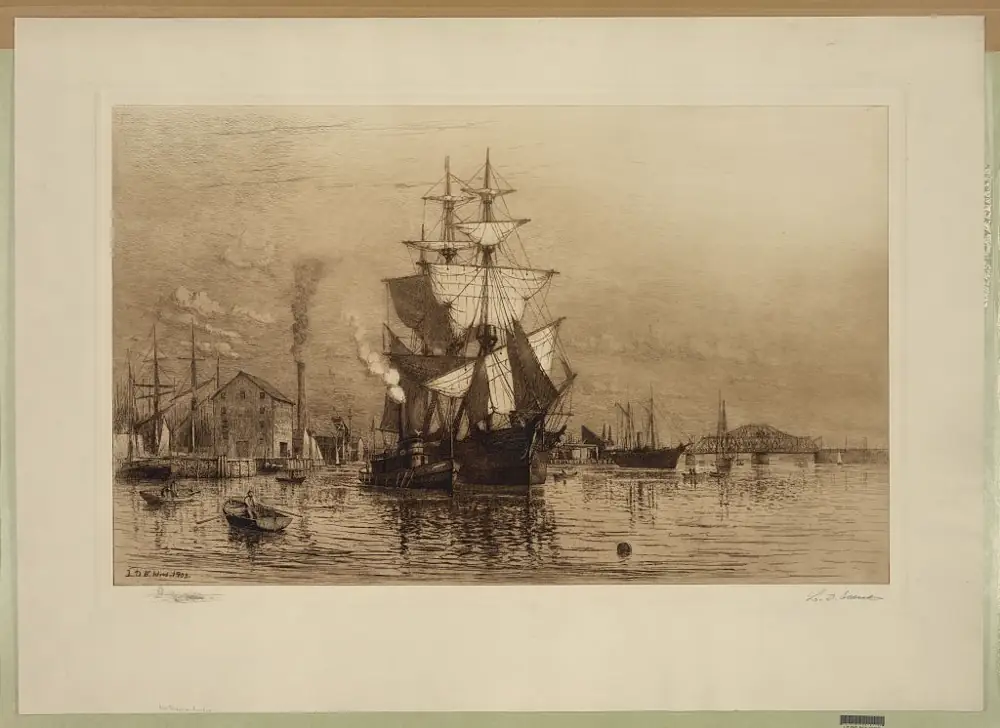
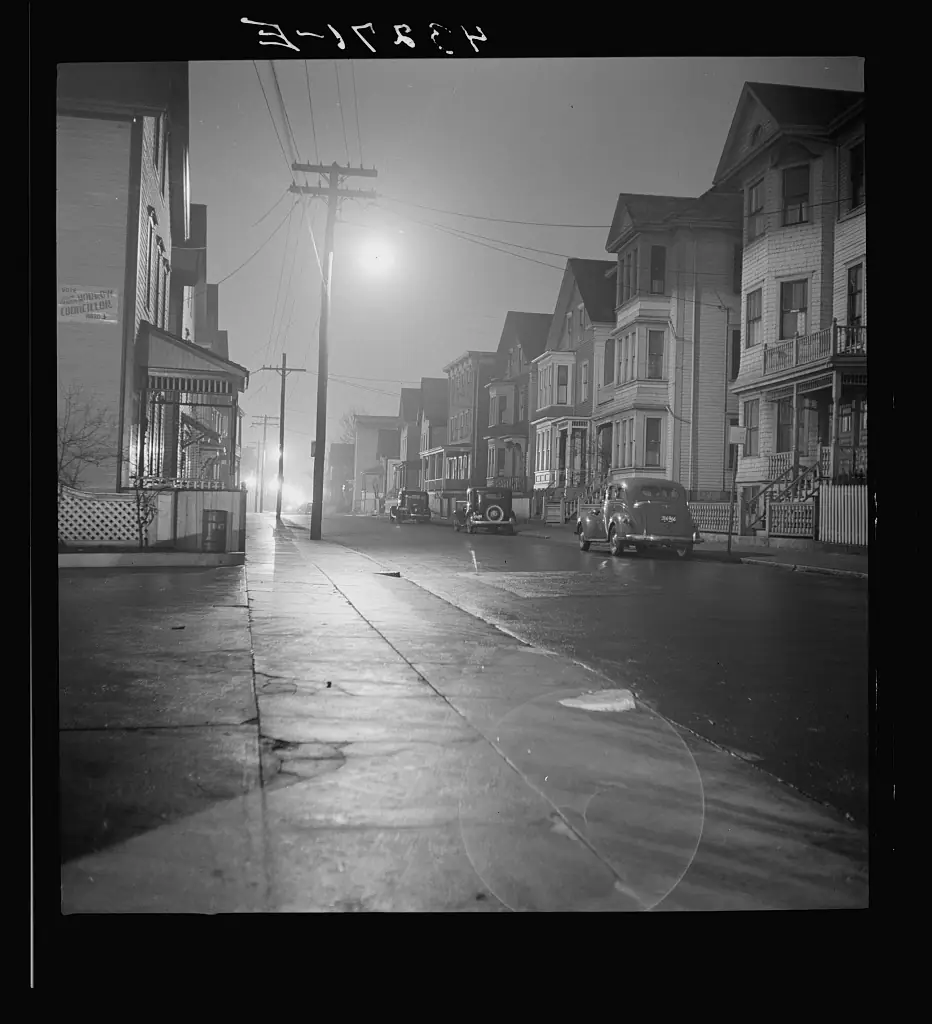
New Bedford harbor in 1903, the working port city that 20 Kenyon Street calls home. Lemuel D. Eldred, 1903. Library of Congress, Prints and Photographs Division. Public domain.A foggy New Bedford night, 1940, the after-dark city a gay bar's glowing windows would one day light. U.S. Farm Security Administration / Office of War Information, Fall 1940. Library of Congress, Prints and Photographs Division. Public domain.
A safe place
For most of the last century, a bar was often the only public room where LGBTQ+ people could simply exist together. On the South Coast, the most enduring of those rooms sits at one address in New Bedford: 20 Kenyon Street.
It has carried more than one name. For forty-one years it was Le Place. Today it is The Gallery Bar. Through every name, it has been the same thing: a safe place. This exhibit is about that continuity, and the people who kept it.
A living place
This is not a story about something that ended. The doors at 20 Kenyon Street are still open. Much of what follows comes from a single rich newspaper account, and the people who lived the rest are still here to tell it. We are listening.
Why a bar
For most of the twentieth century the gay or lesbian bar was the one public room a community had: refuge, meeting hall, mutual-aid network, and, when AIDS came, a place that raised money and held the grieving. The United States had more than two hundred lesbian bars in the late 1980s; by 2021 only around two dozen remained, a number that has since recovered modestly to roughly three dozen. A bar that has kept its doors open at one address for more than forty years is not merely rare. It is a kind of monument.
Context source: PBS NewsHour / The Lesbian Bar Project; WBUR (on the long-lived Fran's Place in Lynn, Massachusetts) for comparison.
Chapter I
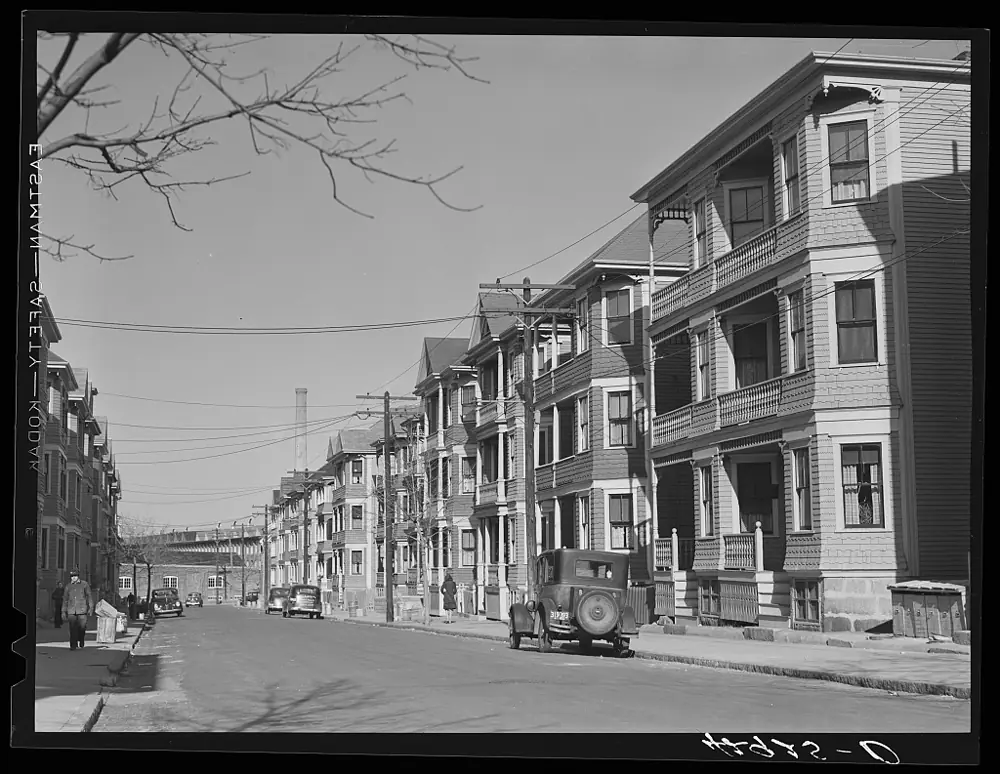
A New Bedford street in 1941, the kind of close working-city block where 20 Kenyon Street would later sit. U.S. Farm Security Administration / Office of War Information, January 1941. Library of Congress, Prints and Photographs Division. Public domain.
1982: two women open a bar
In 1982, Pam Pinault and her co-founder opened Le Place at 20 Kenyon Street. They had been working for lawyers, and as her partner later put it, other people were making money running bars, so why couldn't they. They went on to run a second bar in Fairhaven and a travel agency as well.
It became, in the words of the people who loved it, New Bedford's gay mecca, tucked into the Hicks-Logan neighborhood near the North End, its windows glowing purple and pink after dark. Regulars had another name for it: the Gay Cheers, the place where everybody knew you. It may not have been the city's first LGBTQ+ bar, but it most certainly became the one that lasted.
Not the first gay bar in New Bedford, but the one that has lasted.
The New Bedford Light, 2022
What we have, and what we are still after
The year, the founders, and the reason are documented. The exact opening date, and the name of the Fairhaven bar, are not yet in any record we have found. They live in memory and in licensing files, and we are pursuing both.
Source: The New Bedford Light, Jack Spillane, "Owners of New Bedford gay bar Le Place look back on 40 years," July 13, 2022.
Chapter II
The dance floor
Before it was history, it was a good night out. Le Place ran tea dances on the third Sunday of the month, four to eight in the afternoon, a ritual revived in recent years as homage to the early years of the gay pride struggle. The Gallery Bar keeps the third-Sunday tea dance going today.
There were block parties in the street with roasted pigs, raffles during Sunday football, crowded summer tea dances out on the deck, karaoke, pool, and a bar that opened on Thanksgiving Eve and again on Christmas Day, for the people who had nowhere else to be. For many years the music was kept by the bar's longtime resident DJ.
Verified
Source: The New Bedford Light, July 13, 2022; Safe Space Alliance listing (current tea dance). Note: the bar's DJ is sometimes confused with a founder; the founders were Pam Pinault and her partner. We keep the two distinct.
Chapter III
When the plague came
During the AIDS crisis, the bar became something more than a bar. A New Bedford support group raised thousands of dollars at Le Place fundraisers for local people living and dying with the disease, in years when many institutions turned away. The dance floor became a lifeline.
Told with care
We honor this work without naming anyone's diagnosis. The people helped here, and many lost, are remembered with dignity and never outed. The full story of that support group, its name and its people, is one we are still gathering, gently.
Verified the fundraisers. Unknown the group's full name and members.
Source: The New Bedford Light, July 13, 2022. See also the museum's wider AIDS-era research.
Chapter IV
They tried to frighten it
Being a safe place did not mean being a safe target. In the early years, vandals pulled the fire alarms in the middle of the night and threw firecrackers through the front door. An arson fire left serious smoke damage; New Bedford police solved it, and the regulars came in and helped rebuild. The bar stayed open.
In 2006, when a man attacked the nearby gay bar Puzzles with a hatchet and a gun, the staff at Le Place quietly hid baseball bats and pipes around the room, just in case. They kept dancing anyway.
Connected histories
The 2006 attack has its own memorial in this museum, told with care for those it harmed. Visit the Puzzles exhibit.
Verified the vandalism, arson, and the post-Puzzles response. Unknown the arson's date and whether anyone was charged.
Source: The New Bedford Light, July 13, 2022.
Chapter V
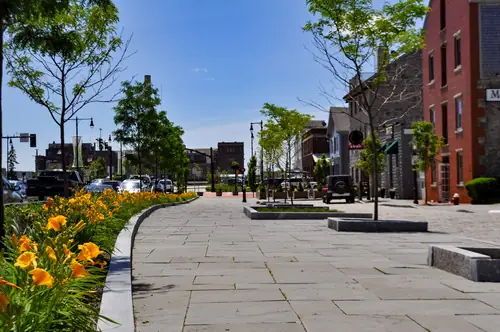
Downtown New Bedford today, the same living city where the doors at 20 Kenyon Street are still open. National Park Service photo, New Bedford Whaling National Historical Park, 2014. Public domain.
Forty years, one address
One building. Four decades. Successive owners and names, but never a closed door for long. The continuity that matters here is the continuity of function: a safe space at 20 Kenyon Street, from 1982 to today.
1982
Le Place opens
Pam Pinault and her co-founder open the bar at 20 Kenyon Street.
Verified
1980s–1990s
A lifeline through the AIDS crisis
Fundraisers at the bar raise thousands for local people with the disease.
Verified
Feb 2006
After Puzzles
Following the nearby hate attack, staff hide bats and pipes for protection, and stay open.
Verified
May 2, 2019
Pam Pinault dies, age 72
Her daughters run the bar alongside her co-founder.
Verified
Sept 30, 2023
Le Place closes after 41 years
The surviving co-founder passes ownership; the founding family steps away.
Corroborated
Sept 13, 2024
The Gallery Bar opens
A new group reopens 20 Kenyon Street as an art bar (57 works by 22 local artists, capacity 99), opening dry until a full liquor license arrives in April 2025. The bar's longtime DJ returns for the reopening.
Verified
June 13, 2026
Still the hub
The Gallery Bar hosts New Bedford Pride Fest, called a hub for the LGBTQ+ community and allies for over 40 years.
Verified
Continuity of place and purpose is documented. Ownership is not continuous: the founding family exited in 2023, and today's Gallery Bar is run by a different group carrying the same mission. We do not claim family ownership of the current bar.
Chapter VI
The keepers
A safe place is only ever as durable as the people who refuse to let it close.
Pam Pinault (1946–2019)
Co-founder, and in her own obituary's words a very successful, self-taught entrepreneur who ran two night clubs for over 36 years. She died at home in Acushnet in 2019, at 72.
Her co-founder
The bar's other founder and its longtime owner across four decades, until she passed it on in 2023. She is the keeper of more of this history than any document holds, and we hope to record it with her, with her consent.
Pam's daughters
Pam's two daughters, who were children when the bar opened and helped run it after their mother's death. One of them gave this exhibit its truest label: "This was a safe haven."
The Gallery Bar, the torch carried forward
When the founding family stepped away in 2023, the doors at 20 Kenyon Street could have closed for good. They did not, because people who loved this place refused to let it close. They reopened it as The Gallery Bar, an art bar hung with the work of local artists, and they did it, in their own words, "because we had to keep it going for the community." We honor that choice, and the people who made it.
They kept what mattered. The third-Sunday tea dance still runs, just as it did at Le Place. They opened their doors dry, on mocktails alone, rather than wait, and threw a "Prohibition Is Over" party when the full liquor license finally arrived in 2025. They host New Bedford's Pride Fest, and they still call 20 Kenyon Street what it has always been: "a hub for the LGBTQ+ community and our allies for over forty years," a place to be "free, safe, seen and welcome."
With gratitude
The South Coast LGBTQ+ Network is proud to count The Gallery Bar among its friends, and a fellow keeper of this history. They picked up a forty-year-old torch and carried it forward, so that the dance floor at 20 Kenyon Street never went dark. This museum is built in the very spirit they keep that bar in: so that none of it is lost, and everyone who came through those doors is remembered. Thank you.
Consent review required before publication
The living people named here are featured by name and word only with their consent. We are reaching out as oral-history partners, not extracting their stories. If you are one of them, this exhibit is yours to shape.
Photographs pending
We are seeking the original Le Place sign, the yellow-building exterior, tea-dance flyers, and family photographs, shared with permission. We will not use images we have not been given.
Chapter VII
How we know, and what we are still confirming
Most of this exhibit rests on one exceptional source, the New Bedford Light's 2022 fortieth-anniversary feature, supported by the closing and reopening coverage and by an obituary. That is a strong foundation, and an honest one to name. The rest waits on the people who lived it.
Exact founding date and the Fairhaven barVerifying
From liquor-license records and from the surviving co-founder.
The AIDS-era support group's identityVerifying
Its full name and its people, gathered with care.
The arsonVerifying
Date, and whether anyone was charged, from contemporaneous records.
The founders' partnershipDeferred to family
Sources describe them as life partners and as best friends. We will not flatten that. The framing is theirs and their family's to choose.
If you danced here
If you have a memory, a flyer, a photograph, or a night you will never forget from 20 Kenyon Street, we would be honored to keep it.
Key sources: The New Bedford Light (2022); Fun 107 (2023, 2024, 2026); The Standard-Times (2024); Boulevard Funeral Home obituary (2019); Safe Space Alliance. Full citations are held in the museum's research record.

 Museum