The forty-nine taken at Pulse, Orlando · June 12, 2016
Where Pulse nightclub, Orlando, FloridaWhen 2:02 a.m., Sunday, June 12, 2016This year the tenth anniversary
This exhibit is a memorial to the forty-nine people killed at the Pulse nightclub in Orlando on June 12, 2016. It describes a mass shooting, anti-LGBTQ+ violence, and profound loss. Please take it at your own pace.
If you need support right now: call or text 988, the Suicide and Crisis Lifeline, or reach The Trevor Project.
Chapter 0
Before you enter
This exhibit is a memorial. It is about forty-nine people who went out dancing on a warm Saturday night and did not come home, and about the lives they were living right up until that moment.
Content note
What follows concerns a mass shooting that targeted an LGBTQ+ space, and the grief that followed. We do not describe the violence graphically, and we keep the focus on the people and their lives. Even so, take it gently. Support resources are gathered at the end, and on the final page.
How we tell this story
We say the names of the dead, and we do not say the name of the man who killed them. Memorials that center the people lost, rather than the person who took them, are the standard the survivors and families themselves have asked for, and it is the one we keep here.
Everything in this exhibit is drawn from the public record and reputable reporting. We do not invent a detail to make a life sound fuller, and we never state or imply anyone's HIV status. Where accounts conflict, we say so. The names and ages are taken from the official list of those killed.
Chapter I
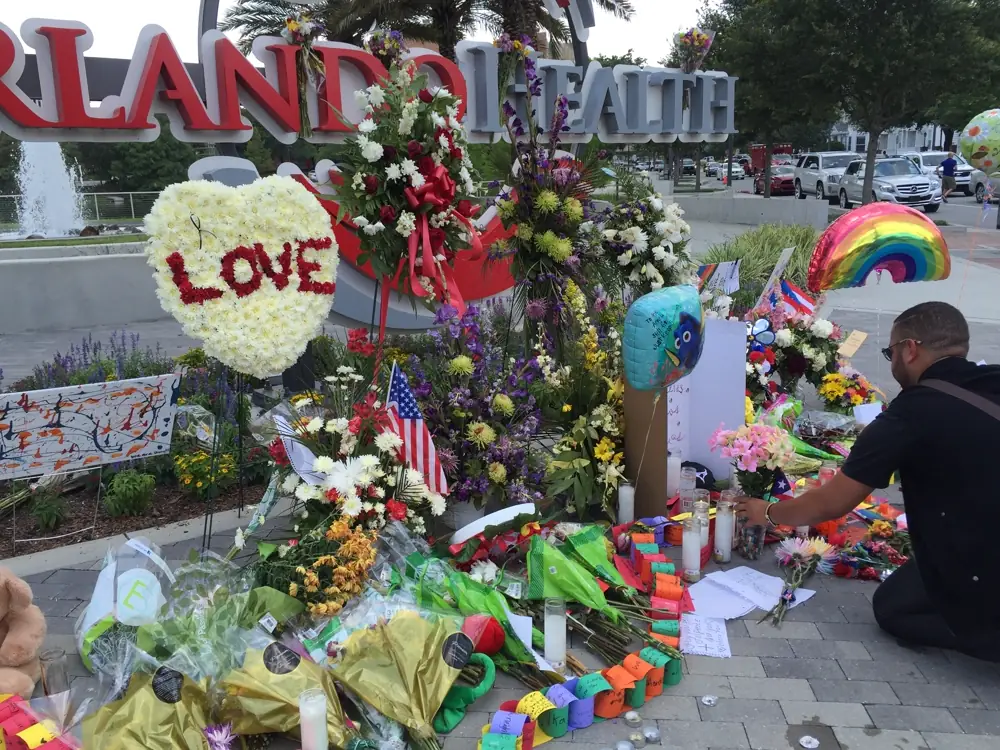
Flowers and candles left outside Orlando Regional Medical Center, the trauma center that received the wounded, June 2016. Voice of America (U.S. federal government). Public domain.
What happened
Pulse was a gay nightclub in Orlando, Florida, opened in 2004 by Barbara Poma and Ron Legler. Poma named it for her brother John, who had died of an AIDS-related illness; she wanted a place that kept his memory and his heartbeat alive. By 2016 it was one of Orlando's best-loved LGBTQ+ spaces, and the dance floor that night belonged to Latin Night.
The first shots came at about 2:02 in the morning on Sunday, June 12, 2016, while the room was full. What followed was a standoff that lasted roughly three hours, through a series of calls and a long, frightening wait. In the early morning, after officers had opened a way out through an exterior wall and a group of people had already escaped through a dressing room, the standoff ended. Forty-nine people were killed. Fifty-three more were wounded by gunfire, and others were hurt as people fled, bringing the number injured to around fifty-eight. It was, at the time, the deadliest mass shooting in modern United States history, and it remains the deadliest single act of violence against LGBTQ+ people in the nation's history.
The response began inside the club, among the people who were there, and moved outward with extraordinary speed. Orlando Regional Medical Center, the region's only top-level trauma center, stands about two thousand one hundred feet from Pulse, close enough that the wounded could be carried and driven there within minutes. Within roughly an hour, six trauma surgeons were at work, among them Dr. Michael Cheatham, Dr. Joseph Ibrahim, and Dr. Chadwick Smith, and more than four hundred hospital staff came in that morning, many of them off duty and unasked. For the first thirty-six minutes, the wounded arrived at a rate of about one a minute. The hospital had rehearsed a mass-casualty drill only months before, and the surgeons have said it shaped everything that came next. Of the wounded who reached the hospital and could be brought into surgery, very nearly all survived.
The city answered in the days that followed with its blood. Lines stretched around the block at donation centers, with people waiting for hours to give, and the region's blood banks took in tens of thousands of units for the survivors. There is a thread in that detail the museum does not want to lose: one of the forty-nine, Rodolfo Ayala-Ayala, known to friends as Rody, worked at the very blood center that gathered the blood that helped keep others alive.
Verified the date, the toll of 49 and 53, the club's history, the 2,100-foot distance, the six surgeons and their names, and the one-per-minute arrival rate. Corroborated the three-hour standoff and the blood-donation surge.
Sources: FBI and Orange County medical examiner records; ORMC trauma-team interviews (Dr. Michael Cheatham); ClickOrlando / WKMG and WFLX 2026 retrospectives; NPR. Full citations are held in the museum's research record.
Chapter II
Why we hold this here
This is a South Coast museum, and Orlando is a thousand miles away. We hold this story anyway, for two reasons.
The first is that Pulse is not only Orlando's. It is a wound carried by LGBTQ+ people everywhere, including here. In the days after, candles were lit on the steps of churches and city halls across Massachusetts, and the South Coast grieved with the rest of the country. A regional museum that told the story of queer joy and queer community but left out the night that struck at both would not be telling the truth.
The second is closer to home. This museum already holds the story of Puzzles, 2006, the hatchet-and-handgun attack on a New Bedford gay bar, and the story of 20 Kenyon Street, a bar that was a sanctuary here for forty years. The gay bar as a refuge, and the gay bar as a target, are a single thread that runs from New Bedford to Orlando. Pulse is the same story, told at its most terrible scale.
Massachusetts threads, named honestly
Two of the forty-nine had Massachusetts ties: Stanley Almodovar III was born in Springfield before his family moved to Florida, and Kimberly Morris performed and worked in Northampton before moving to Orlando. These are Western Massachusetts connections, not South Coast ones, and we name them as exactly what they are.
Chapter III · In memoriam
The forty-nine
Here they are, each one. Select a name to read a little of who they were, the lives they were building, and how they are remembered today. The hearts mark the five couples who were at Pulse together and died together.
49 lives
Stanley Almodovar III23
A certified pharmacy technician born in Springfield, Massachusetts before his family moved to Florida, Stanley was a graduate of East Ridge High School in Clermont and was remembered as irrepressibly funny, the person who could walk into a frowning room and leave everyone smiling. His family asked that people remember his smile and the way he lived every day as if it were his last. His Florida hometown of Clermont formally honored him with a proclamation declaring a day in his memory, and he is among the names read aloud each year at Pulse anniversary observances, a young man whose warmth outlasted him.
Sources: Orlando Weekly; WFTV; ClickOrlando.
Amanda Alvear25
A pharmacy technician studying to become a nurse at the University of South Florida, Amanda was remembered by her brother as a loving person who was all heart, someone who got along with everybody, no matter what they looked like. She was at Pulse with her best friend Mercedez Flores, who also died that night; with a third friend the trio had been inseparable since their school days, so full of laughter that everyone called them the Hyenas. In the weeks after the attack her brother Brian began a Hugs, Not Hate campaign, embracing strangers across Central Florida to answer hatred with affection. Each December, around Amanda's birthday, her family hosts the Amanda's Angels Legacy of Love toy drive, giving gifts in her name because, as her mother Mayra said, Amanda liked to spread joy.
Sources: Orlando Weekly; FOX 13; WTSP; ClickOrlando.
Oscar A. Aracena-Montero26 ♥
Oscar came from the Dominican Republic, moving to Central Florida with his father as a child while staying close to his mother in Santo Domingo, whom he called often; she was granted a special visa to attend his funeral. He worked as a manager at McDonald's and was, by every account, always trying to better himself, a young man with a radiant smile who loved to dance to bachata. He had recently bought a home with his partner, Simon Carrillo Fernandez, where they lived with their three chihuahuas, and the two had just returned from a trip together. Simon was also among the forty-nine, and the couple is remembered together, their names read each year among the Pulse forty-nine.
Sources: ClickOrlando; Orlando Weekly; Romper.
Rodolfo Ayala-Ayala33
Known to friends as Rody, he worked as a platelet supervisor at OneBlood, the donation center that, in the days after the attack, collected blood for its survivors. Colleagues remembered a joyful, courageous, dance-loving presence who brought so much light to the team every day. OneBlood placed a plaque in its lobby with his photograph, and his coworkers pass it daily; as one of them said, I pass by it all the time and look at him and just smile. A decade on, his team still keeps his memory close, saying simply that they miss him tremendously and will forever remember him.
Sources: Spectrum News 13; ABC Action News.
Alejandro Barrios Martinez21
Alejandro grew up in Cuba and moved to Orlando in 2014 to live with his father, working to master English and, as his father said, to build his project of happiness. Those who knew him recalled a young man who always had a smile on his face, joyful and hopeful, with a new job he had just landed. One of his final wishes was honored when his idol, the Puerto Rican singer Olga Tañón, performed at his funeral and gave his family a blouse she had worn in one of her music videos, a gesture his loved ones treasured. His mother received a humanitarian visa to see him one last time, and his partner wrote to him afterward, I promise you I will always love you, as you did until the final minute of your life.
Sources: Orlando Weekly; Washington Blade.
Martin Benitez Torres33
Originally from Puerto Rico, Martin was studying to become a pharmacy technician at a Tampa campus of the Ana G. Méndez University System and was visiting family in Orlando when he died. Friends called him Flaco and remembered a humble, generous, deeply creative soul with a gift for costume and design; a former coworker recalled that he loved to design costumes for office Halloween parties, and a friend called him the best costume-maker and the life of the party. Another friend described him as a humble, caring soul, a person who gave and expected nothing in return. On his Facebook page he had shared a reflection about treasuring everything beautiful in the world, a fitting note for an artist remembered for the joy and color he brought to every room.
Sources: Orlando Weekly; ClickOrlando.
Antonio D. Brown30
Antonio "Tony" Brown was a captain in the U.S. Army Reserve and a 2008 graduate of Florida A&M University, where he studied criminal justice and took part in ROTC, later earning a master's degree in business administration. Commissioned in 2008 and promoted to captain in 2012, he served as an observer-controller and trainer and completed an eleven-month deployment to Kuwait, and his decorations included the Meritorious Service Medal. His commander remembered him as a loyal and dutiful officer who truly cared about the soldiers in his charge, a leader who met every challenge with a smile on his face and an unwavering spirit. Fellow alumni and soldiers have continued to honor his memory and his service.
Sources: DVIDS; Military.com; Task & Purpose. Some outlets list his age as 29.
Darryl R. Burt II29
Darryl "DJ" Burt II was a financial-aid officer at Keiser University in Jacksonville, where he worked with military and veteran students after rising from a job managing a McDonald's. Just before he died he was celebrating a master's degree in human resources management. A newer member of the Jacksonville Jaycees, he had already co-chaired a clothing drive for people experiencing homelessness, and the chapter's president called him a rising star who was all about giving back. Friends and colleagues remembered him as vivacious and full of life, with a big heart turned toward his community.
Sources: Orlando Weekly; News4Jax; Heavy.
Jonathan A. Camuy Vega24
A young television producer, Jonathan moved to Florida in 2015 to chase a media career, joining Telemundo as a producer on the children's singing show "La Voz Kids." A graduate of the University of Puerto Rico at Arecibo and a member of the National Association of Hispanic Journalists, he was remembered by those who taught and loved him as someone who always smiled and was full of life, no matter how late they were working. He stayed devoted to his family, calling his mother daily and affectionately naming her his eternal girlfriend, the one woman who would never break his heart. His parents asked that people remember his philosophy of living fully: we are born to live, and so short is our time that it is a bad idea not to enjoy every step and every moment.
Sources: Orlando Weekly; NBC News.
Angel L. Candelario-Padro28
A nurse and National Guard member from Guánica, Puerto Rico, Angel had built his career with care, studying nursing in Puerto Rico and spending nearly two years at the Illinois College of Optometry in Chicago before relocating to the Orlando area. He was just days from starting a new job as an ophthalmic technician at the Florida Retina Institute, which said it had been looking forward to Angel becoming part of the FRI family. Colleagues remembered his kindness, his vivacious spirit, and his passion for fitness and dancing, and his aunt described him as humble, respectful, and studious. Among the earliest of the forty-nine to be brought home, he was buried with military honors in Guánica, laid to rest in a white lab coat with his stethoscope, his coffin draped with an American flag, mourned across his island hometown.
Sources: Orlando Weekly; NPR; CBC; Daily Herald.
Simon A. Carrillo Fernandez31 ♥
Originally from Venezuela, Simon moved to Florida in 2006 and worked his way from a job at McDonald's to general manager, becoming a U.S. citizen and studying accounting with the dream of his own business. Colleagues remembered a boss who never forgot a birthday and always arrived with a cake. He doted on his chihuahuas, loved to travel, and made his sister laugh so hard she called their time together laughter therapy. He had recently returned from a trip with his partner, Oscar Aracena-Montero, with whom he had bought a home, and Oscar was also among the forty-nine. His name is read each year at Orlando's anniversary remembrances.
Sources: Orlando Weekly; Legacy.com.
Juan Chavez-Martinez25
Known as Juancho, Juan came from Huichapan, Mexico, having left home nearly a decade earlier to help lift his family out of poverty by sending money back to his parents. He worked as a housekeeping supervisor at a Kissimmee resort while pursuing a creative dream as a hairstylist, makeup artist, and decorator, and he loved music and dance and was generous with his nieces. Friends said he left them his joy and his willingness to share his artistic gifts. A tribute cross bearing his name was placed among the others outside the Orange County Regional History Center in Orlando, where the memorial crosses were displayed and later preserved in the state archives.
Sources: Orlando Weekly; Florida Memory.
Luis D. Conde39 ♥
A makeup artist from Puerto Rico, Luis co-owned the Kissimmee salon Alta Peluquería D'Magazine with his partner, the hairstylist Juan P. Rivera Velázquez, who was also among the forty-nine. The two had known each other since high school in Puerto Rico and were partners for roughly sixteen years, described by those who knew them as inseparable. At the salon Juan styled hair while Luis handled makeup and managed the business, and together they worked fashion shows and community pageants. Luis was remembered for making people feel beautiful; months after the couple died, Juan's sister reopened the salon as a way to continue their legacy.
Sources: Orlando Weekly; AJC; Spectrum News 13.
Cory J. Connell21
A 2013 graduate of Edgewater High School in Orlando, Cory was studying at Valencia College and bagging groceries at a College Park Publix while working toward his dream of becoming a firefighter; on Facebook he had written of the calling, it is not something you do, it is something you are. He loved football, racecars, and his girlfriend, and family and friends remembered him as funny, respectful, and hardworking. After his death Orange County honored him as an honorary firefighter, and Edgewater High School retired his No. 81 football jersey. The school's parent association established an annual scholarship in his name for two college-bound seniors who reflect the values he showed on and off campus.
Sources: Orlando Weekly; Watermark; Firehouse.
Tevin E. Crosby25
Tevin grew up in Statesville, North Carolina, the youngest of three children, and went into business, founding his own marketing company, Total Entrepreneurs Concepts, whose initials echoed his own. As a leader he kept his team motivated with inspirational quotes and bowling nights, and he was the friend always ready with advice and a helping hand. He was close to his sister and her children, traveling often for family milestones, and he loved to cook for family gatherings. His sister remembered him simply: my brother was full of light, full of energy.
Sources: Orlando Weekly; ClickOrlando; Detroit News.
Franky J. Dejesus Velazquez50
Franky "Jimmy" DeJesús Velázquez, a native of San Juan, Puerto Rico, and at fifty the oldest of the forty-nine, lived in Orlando, where he worked as a visual merchandiser and was known online for his funny, uplifting posts. In Puerto Rico he had enjoyed an illustrious dancing career, traveling the world with Gíbaro de Puerto Rico, a troupe devoted to the island's traditional jíbaro folk music. Friends recalled a perfectionist with a stubborn streak and a devoted uncle who made time each week for a short phone call with each of his many nieces and nephews. He was at Pulse with his closest friends the night he died, and his name endures in the One Orlando Collection kept to honor those lost.
Sources: Orlando Weekly; One Orlando Collection.
Deonka D. Drayton32
Deonka "Dee Dee" Drayton was raised in the Midlands of South Carolina and was a larger-than-life presence, remembered for her jokes, her dreadlocks and snapback hats, and the fierce love she gave the people she cared about. She dreamed of becoming a chef and was working to build a better life for herself and her young son. Loved ones described her as ambitious and confident, someone who, at heart, simply wanted to be loved, and she was working at Pulse the night of the attack. Her family has returned to Orlando's anniversary ceremonies to keep her memory; at one remembrance her mother told those gathered that her daughter's spirit lives on through the memories and love she shared with so many.
Sources: Orlando Weekly; Florida Courier; Post and Courier.
Mercedez M. Flores26
Born in Queens, New York, and of Guatemalan heritage, Mercedez lived in Davenport, Florida, and worked at Target while studying at Valencia College, where she pursued an interest in literature and hoped to become a party planner. Loved ones called her a beautiful soul, free-spirited, caring, and determined; her father called her the happiest girl of all time. A devoted music fan, she went to Pulse often on weekends, frequently alongside her best friend, Amanda Alvear. The two were at Latin Night together the night they both died, their bond remembered by friends as deeply supportive.
Sources: Romper; Bustle; 6abc.
Peter O. Gonzalez-Cruz22
Known to family as Ommy, Peter worked for UPS in Orlando, where customers remembered him always smiling, and he was one of the youngest of the forty-nine. He was the center of his social circle, the life of any party; as his aunt put it, if Peter is not at the party, no one wants to go. A former teacher wrote that she was honored to have a young man of his caliber as a student. His mother remembered him as confident, humble, and unfailingly positive, a young man whose smile reflected true love, writing after his death that a piece of her life was torn away.
Sources: Orlando Weekly; ClickOrlando.
Juan R. Guerrero22 ♥
Juan had just finished his first year of pre-finance studies at the University of Central Florida. He had come out to a loving, accepting family, and had been with his partner, Christopher "Drew" Leinonen, for nearly two years; the two were talking about a future together. After both were killed at Pulse, their families chose to hold a joint funeral, an idea proposed by Drew's mother, so the couple could be side by side as loved ones said goodbye. Their story became one of the most widely told of that June, and in Drew's memory friends founded The Dru Project, which supports gay-straight alliances and awards scholarships to LGBTQ students, carrying forward the love the two men shared.
Sources: TIME; UCF; Orlando Weekly.
Paul T. Henry41
Paul Terrell Henry was a Chicago native and a devoted father of two whose children came first in everything he did. A lifelong learner, he earned a master's degree in business and a degree in theology, and friends remembered him most for his joy in music, dancing, playing piano, and singing. At the time of his death he was making a home in Florida and preparing to return to school once again. His surviving partner, Francisco Hernandez, said Paul saw the best in him and pushed him toward it, and after the loss enrolled in college to finish the degree Paul had always believed he could earn.
Sources: Orlando Sentinel; Legacy.com; WFLA.
Frank Hernandez27
Frank Hernandez grew up in Weslaco, Texas, and was proud of exactly who he was. He began working at Calvin Klein not long after graduating high school in 2006 and rose to store manager, moving from Texas to Orlando about two years before his death for the chance to run a store there. He often dressed in rainbow colors or his "GAY O.K." shirt, and he wore a tattoo on his arm that read love has no gender. He was building a life in Orlando with his longtime boyfriend, Brett Rigas, and their two dogs, and those who loved him remembered a lively, big-hearted man who carried his pride openly.
Sources: Orlando Weekly; Romper; San Antonio Current.
Miguel A. Honorato30
Miguel Ángel Honorato was a husband and a father of three sons who managed several central Florida restaurants and ran a catering business. He came to the United States from Mexico as a young child and grew up in Apopka, surrounded by a large, close family that knew him as the one who would drop everything to help. His relatives ran a longtime Mexican food business, and Miguel dreamed of growing it into something more contemporary and welcoming. After his death his family carried that dream forward: in April 2018 his brother opened a restaurant in Apopka named San Miguel Mexican Grill, run in Miguel's honor and carrying his name.
Sources: Spectrum News 13; The Apopka Voice.
Javier Jorge-Reyes40
Javier Jorge-Reyes, known to friends as Javi, was a native of Guayama, Puerto Rico, who took deep pride in his heritage. He studied at the Universidad del Sagrado Corazón and built a career in Orlando as a salesman and supervisor at Gucci, where customers and colleagues adored him for his humor, his sass, and his ready smile. A skilled makeup artist as well, he was remembered by friends as humble, generous, and relentlessly positive, the kind of person whose energy and love of beautiful things were infectious. He was laid to rest near his family in Guayama, and those who knew him keep his memory alive through tributes that recall how much warmth he brought to their lives.
Sources: ClickOrlando; Heavy; Legacy.com.
Jason B. Josaphat19
Jason Benjamin Josaphat was one of the youngest of the forty-nine, a Haitian American born in Fort Lauderdale to Haitian parents. He was an ambitious young man with many passions, among them photography, athletics, and computers, and he had recently trained as a business office specialist at Southern Technical College, where staff remembered him as an exceptional student. As both a Black and an LGBTQ young man, he bridged communities that are too often left out of the way Pulse is remembered. After his death, Southern Technical College held a blood drive dedicated to his memory, and a tribute cross bearing his name stood outside the Orange County Regional History Center among those honoring the victims.
Sources: Orlando Weekly; Bay News 9; Florida Memory.
Eddie J. Justice30
Eddie Jamoldroy Justice was an accountant who lived in downtown Orlando and was, by his family's account, a homebody who loved to eat, work out, and make everyone laugh. During the attack he sent his mother, Mina Justice, a series of text messages that began Mommy I love you. In the years since, Mina has refused to let her son fade from memory, vowing to keep talking until she cannot talk anymore, and pledging to make sure everyone knows who he was and what he stood for. To his mother he was, simply, her everything.
Sources: CBS News; NBC News; WFTV.
Anthony L. Laureano Disla25
Anthony Luis Laureano Disla was a gifted dancer and choreographer from San Juan, Puerto Rico, who had been dancing since he was about ten years old. He studied in Santurce before moving to Orlando to chase his dream of choreography, and he loved suspenders and fedoras as he danced mambo, salsa, and ballroom. He also performed in drag as Alanis Laurell, a well-known presence on stage. The night he died, he was celebrating that the following Monday he was to begin work as a choreographer for the Telemundo program "La Voz Kids." Since his death, his mother, Olga Disla, has been an outspoken advocate for stronger gun laws and for equality, and a steady voice for accountability in how Orlando remembers its dead.
Sources: ClickOrlando; Orlando Weekly; CPI.
Christopher A. Leinonen32 ♥
Christopher Andrew "Drew" Leinonen was a mental-health counselor who earned his degrees at the University of Central Florida. As a teenager he founded one of the area's first gay-straight alliances, work that earned him an Anne Frank Humanitarian Award and that made student GSAs the heart of his life's advocacy. He was at Pulse with his partner of nearly two years, Juan Ramón Guerrero, also among the forty-nine; after both were killed, their families held a joint funeral. In June 2017 his friends founded The Dru Project to carry his spirit forward, a nonprofit that funds college scholarships, supports gay-straight alliances, and publishes a widely used GSA guide. His mother, Christine Leinonen, became a nationally known advocate for gun-violence prevention, and through her voice and his friends' foundation, Drew's belief in unity and love continues to reach LGBTQ young people across the country.
Sources: TIME; The Dru Project; Watermark.
Brenda L. Marquez McCool49
Brenda Lee Marquez McCool was a mother of eleven, a grandmother of six, and a two-time cancer survivor, remembered as loud, funny, over-the-top, and fiercely loving, forever taking in others who needed help. Originally from Brooklyn, she was at Latin Night dancing salsa with her son Isaiah, who is gay and could be fully himself in that room; Isaiah survived. Her step-nephew, the actor Wilson Cruz, has said she went to Pulse so that her son could be exactly who he was without any fear, and that there was nothing she would not do to make sure Isaiah felt loved and protected. At her funeral in Orlando, Isaiah paid tribute to the mother who had given everything for her children.
Sources: NBC News; The Washington Post; ABC News.
Jean C. Mendez Perez35 ♥
Jean Carlos Méndez Pérez moved from Puerto Rico as a young man and became a warm, popular salesman at a perfume shop in the Orlando area. It was there, selling a bottle of cologne, that he met Luis Daniel Wilson-León, beginning a relationship that lasted about eight years. Friends described the two as opposites who could not live without each other, and they were regulars at Pulse who loved Latin Night. A doting uncle who treasured time with his nieces and nephews, Jean Carlos was remembered by his father as dynamic. He and Luis, also among the forty-nine, died together at the club they loved, remembered as inseparable in life as they were that night.
Sources: Orlando Weekly; Heavy; Legacy.com.
Akyra Monet Murray18
Akyra Monet Murray was the youngest of the forty-nine. She had graduated only days earlier from West Catholic Preparatory High School in Philadelphia, finishing third in her class of 2016, and she was a standout guard who reached 1,000 career points and had signed to play at Mercyhurst University on scholarship. She was in Orlando with family to celebrate her graduation. At a vigil at Philadelphia City Hall, her teammates led mourners in a march, chanting West Catholic lives for Akyra. Her school retired her number 20 jersey and has carried her name forward through a scholarship presented for the first time to a former teammate, who called Akyra a mentor not just on the court but off of it as well.
Sources: CBS Philadelphia; Orlando Weekly; NBC Philadelphia.
Kimberly Morris37
Kimberly "KJ" Morris grew up in Torrington, Connecticut, and spent about a decade in western Massachusetts, where she could fully be herself. She worked door staff at a Northampton nightclub and performed as a beloved drag king known as Daddy K, a Northampton Pride fixture remembered for making the people watching feel like they were up on the stage with her. A former college athlete, she had moved to Orlando about two months before the shooting to be closer to family, and she was working at Pulse. Friends in both states remembered her as warm, gregarious, and larger than life. Her hometown circle has kept her name alive through a memorial scholarship directed through the Community Foundation of Western Massachusetts, with donations collected on the anniversary of her death.
Jean Carlos Nieves Rodríguez came from Puerto Rico and graduated from high school in Orlando, then built a working life through steady effort, rising from a teenage job at McDonald's to managing a store. About a month and a half before his death he had bought his first house, so that he and his mother could live somewhere nicer. He was a quiet support for his younger sister, covering her phone bill when money was short and once telling her he loved her more than he loved himself. He was remembered by family and friends as kind and hardworking, and a tribute cross bearing his name stood among those honoring the victims in Orlando.
Sources: Orlando Weekly; Florida Memory.
Luis O. Ocasio-Capo20
Luis Omar Ocasio-Capó, known to everyone as Omar, spent his childhood in Ponce, Puerto Rico, dancing at parades and festivals from an early age. He worked as a barista at a Target Starbucks and had registered for theater classes at Valencia College that were to begin the very week of the shooting. Friends and a former teacher called him a ray of sunshine, and his sister said he danced to anything and was all smiles. He dreamed of acting and, above all, of lifting his mother out of poverty and making her proud. His sister later reflected that his name did travel all around the world as he had hoped, just not in the way anyone wanted.
Sources: Orlando Weekly; ClickOrlando; One Orlando Collection.
Geraldo A. Ortiz-Jimenez25
Geraldo Ortiz-Jiménez, called Drake by friends, traveled to Orlando from Puerto Rico to see Selena Gomez perform, a concert he was thrilled to attend as a devoted fan who often posted videos of himself singing along to her songs. He was studying law at the Universidad del Este in Puerto Rico and was a dedicated gym-goer who shared workout photos right up to the night before he died. Friends from his gym back on the island mourned him publicly, and he was remembered as sweet, funny, and kind to everyone he met. While performing two days after the shooting, Selena Gomez dedicated a song to the forty-nine, an act of remembrance tied to fans like him.
Sources: Orlando Weekly; ClickOrlando.
Eric Ivan Ortiz-Rivera36
Eric Iván Ortiz-Rivera was raised in Dorado, Puerto Rico, and moved to Orlando in 2007 for a better life, working in retail and merchandising. A creative spirit known for being always happy, he loved to paint and carried a playful humor. He was only weeks from his first wedding anniversary with his husband, whom he had married on June 26, 2015, the day the Supreme Court affirmed nationwide marriage equality, a coincidence the family called big and happy. His sister honored him with a feather tattoo echoing one Eric had gotten, adding birds because, she said, he is flying high.
Sources: Orlando Weekly; ClickOrlando; Heavy.
Joel Rayon Paniagua32
Joel Rayón Paniagua was a native of Veracruz, Mexico, who left home to work in gardening and construction and settled in the Tampa area, becoming a hardworking provider for his family back in Veracruz. By June 2016 he had paid off the last of what he owed and was beginning to save toward a brighter future. Family and friends remembered him for his piety, his humility, and his good humor, and friends recalled him as loyal and fun, always trying to do things to make you feel better. He loved to dance, and he had gone to Pulse that night to dance with friends.
Sources: Orlando Weekly; Legacy.com. Some outlets list his age as 31.
Enrique L. Rios Jr.25
Enrique Ríos Jr. came from Brooklyn's Williamsburg neighborhood and built his young life around caring for others. He worked as a care coordinator at a home-health agency and was studying social work, driven by a deep devotion to older people, and he chose to live with and look after his ailing grandmother. Mourners, many dressed in purple, his favorite color, remembered his contagious laughter, his love of salsa and bachata, and his love of cooking with his mother. He was visiting Orlando for a friend's birthday. His mother, Gertrude Merced, asked that his legacy be one of love, not fear, and the response to a fundraiser to bring him home far exceeded her modest goal, a measure of how widely he was loved.
Sources: Orlando Weekly; ClickOrlando; DNAinfo.
Juan P. Rivera Velazquez37 ♥
Juan Pablo Rivera Velázquez was a hairstylist and makeup artist from Puerto Rico who ran the Alta Peluquería D'Magazine salon in Kissimmee with his partner, Luis D. Conde, also among the forty-nine. The two had attended the same high school in Puerto Rico and were partners of roughly sixteen years; his sister said their love could not be compared. Their salon was a haven for the community, a place where people knew they were loved, and Juan was developing a cosmetics line he called Color Face Creation. After the couple was killed, his sister reopened the salon as D'Magazine by Juan P. and relaunched his makeup line in his honor, with their mother resolving that they had to keep his legacy going.
Sources: Orlando Weekly; AJC; Spectrum News 13.
Yilmary Rodriguez Solivan24
Yilmary "Mary" Rodríguez Solivan had moved from Ponce, Puerto Rico, to Kissimmee with her family. She was a wife and the mother of two young sons, the younger only about three months old, and she was remembered by her sister as the most loving and caring person you could ever meet, someone whose smile lit up the room and whose laughter brought a smile to your heart. A surviving photograph from that night shows her smiling so widely her eyes crinkled. She was out with friends, including Jonathan Camuy Vega, who was also among the forty-nine, and her family established a fundraiser to support her husband and her two young sons.
Sources: Orlando Weekly; ClickOrlando; NBC News.
Christopher J. Sanfeliz24
Christopher Joseph Sanfeliz was a personal banker for JPMorgan Chase in the Tampa area who had worked his way up from teller while taking business classes, attending Hillsborough Community College after graduating from Gaither High School in 2010. At Gaither he was active in the marching band, and friends and family remembered him as outgoing and relentlessly positive, described by one as the most positive guy I have ever known. After his death, Chase publicly mourned him as one of our own, and a vigil was held for him at Gaither High School, drawing classmates and community members. His family sought to channel their grief into inclusive programs at his alma mater, keeping his name tied to a welcoming place for students.
Sources: Tampa Bay Times; WUSF; Legacy.com.
Xavier Emmanuel Serrano Rosado35 ♥
Xavier Emmanuel Serrano Rosado, a dancer and performer from Ponce, Puerto Rico, was known on stage as "Eman Valentino" and was celebrated for a stage presence built on years of theme-park and club performance. To spend more time with his young son, Kelvyn, he had stepped back from full-time performing and taken work at a shoe store, and friends and family said his life centered on his child. He was remembered as a devoted father who built blanket forts and played video games with his son, and a man whose personality could light up a room. In his final months he had found happiness in a relationship with Leroy Valentin Fernandez, also among the forty-nine; the two spent their last night together at Pulse, and a public radio remembrance later preserved accounts of his artistry as the man who could dance.
Sources: CF Public; Orlando Weekly; ClickOrlando.
Gilberto Ramon Silva Menendez25
Gilberto Ramón Silva Menéndez came from Manatí, Puerto Rico, and had moved to Orlando, where he worked while studying healthcare management at Ana G. Méndez University with the dream of becoming a health professional and helping people in need. Beyond his studies, he was active in the dog show world as a Saint Bernard enthusiast, and after his death the dog-fancier community paid tribute to him as one of their own. Those who knew him remembered a happy young man who loved music and life, his community connections stretching from Puerto Rico to Orlando to the national world of purebred dog enthusiasts.
Sources: American Kennel Club; Orlando Weekly.
Edward Sotomayor Jr.34
Edward "Eddie" Sotomayor Jr., of Sarasota, Florida, was a national brand manager for an LGBTQ travel company and one of the most recognized figures in the gay travel market. He became beloved as "Top Hat Eddie" for the black top hat he wore on tours so travelers could spot him in a crowd. His work spanned themed cruises and the organizing of the first gay cruise for Americans to Cuba, and he carried a personal mantra: do all the good you can, to as many people as you can, as often as you can. Mourners wore top hats at his funeral in his honor, and artists in Cuba staged a live street tribute in his memory, with performers in top hats chanting his words. Colleagues remembered him as a trailblazer who believed travel was the key that unlocks bias and a lack of understanding.
Sources: Tampa Bay Times; Travel Weekly; ClickOrlando.
Shane E. Tomlinson33
Shane Evan Tomlinson was a singer and the lead vocalist and manager of the central Florida band Frequency, and a 2003 graduate of East Carolina University, where he earned a degree in communication. He chased a music career with his whole heart, performing at venues around Orlando, and he had performed the very night before the shooting. Those who knew him described a giving heart and a man who had a heart for everybody and liked to help people in need. An administrator at his alma mater remembered that he was destined for a grand stage and was doing exactly what he wanted to do, and after his death the university gathered for a vigil in his honor in Greenville, North Carolina.
Sources: ClickOrlando; Orlando Weekly; Heavy.
Leroy Valentin Fernandez25 ♥
Leroy Valentin Fernandez was devoted to caring for his mother and had recently started a job he loved as a leasing agent at an Orlando apartment community. Friends described him as spirited and joyful, someone who filled the world around him with music and fun. In his final months he had found love with the dancer Xavier Serrano Rosado, also among the forty-nine, and the two spent their last night together at Pulse. He is remembered as a young man whose warmth drew people in and whose new chapter, in both work and love, had only just begun.
Sources: Romper; CF Public; NBC News.
Luis S. Vielma22
Luis Sergio Vielma worked as a ride attendant on Harry Potter and the Forbidden Journey at Universal Orlando while studying to become a physical therapy assistant at Seminole State College. His death drew an outpouring of grief that reached the author J.K. Rowling, who wrote that she could not stop crying on learning he had died and sent flowers to his family with a note reading, to Luis, who died for love, you will never be forgotten. In the days after the shooting, coworkers, friends, and parkgoers gathered near Hogwarts Castle at Universal to raise their wands in his memory, a tribute that became one of the most widely shared images of mourning after Pulse. His sister later carried his spirit of care forward as a nursing student in his name.
Luis Daniel Wilson-León, a Puerto Rico native, moved to Florida in 2004 barely speaking English and quickly built a life there, working as a manager at a shoe store. About a decade before his death he met his longtime partner, Jean Carlos Méndez Pérez, when he bought a fragrance from the perfume counter where Jean worked, and the two fell in love soon after. Friends remembered Luis as a protector and a rock who, having faced homophobia in his youth, never answered hate with hate and instead offered steady support to those who needed it. He and Jean, also among the forty-nine, were inseparable in life and were killed together, their story retold as one of the enduring couples among the Pulse victims.
Sources: Pulse Orlando; Heavy; Legacy.com.
Jerald A. Wright31
Jerald "Jerry" Arthur Wright was a Walt Disney World cast member who worked in merchandising at the Magic Kingdom and had earned a promotion just two days before his death. He was at Pulse to help a friend celebrate a 21st birthday, and coworkers remembered him for his smile and his warmth. In the years since, his parents, Fred and Maria Wright, lifelong Republicans and Second Amendment supporters, became dedicated advocates for gun-violence prevention. Maria Wright responded to the loss by asking, my son was killed, what can I do, and the couple went on to work with the Everytown Survivor Network and to speak before audiences including Orlando Pride and Moms Demand Action, turning their grief into a public call for change.
Saturday at Pulse was Latin Night, and that is not a detail to pass over. The overwhelming majority of the people killed were Latino and Hispanic, and roughly half of them were Puerto Rican. Many had come to Orlando from the island; others from Mexico, the Dominican Republic, Cuba, Venezuela, and the cities of the mainland United States.
The room they were dancing in was, for many, the one place where every part of who they were could be present at once: queer and Latino, in their own music, in their own language, among their own people. That is what was attacked. To remember Pulse honestly is to remember that it fell hardest on LGBTQ+ people of color, on a night built for them, and to hold their names, their music, and their countries in the telling.
They were dancing to their own music, in their own language, as their whole selves. That is what a sanctuary is, and that is what was taken.
From the museum's research
Verified that it was the club's Latin Night and that most of those killed were Latino or Hispanic, many of them Puerto Rican.
Chapter V
Those who survived
Fifty-three people were wounded by gunfire and lived. Many more were inside that night and were not struck, and they too carry it. Survival was not a single moment but a long road. The wounds were serious, and recovery was measured in months and in surgeries; the last patient well enough to leave Orlando Regional Medical Center did not go home until September. For some, walking again came slowly and with help. For nearly everyone who was there, the harder recovery has been the one that does not show.
The survivors have not been left to carry it in silence, in large part because they refused to let one another. Brandon Wolf, who lost his close friends Drew Leinonen and Juan Guerrero that night, helped found The Dru Project in Drew's memory, went on to speak for national LGBTQ+ organizations, and has written about what it means to keep living as a survivor. Christopher Hansen has spoken openly about years of survivor's guilt and about finding his footing again, and has worked to make sure help reaches the survivors of other attacks. Tiara Parker, who was inside that night, helped organize a remembrance for the tenth anniversary that belonged to the survivors and the families themselves.
Their grief became, for many of them, a kind of work. Some turned toward advocacy, some toward caring for others, some toward simply telling the truth of what happened and what it cost. Networks of survivors and families have insisted that the people who lived through Pulse should have a say in how Pulse is remembered. That insistence, that the story belongs first to the people it happened to, is one this museum shares.
Among the survivors is a son. Brenda Lee Marquez McCool, one of the forty-nine, was dancing salsa with her son Isaiah, who is gay and who could be fully himself in that room. Isaiah survived. We hold his survival here not as a happy ending, because there is no happy ending to this, but as the truth alongside the grief: that on a night built for queer joy, a mother and son were dancing together, and that one of them is still here to remember it.
Verified that 53 people were wounded by gunfire and survived, and the months-long recovery. Corroborated the survivors' ongoing advocacy.
Sources: Orlando Weekly; The Advocate; CNN; NBC News; OneBlood survivor accounts. Living survivors are named only where they have spoken publicly and on the record about their own work.
Chapter VI
The line of violence we stand against
They lined up to give blood
In the hours after the attack, the people of Orlando did what communities do when the worst happens. They lined up to give blood. The lines stretched down sidewalks in the June heat, and the wait ran to several hours. It was an act of love offered to strangers, and it carried a quiet grief inside it.
For many gay and bisexual men who stood in those lines, or who wanted to, there was a second wound waiting. In June 2016, federal policy deferred any man who had had sex with another man within the past twelve months from donating blood at all. The rule had been set by the Food and Drug Administration in December 2015, when it replaced an even older lifetime ban that had stood since 1983. The policy spoke the language of behavior rather than identity, but its effect was plain. A sexually active gay or bisexual man, grieving his own, was turned away from giving the one thing he had to give.
In the rush of that day, a hopeful rumor spread that the rule had been lifted so that gay and bisexual men could donate for their own community. It was not true. The regional blood center OneBlood said so directly, stating that all federal guidelines remained in effect, and no center made a special exception. We record this carefully, because the truth is painful enough without embellishment. The irony was not that a ban was briefly lifted and then restored. The irony was that it was never lifted at all, and men who loved this community were told their blood was not wanted on the very day that community was grieving its own. The policy did not stay frozen: in 2020 the deferral was shortened to three months, and in 2023 it was set aside in favor of an individual risk assessment asked of every donor.
A line that did not begin in Orlando
A museum exists, in part, to refuse forgetting. The line of violence against LGBTQ+ people in this country did not begin in Orlando, and the people of Orlando were not the first to be told, in the silence that followed, that their lives were not worth the public's grief.
On June 24, 1973, an arsonist set fire to the UpStairs Lounge, a gay bar on the second floor of a building in the French Quarter of New Orleans. Thirty-two people died. For more than four decades it stood as the deadliest attack on LGBTQ+ people in the history of the United States. What is hardest to record is not only the fire but what came after it. Some churches would not bury the dead. A priest who held a service for them was rebuked by his own bishop. Some of the bodies went unclaimed. No one was ever charged, and for years the fire itself was nearly erased from public memory.
That is the line this museum draws: between a community that is told its dead do not matter, and a community that says these names aloud and keeps them. When forty-nine people were killed at Pulse on June 12, 2016, the attack was, at that time, the deadliest mass shooting in modern United States history, a record later surpassed in total by the Las Vegas shooting of October 2017. Pulse remains the deadliest single act of violence against LGBTQ+ people in the history of this country. We state that precisely, because precision is its own form of respect. The thread runs from New Orleans in 1973 to Orlando in 2016, and it does not stop there, from a 1997 bombing at an Atlanta lesbian bar to the 2022 shooting at Club Q in Colorado Springs and, closer to home, the 2006 attack at Puzzles in New Bedford. The gay bar has always been two things at once: a sanctuary and a target.
Verified the framing that Pulse remains the deadliest act of violence against LGBTQ+ people in U.S. history, and the UpStairs Lounge toll of 32. Corroborated the 2016 blood-deferral policy and the later 2020 and 2023 changes.
Sources: FDA Federal Register guidance (2015, 2023); OneBlood and contemporaneous reporting (NPR, CNBC); the UpStairs Lounge record (NPR, History.com, National Park Service). Full citations are held in the museum's research record.
Chapter VII
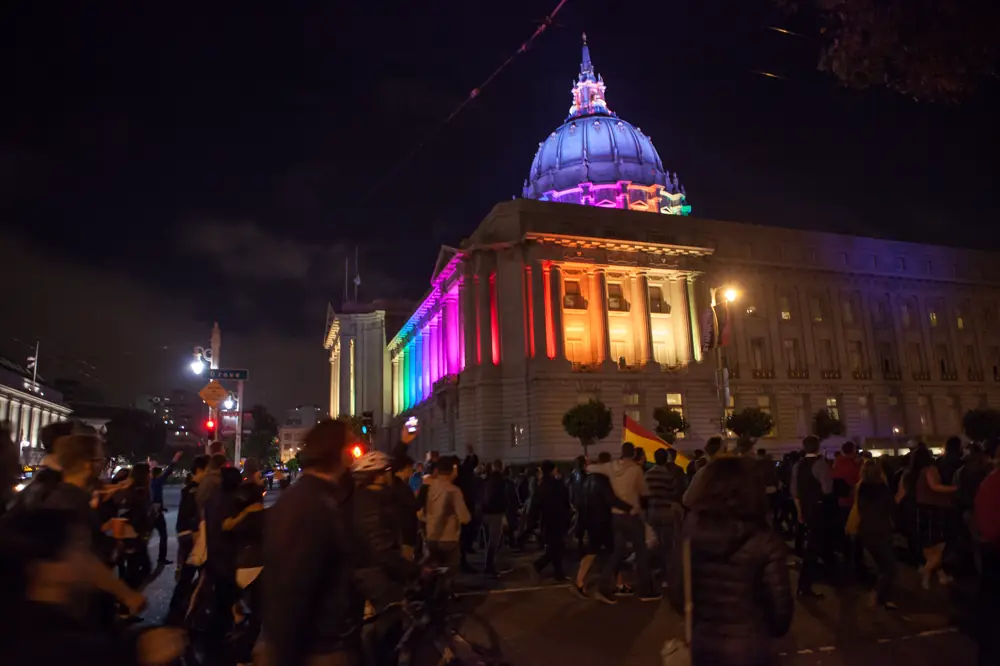
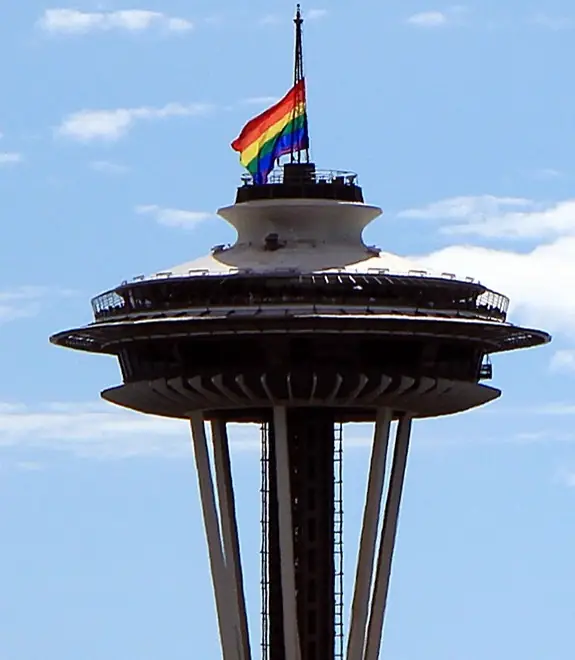
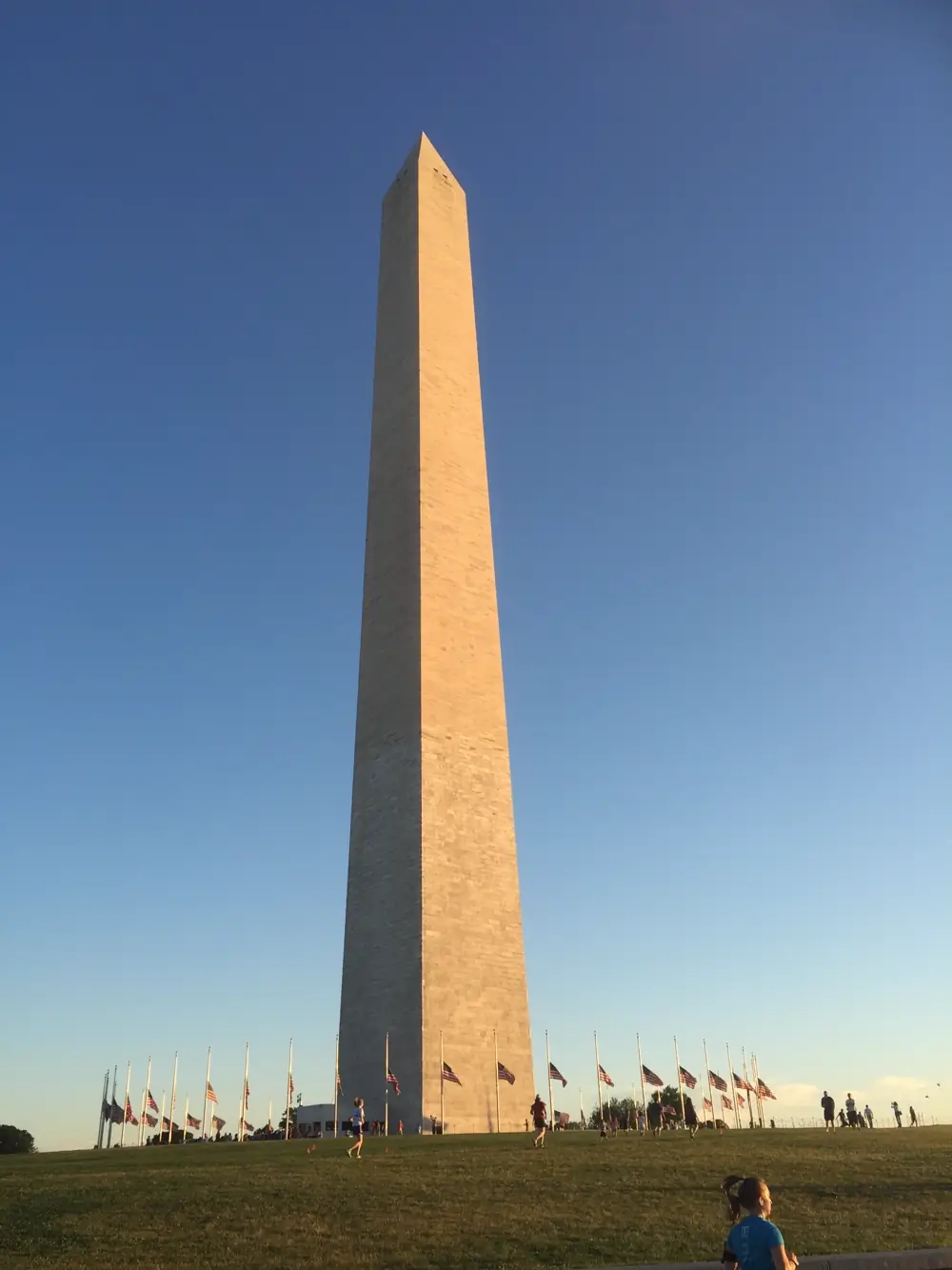
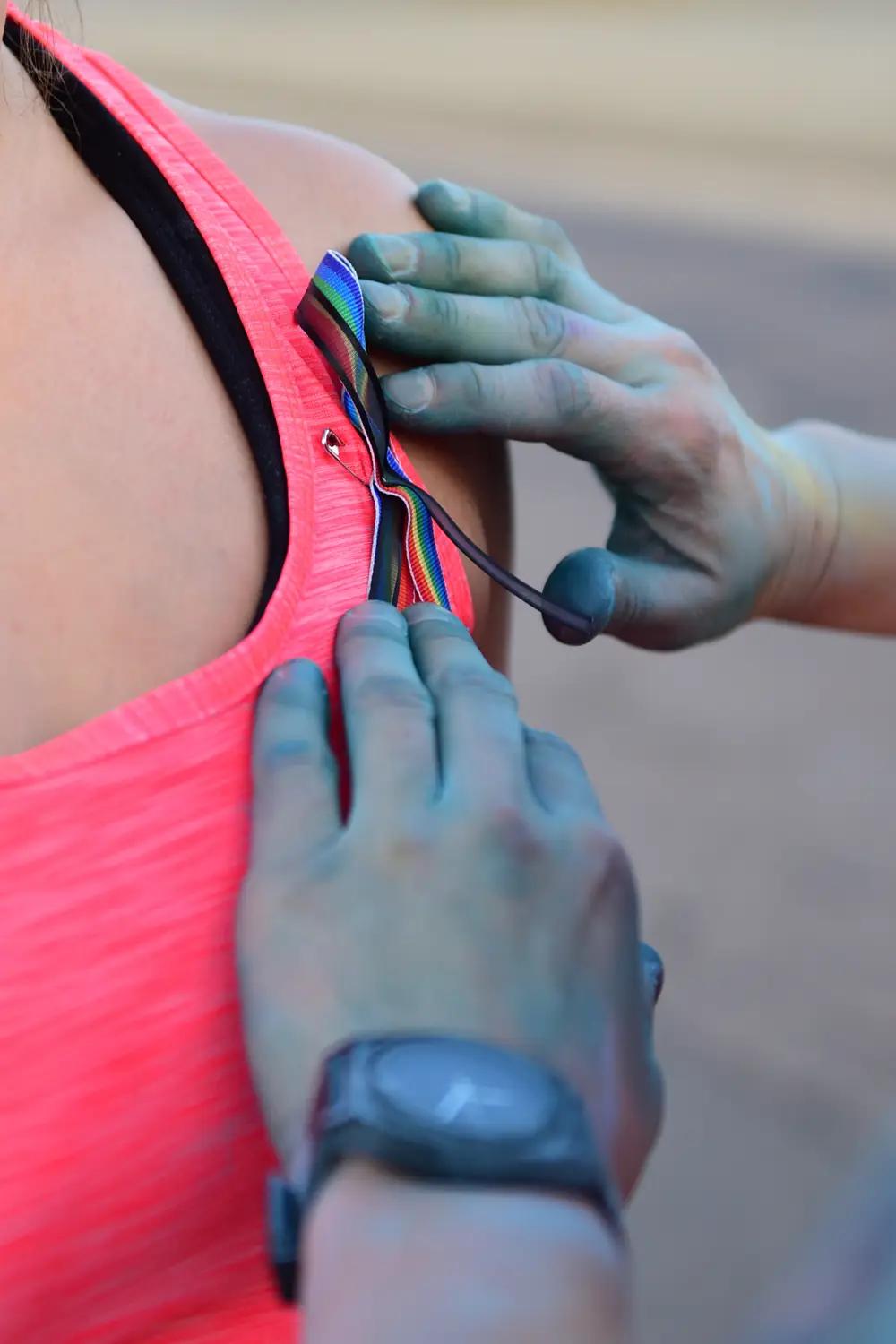
San Francisco City Hall lit in rainbow colors as the city held a vigil the night of June 12, 2016. Pax Ahimsa Gethen (Funcrunch), via Wikimedia Commons. CC BY-SA 4.0.Seattle's Space Needle flew a rainbow flag at half-mast on June 12, 2016. LavaBaron, via Wikimedia Commons. CC BY-SA 4.0.Flags lowered to half-staff at the Washington Monument after the attack. Rex Hammock, via Wikimedia Commons. CC BY 2.0.An airman wears a rainbow ribbon in remembrance of the Pulse victims at a Pride event, June 24, 2016. Staff Sgt. Lausanne Kinder, U.S. Air Force. Public domain.
How the world grieved, and how they are remembered
The grief did not stay in Orlando. In the days after June 12, 2016, people gathered by candlelight in cities across the United States and around the world, on church steps and city hall plazas and in public squares, to stand together and to say the names aloud. In Orlando itself, an estimated fifty thousand people filled Lake Eola Park on June 19 to light candles and read the names of the dead into the night. That summer, Pride celebrations already on the calendar became something heavier and braver at once: a season of mourning and of defiance, of refusing to be made afraid of one another's company.
That same Sunday evening, the grief reached a national stage. At the Tony Awards, hours after the attack that morning, Lin-Manuel Miranda accepted an award and, fighting tears, read a sonnet he had written. Its closing became a kind of refrain for the whole country in those weeks: "And love is love is love is love is love is love is love is love, cannot be killed or swept aside." It was not a policy and it was not an answer. It was a vow, spoken in public, that the thing the attack had tried to kill would outlast it.
Orlando answered with a phrase of its own. "Orlando United" became the city's response, and June 12 was set aside as Orlando United Day, a day of love and kindness observed each year by the city, the county, and a coalition of more than thirty local LGBTQ+ organizations. Every year the forty-nine names are read aloud, one after another, because to say a person's name is to insist that they were here, that they were loved, and that they are not a number.
Some of the grief was built into lasting things. Friends of Christopher "Drew" Leinonen, who as a teenager had founded a gay-straight alliance at his high school, started The Dru Project in his memory; it supports gay-straight alliances, publishes a widely used guide for them, and has given more than a quarter of a million dollars in scholarships and grants. In Philadelphia, West Catholic Preparatory High School retired the number twenty jersey of Akyra Murray, the youngest of the forty-nine, and created a scholarship in her name. The onePULSE Foundation established forty-nine college scholarships, one in honor of each life, shaped around the dreams and vocations each person had been reaching toward.
What threads through all of it is a refusal to let the last thing said about these forty-nine be the manner of their deaths. They are remembered instead through scholarships and gay-straight alliances, through a retired jersey and a day of kindness, through fifty thousand candles and a sonnet read aloud on a hard night. Remembrance, done well, is not only looking back. It is the promise that the lives go on doing good in the world, carried now by the people who loved them.
Sources: CNN and CBS News (the 2016 Tony Awards sonnet); City of Orlando and Orange County (Orlando United Day); The Dru Project; CBS Philadelphia (Akyra Murray); onePULSE Foundation announcements.
Chapter VIII
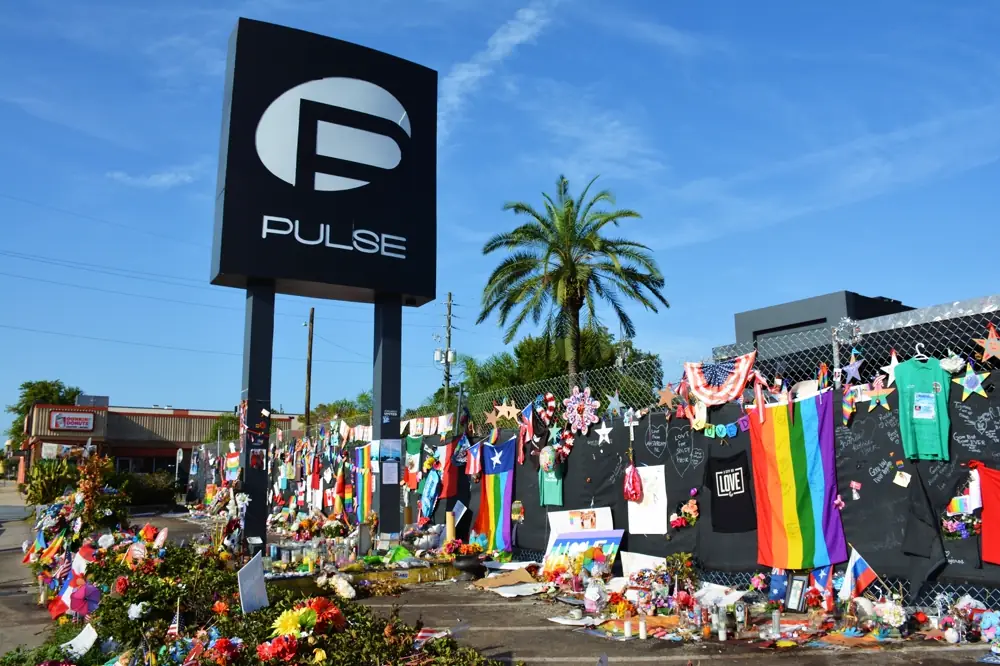
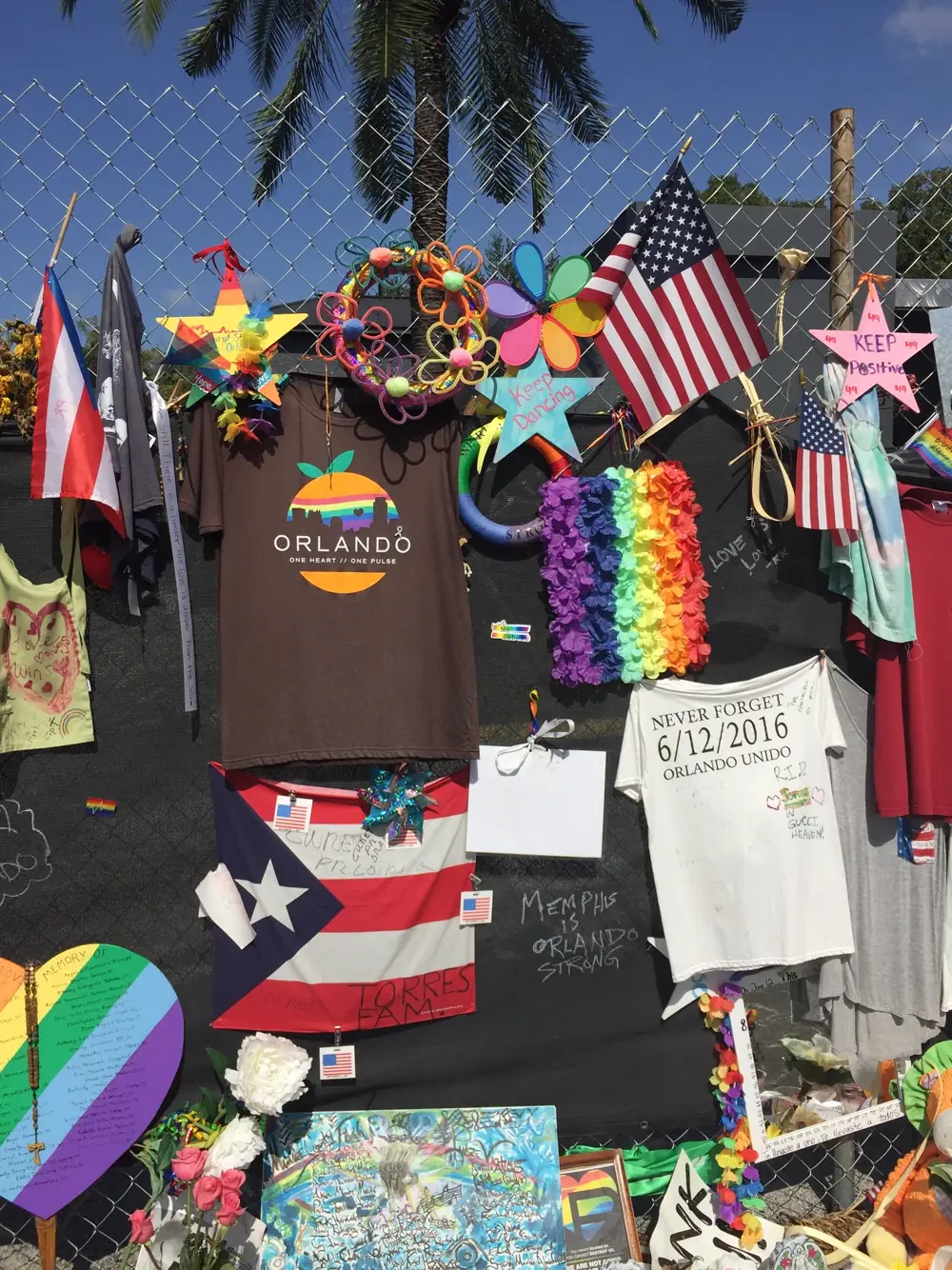
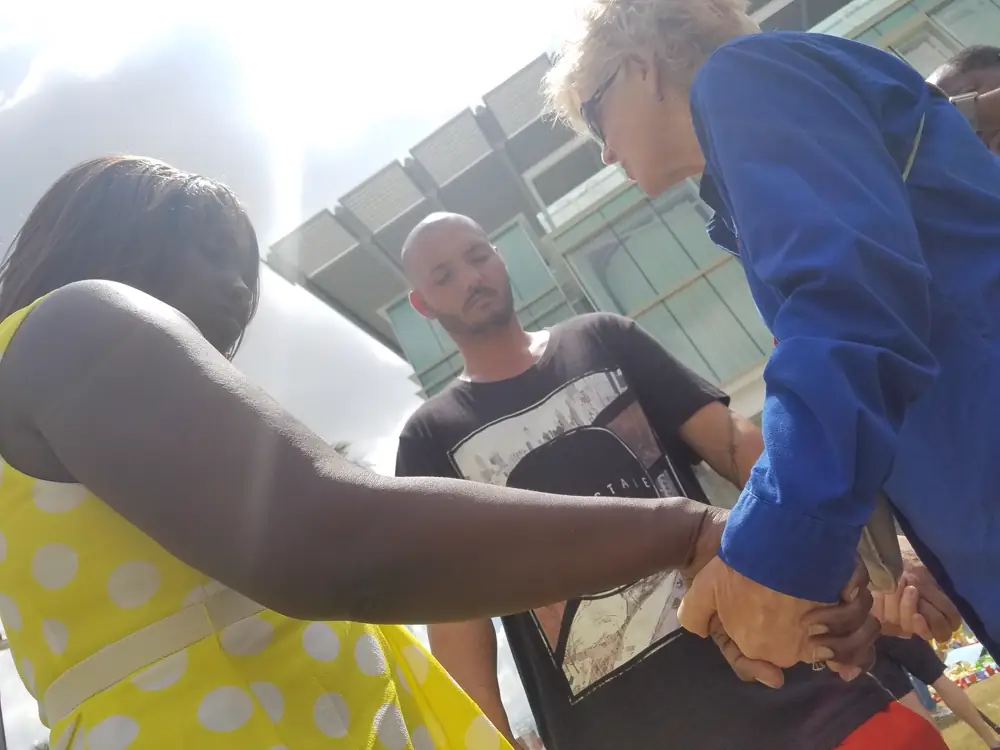
Flowers, candles, and Pride flags left on the fence at Pulse in the weeks after the attack. Walter (Flickr), via Wikimedia Commons. CC BY 2.0.A street memorial in Orlando honoring the forty-nine, summer 2016. Sabrejett, via Wikimedia Commons. CC BY-SA 4.0.Mourners gather to pray at Orlando's victim memorial, June 2016. A. Arabasadi / Voice of America (U.S. federal government). Public domain.
A place to mourn
Before anyone planned a memorial, the people made one. Within days of the attack, the sidewalk and the fence around the club filled with flowers and candles, with Pride flags and transgender flags and the flag of Puerto Rico, with photographs and handwritten notes and small offerings left by strangers. It grew a little more each day. It was not designed and it was not commissioned. It was the oldest human answer to loss, the need to bring something to the place where it happened and to stand there for a while.
In 2018 a temporary interim memorial was built on the site, with a steel fence where visitors could leave messages and mementos, wall exhibits, and benches, so that families, survivors, and first responders would have a place to come and grieve while a permanent memorial was planned. For years that planning was carried by the onePULSE Foundation, created to build a permanent memorial and museum and led by Barbara Poma, a former co-owner of the club. The road it traveled was a troubled one. We tell that part plainly, because survivors and families lived it, and because a memorial honest about the lives owes honesty about what was done in their name.
The plans for a museum grew to an estimated forty-five million dollars or more, and many survivors and families objected that an expensive museum risked turning their loss into a spectacle. Critics noted that the foundation's board did not include survivors or victims' family members, and questioned the dual role of a former club owner leading the effort. Orange County officials said the foundation had breached its property agreement through unauthorized lease arrangements involving public tourism funds, and reporting in the foundation's final period described spending that far outran its income. In late 2023, the memorial and museum plans were permanently suspended, and the onePULSE Foundation moved to dissolve and ceased operations by the end of that year. These are documented findings, attributed to officials and to reporting, and we set them down without embellishment.
In December 2023 the City of Orlando took the lead, establishing a dedicated memorial fund and committing to finish what years of effort had not. The site already carried a national weight: on June 25, 2021, President Biden had signed a law, passed by Congress, designating it the National Pulse Memorial. What had been missing was the place itself.
As of early 2026, that place is finally taking shape, and we date what we say because it is still changing. The city-led design, advanced to about sixty percent complete by May 2026 after a thirty percent concept shown that March, centers on a permanent Memorial Park: a reflection pool, a healing garden, a survivor's wall honoring those who were injured, and a row of columns carrying a tribute to each of the forty-nine, set along a curving rainbow pathway. The project is budgeted at about twelve million dollars, funded by the city and Orange County under an agreement approved in September 2025, with permitting expected in mid-2026, construction targeted to begin in September 2026, and the memorial expected to open in 2027. After the spontaneous fence and the long, painful interim, the forty-nine are at last to have a permanent place where they will be named in stone, and where anyone who loved them, or never knew them, can come and stand a while.
A note on what is still changing
The permanent memorial's design, budget, and timeline are evolving, and the facts here are dated to reporting through May 2026. We will update this exhibit as the Memorial Park is finalized and built.
Sources: City of Orlando and pulseorlando.org; Central Florida Public Media and WLRN (2025 to 2026 design and funding); the National Pulse Memorial Act (2021); WFTV and Centro de Periodismo Investigativo (the onePULSE record).
Chapter IX
How we know, and where to find support
The names and ages in this exhibit are taken from the official list of those killed. The biographies are drawn from reputable reporting and obituaries, cross-checked across sources. Where outlets disagreed on a detail, we left it out or flagged it rather than choose for the dead. We did not include accounts of individual heroism that appeared in only a single source, however moving, because we will not build a memorial on a fact we cannot stand behind.
What we deliberately left out
We do not name the gunman. We do not describe the violence in detail. We do not state or imply anyone's HIV status. And we did not invent a profession, a dream, or a last word to fill a profile that the record left thin. Some of the forty-nine are remembered here in three sentences and some in seven, only because that is how much the public record holds, not because any life mattered less.
Support & care today
If this exhibit is heavy to carry, you do not have to carry it alone. The Trevor Project supports LGBTQ+ young people at 1-866-488-7386, by text to 678-678, or by chat. The 988 Suicide & Crisis Lifeline is available to anyone, day or night, by call or text to 988. Trans Lifeline offers peer support at 1-877-565-8860.
If you carry a piece of this story
If you knew one of the forty-nine, attended a South Coast vigil, or hold a photograph, a flyer, or a memory of how this region grieved, we would be honored to preserve it, with your consent and on your terms.
Key sources: FBI and medical examiner records; the National Pulse Memorial; Orlando Weekly's "Remembering the Orlando 49"; ClickOrlando / WKMG; the Orlando Sentinel; NPR, NBC, CBS, ABC, TIME, and The Washington Post; Tampa Bay Times; the trauma team at Orlando Regional Medical Center; the UpStairs Lounge record (NPR, History.com, National Park Service); the City of Orlando; and family obituaries. Full citations are held in the museum's research record.

 Museum