Bisexual visibility, from a Boston support group in 1983 to September 23 · the word, the flag, the day, and the count
Of LGBTQ+ adults 58.6 percent are bisexualBi adults out to most of the important people in their lives 19 percentOldest national bi organization Boston, 1985
Chapter 0
Before you enter
Bisexual people are the largest group inside the LGBTQ+ community and the one least often seen in it, by the community's own measure and by everyone else's. This exhibit is about how that came to be, who built the movement that named it, and why one of its founders wanted a single day of the year to be, in her words, just for us.
What this exhibit holds
Most of it is a celebration: a definition, a manifesto, a flag drawn to a set of proportions its maker wrote down, and a party that three volunteers decided to throw in 1999. Chapter X holds the hard numbers, on mental health, on intimate partner violence, and on poverty, because a museum that only celebrates is a greeting card. Support resources sit at the top of that chapter and at the end of the exhibit.
How we tell this story
We call a person bisexual only where they called themselves that, in their own writing or in a source that quotes them doing so. We never infer it from a relationship, a marriage, or a rumor, and we do not go back through history assigning the word to people who never had the chance to use it.
We print no count that nobody counted. Where a survey gives a figure, we give the survey, the year, and the sample beside it, and where surveys disagree we show both. There are several disagreements in this record, and one of them, in Chapter X, is the finding.
The word itself has moved. Some people who would once have said bisexual now say pansexual, or queer, or bi+, and some say two of those at once. This exhibit uses "bisexual" and "bi" because that is the word in every document it quotes, and it uses "bi+" where an organization uses it about itself. It does not decide for anyone which word is theirs.
Most of all, this is a Massachusetts exhibit, and the record surprised us. The oldest nationally focused bisexual organization in the country was founded in Boston, the oldest bisexual women's publication in the world is published here, and a bisexual woman was among the first same-sex couples legally married in the United States, and she married here. What we could not find was a single documented piece of bisexual history from the South Coast itself. Chapter XI says so plainly and asks for your help.
Chapter I
As many definitions as bisexuals
Two texts define the word for the movement that uses it. One is a manifesto printed in the first issue of a San Francisco magazine. The other is a single sentence by a woman who lives in Massachusetts, and it is the sentence a city council chose to read into its record in 2025.
Robyn Ochs, as published on her own site
"I call myself bisexual because I acknowledge in myself the potential to be attracted, romantically and/or sexually, to people of more than one gender, not necessarily at the same time, in the same way, or to the same degree."
robynochs.com. Her wording has varied slightly over the years; a 2020 version adds that "the bi in bisexual refers to the potential for attraction to people with genders similar to and different from my own." The original sets the middle phrase off with dashes, which this museum does not use. Verified
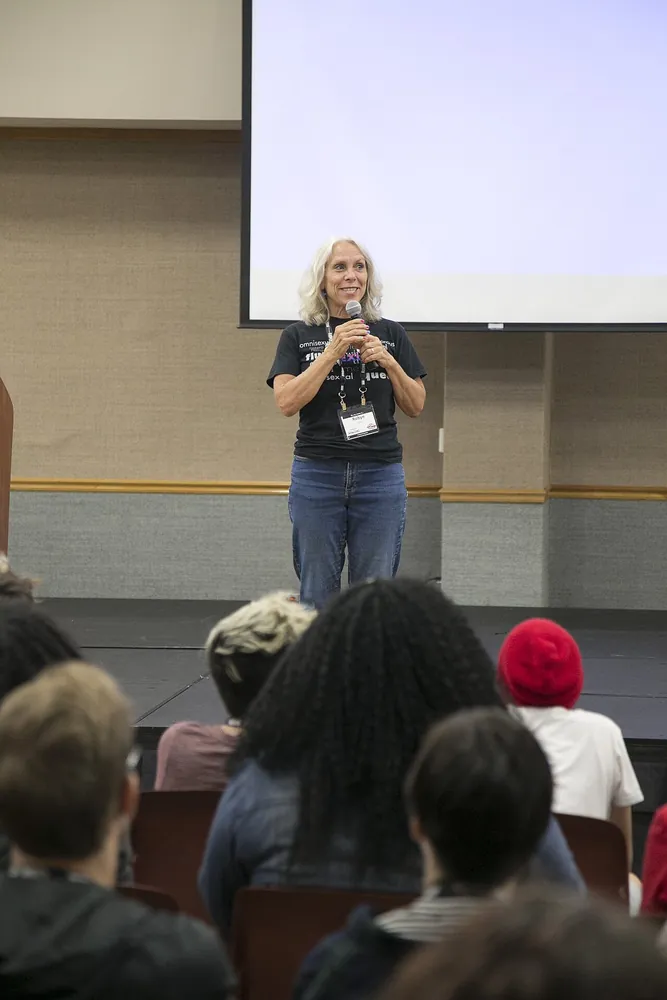
Robyn Ochs presenting at Campus Pride, July 2016. Katie Simmons-Barth, via Wikimedia Commons. CC BY 2.0.
Ochs is a Massachusetts resident, the editor of Bi Women Quarterly, and one of the founders of the organization in Chapter IV. Her definition does three things at once, and each of them answers a question bisexual people are tired of being asked. "More than one gender" does not say two, so it does not depend on there being only two. "Not necessarily at the same time" answers the person who thinks a bisexual woman married to a man has stopped being bisexual. "Not necessarily in the same way, or to the same degree" answers the person who demands a fifty-fifty split as proof. Verified
The older text is angrier, because it was written in a decade that gave it reason to be. Anything That Moves was a magazine published by the Bay Area Bisexual Network in San Francisco, and its first issue, in the winter of 1991, carried a manifesto that the movement has quoted ever since.
The Bisexual Manifesto, Anything That Moves, first issue, winter 1991
"We are tired of being analyzed, defined and represented by people other than ourselves, or worse yet, not considered at all."
"Bisexuality is a whole, fluid identity. Do not assume that bisexuality is binary or duogamous in nature: that we have 'two' sides or that we must be involved simultaneously with both genders to be fulfilled human beings. In fact, don't assume that there are only two genders. Do not mistake our fluidity for confusion, irresponsibility, or an inability to commit. Do not equate promiscuity, infidelity, or unsafe sexual behavior with bisexuality. Those are human traits that cross all sexual orientations. Nothing should be assumed about anyone's sexuality, including your own."
"There are as many definitions of bisexuality as there are bisexuals."
Full text from the magazine's own site, archived 2005. BiNet USA's history timeline dates the magazine's launch to winter 1991; popular retellings often say 1990. Verified
A correction to the popular record
The manifesto is often quoted as rejecting "fence-sitting" or a "trinary." Neither word appears in it. We checked the full text, and we print only what is there. Corrected
Notice the line "don't assume that there are only two genders," written in 1991. The argument that bisexuality reinforces a gender binary, which is still made about the word today, was answered in the movement's founding document before most of the people making the argument were born. Verified
Sources: robynochs.com, home page and biography, and her October 9, 2020 essay "I call myself bisexual because"; anythingthatmoves.com, "ATM Manifesto / About Our Name," archived August 28, 2005; BiNet USA history timeline, archived 2017. The claim that Ochs revised her definition between 2002 and 2005 appears only in secondary summaries and is not asserted here.
Chapter II
New York, 1970 to 2005
The Mother of Pride, and the dispute
A bisexual woman helped organize the first anniversary march for Stonewall, and the bisexual movement has honored her for it ever since. How much of the credit is hers is contested by people who were in the room, and this museum shows both accounts rather than choosing quietly.
The Bronx · New York
Brenda Howard
December 24, 1946 to June 28, 2005 · bisexual activist
Brenda Howard was born in the Bronx on Christmas Eve, 1946, and died on June 28, 2005, the thirty-sixth anniversary of the Stonewall uprising. In 1987 she co-founded the New York Area Bisexual Network and for years ran its information line. She organized for BiPAC and as a regional organizer for BiNet USA, and she was among those who lobbied to put the word "Bisexual" in the title of the 1993 March on Washington for Lesbian, Gay and Bi Equal Rights and Liberation. On all of that the record is clear. Verified
The title "Mother of Pride" rests on 1970. That June, a year after the police raid on the Stonewall Inn, New York held the Christopher Street Liberation Day march, the event that became the annual Pride march. Howard was part of the committee that planned it. The New York Area Bisexual Network's memorial page says she coordinated the one-month anniversary rally in July 1969, created the rally and march for the first anniversary, and originated the idea of a week of events around it. A line often repeated with her name is Tom Limoncelli's: "The next time someone asks you why LGBT Pride marches exist or why Gay Pride Month is June tell them 'A bisexual woman named Brenda Howard thought it should be.'"
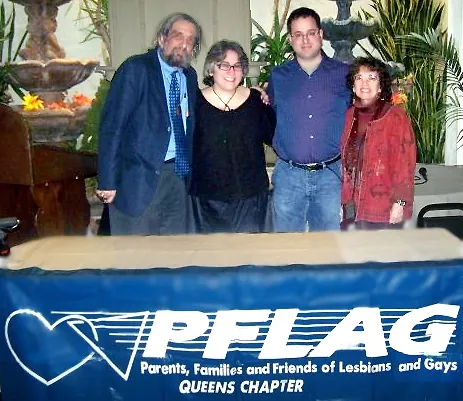
No free-licensed photograph of Brenda Howard exists anywhere we could find, so this chapter holds none of her. Instead, four recipients of the Brenda Howard Memorial Award, February 2009, whom the file names as Larry Nelson, Wendy Curry, Tom Limoncelli, and Wendy Moscow. Curry appears in Chapter VII; Limoncelli's sentence about Howard is quoted above. Snapshot credited to Larry Nelson, Queens chapter of PFLAG, via Wikimedia Commons. CC BY 3.0. Names as given on the file
The bisexual community's account
Howard "coordinated a rally one month after the Stonewall Riots" and "created the rally and march for the 1-year anniversary," and is "the Mother of Pride."
New York Area Bisexual Network memorial page; Legacy Project Chicago; The Advocate, "Remembering Brenda: An Ode to the Mother of Pride." Corroborated
Eight early Gay Liberation Front members, open letter, June 24, 2021
Howard "was one among many who participated in planning" and was "by no means the 'Mother of Pride.'" The march was proposed by Ellen Broidy and Craig Rodwell at the Eastern Regional Conference of Homophile Organizations in the fall of 1969, and the word "Pride" was already in use.
Signed by Perry Brass, Ellen Broidy, Steven Dansky, Karla Jay, John Knoebel, Mark Segal, Martha Shelley, and Allen Young; published in the San Francisco Bay Times. Verified
The New York Public Library holds the papers of the Christopher Street Liberation Day Committee, and the finding aid names no individual as the march's organizer. So the primary record neither confirms Howard as the originator nor erases her from the planning. What is not in dispute is that a bisexual woman was in the room where Pride was made, in a decade when the word "bisexual" was rarely said aloud in those rooms, and that she then spent the rest of her life building the bisexual movement. This exhibit calls her what the evidence supports: a bisexual activist who helped organize the first Pride march, and who is often called the Mother of Pride. It does not say who coined the title, because we could not find out. Origin of the title: unknown
Sources: nyabn.org, Brenda Howard memorial page; Legacy Project Chicago; The Advocate (Eliel Cruz); San Francisco Bay Times, "'Mother of Pride' Importance Disputed by Early NY Gay Liberation Front Members," June 24, 2021; New York Public Library, Christopher Street Liberation Day Committee records, MSS 540.
Chapter III
Boston, 1983
A support group called the BiVocals
The oldest bisexual women's organization still in existence, and the oldest bisexual women's publication in the world, both began in Boston in 1983 with a support group whose name was a pun.
The Bisexual Resource Center's own history records that the Boston Bisexual Women's Network was founded in 1983 "out of a women's support group called the BiVocals." BiNet USA's national timeline calls it "the oldest extant bisexual women's group" in the country. Its newsletter, Bi Women, began the same year. Verified
That newsletter is still being published. It is called Bi Women Quarterly now, it is edited by Robyn Ochs, and its own masthead says it has been "in continuous publication since 1983" and is "the oldest bisexual+ women's publication in the world." Forty-three years of continuous publication is a longer run than most of the gay and lesbian press of the same era managed. Verified
1983
Boston Bisexual Women's Network founded, from the BiVocals support group.
Bisexual Resource Center history; BiNet USA timeline. Verified
43
Years of continuous publication for Bi Women, now Bi Women Quarterly.
biwomenquarterly.com. Verified
1984
Boston Bisexual Men's Network formed.
BiNet USA timeline only. Corroborated
The paper survives because two Boston-area libraries kept it. Northeastern University's archives hold the newsletter's run from 1983 to 2005 in its Bisexual Resource Center collection, and the Schlesinger Library at Harvard has digitized back issues from 1983 to 2010. That means the bisexual movement's earliest continuous written record in the United States is a Massachusetts record, catalogued and readable in two Boston reading rooms. Verified
It also means this exhibit could have gone deeper than it did. The Bi Women issue of December 1999 to January 2000 carries what may be the first printed account of the first Celebrate Bisexuality Day, quoted in Chapter VII from a later newsletter that cites it. We did not open the Schlesinger scan ourselves, and we say so where the quote appears.
Sources: biresource.org, "Our History"; BiNet USA history timeline, archived 2017; biwomenquarterly.com; Northeastern University Archives and Special Collections, Bisexual Resource Center records (M144), series for Bi Women newsletter; Curve magazine on the Schlesinger digitization.
Chapter IV
Boston, 1985
The East Coast Bisexual Network
Two years after the women's network, Boston-area activists used the profits from a regional conference to found a network for the whole East Coast. It is now the Bisexual Resource Center, it turned forty in 2025, and it is the oldest nationally focused bisexual organization in the United States.
The Bisexual Resource Center describes itself as "originally started in 1985 as the East Coast Bisexual Network." Northeastern University's finding aid for the organization's papers adds the names and the money: it was founded "by Boston-area activists including Robyn Ochs, Laura Sachs, and Scott Lewis," using the proceeds of a regional bisexual conference. It incorporated as a nonprofit in 1989 and, as the finding aid records, opened its first office that year at 338 Newbury Street, in the Lesbian and Gay Community Center. Verified
A Boston ledger
1985Boston
East Coast Bisexual Network founded, from conference profits, by Boston-area activists including Ochs, Sachs, and Lewis.
Verified
1987Boston
The network "established the first Bisexual History Archives with Robyn Ochs' initial collection."
Corroborated, OutHistory only
1989338 Newbury St.
Incorporated as a 501(c)(3); first office in the Lesbian and Gay Community Center.
Verified
1990 to 2002
Publishes the Bisexual Resource Guide, the movement's directory of groups and resources.
Verified
199295 Berkeley St.
Office moves.
Verified
1993Washington, D.C.
Co-sponsors the National Conference Celebrating Bisexuality during the March on Washington, the first national march with "Bi" in its title.
Verified
1993 or mid-1990s
Renamed the Bisexual Resource Center. Northeastern's finding aid says 1993; the Center's own history says "in the mid-nineties." We print both.
Verified, date disputed
April 1998Cambridge
An International Conference on Bisexuality is held in Cambridge, Massachusetts.
Corroborated, BiNet timeline only
By 200829 Stanhope St.
Office at 29 Stanhope Street.
Verified
March 2014
Declares the first Bisexual Health Awareness Month.
Corroborated, OutHistory only
Sept 21, 2025Jamaica Plain
Fortieth anniversary marked at its Celebrate Bisexuality+ Day event at the Loring Greenough House.
Verified
Rows marked Verified come from the Center's own site or Northeastern's finding aid. Rows marked Corroborated rest on a single secondary timeline and are shown so that someone can confirm them.
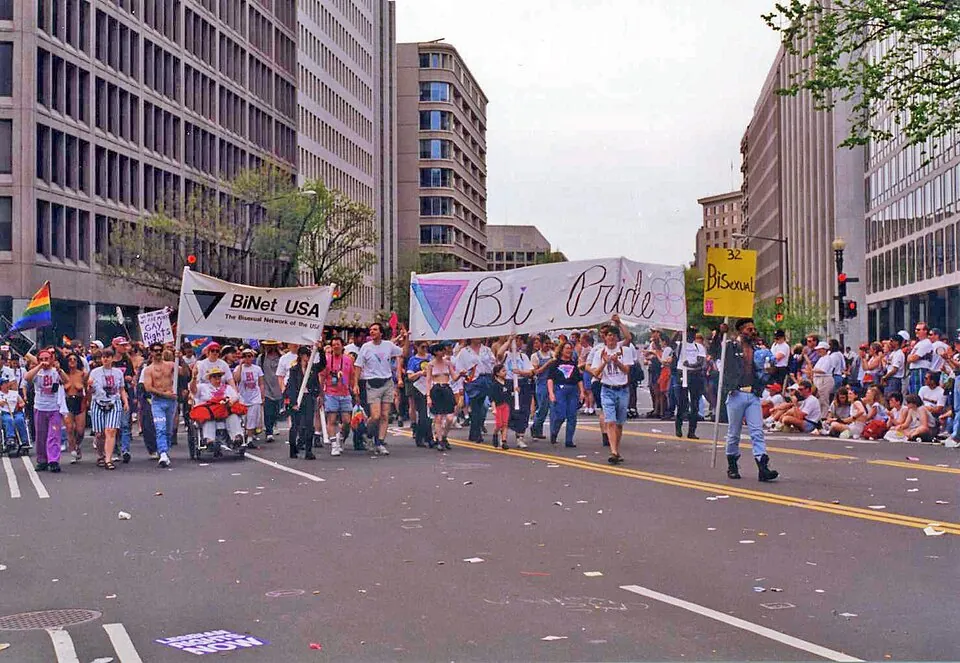
Participants representing Bi Pride at the March on Washington for Lesbian, Gay and Bi Equal Rights and Liberation, April 25, 1993, the week the Center co-sponsored the National Conference Celebrating Bisexuality. James Steakley, via Wikimedia Commons. CC BY-SA 4.0.
Today the Center says its work is "to connect the bi+ community and help its members thrive through resources, support, and celebration," and it calls itself "the oldest nationally-focused bisexual organization in the U.S." and, on its fortieth anniversary page, "the longest-running bi+ advocacy organization in the U.S." Both phrases are its own, and we have found nothing that contradicts either. Verified
One thing the Center did in the 1980s belongs in the next chapter, because it was a response to an accusation. According to Northeastern's history of Boston's LGBTQ+ community groups, "in the late 1980s, the East Coast Bisexual Network made HIV/AIDS education and activism a priority, as bisexual men and women were popularly accused of transferring the disease." Corroborated
Sources: biresource.org, home page, "Our History," and "Celebrate Bisexuality+ Day 2025"; Northeastern University Archives and Special Collections, Bisexual Resource Center records (M144) finding aid; Northeastern LGBTQA history site, community groups; OutHistory, bisexual timeline; BiNet USA history timeline. The Center's mailing address appears only on a third-party listing and is not printed here.
Chapter V
1974 to 1995
The years they were blamed
Before there was a flag or a day, there was a national press that treated bisexuality first as a fashion and then as a threat. The founders of the day in Chapter VII were reading these stories when they decided they wanted one day that was not an argument.
In May 1974 Time magazine ran "The New Bisexuals," and Newsweek ran a piece under the title "Bisexual Chic: Anyone Goes." The historian Julia Shaw summarizes Newsweek's verdict as "probably just a trend." We have confirmed the Time headline and date and the existence of the Newsweek piece, but not Newsweek's exact date, so we do not print one. Corroborated
By 1987 the tone had changed. AIDS was killing people, and the press went looking for someone to carry the virus across the line between gay and straight America. On April 3, 1987, the New York Times published "AIDS Specter for Women: The Bisexual Man."
The New York Times, April 3, 1987, quoting its experts
"Most bisexuals are just married men who are gay."
"If anything, AIDS will drive bisexual men deeper into the closet."
The first line is attributed to the psychiatrist Richard A. Isay, the second to the sociologist Pepper Schwartz. Headline and date verified; the quotations are reproduced from a secondary transcription of the article and are marked accordingly. Corroborated
That July, Newsweek put "Bisexuals and AIDS: The Dangers of a Double Life" on its cover. In October 1989, BiNet USA's timeline records, the New York Area Bisexual Network ran a letter-writing campaign against a Cosmopolitan article "that maliciously stereotypes bisexual men as dishonest spreaders of AIDS." And in Boston, as the previous chapter records, the East Coast Bisexual Network made HIV education a priority precisely because bisexual people "were popularly accused of transferring the disease." Corroborated
A line we did not print
A widely repeated sentence has Newsweek in 1987 calling bisexuals "the ultimate pariahs of the AIDS crisis." It is attributed through a 1995 scholarly book, and we could not find the issue or page. It may well be real. It is not here. Unverified
Eight years after the "double life" cover, on July 17, 1995, Newsweek ran another: "Bisexuality: Not Gay. Not Straight. A New Sexual Identity Emerges." The article declared "we are in a bisexual moment," called bisexuality "the hidden wild card of our erotic culture," and described bisexual people who felt "rejected on two fronts: by straights for being too gay, and by gays for not being gay enough." Cover and date verifiedQuotations corroborated
Read the three headlines in order. In 1974 bisexuality was a trend. In 1987 it was a danger. In 1995 it was new. The same identity, in the same magazine, was described three times in twenty-one years and never once as something that had been there all along. By 1995 the Boston women's network was twelve years old and the East Coast network was ten. The people the press kept discovering had been holding meetings the whole time. Verified
Sources: Time, "The New Bisexuals," May 13, 1974; Julia Shaw, "Nope, Not a Trend," Literary Hub, June 29, 2022, excerpting her book; the New York Times, April 3, 1987 (Jon Nordheimer), quotations via bistuff.org.uk; Newsweek, July 13, 1987 issue listing; BiNet USA history timeline; Northeastern LGBTQA history site; Newsweek, July 17, 1995 (John Leland), issue scan on the Internet Archive, quotations via the LGBT History Archive and Shaw.
Chapter VI
December 5, 1998
December 5, 1998: the flag
Michael Page, a BiNet USA volunteer in Florida, wrote down exactly why he made the bisexual pride flag, what each stripe meant, and how wide each one should be. His text survives on an archived copy of his own site, and this museum draws the flag to his proportions rather than borrowing a photograph.
Magenta, 40 percent. Page's PMS 226. In his key, attraction to one's own gender.
Lavender, 20 percent. Page's PMS 258, "the resultant color when you overlap pink and blue." Attraction across more than one gender.
Royal blue, 40 percent. Page's PMS 286. In his key, attraction to a different gender.
Michael Page, "The History of the Bi Pride Flag," BiFlag.com, archived August 1, 2001
"The first Bi Pride Flag was unveiled on Dec 5, 1998. The intent and purpose of the flag is to maximize bisexual pride and visibility. This flag is for free public usage."
"As a result of volunteer work I was doing for BiNet USA, it occurred to me that if bi people were going to be visible at home, pride events and political rallies, we needed a Bi Pride Flag!"
"Based on my own personal experience, the vast majority of bi people I have spoken with, feel no connection to the rainbow flag, the pink triangle, the black triangle, the Lambda symbol or the double-edged hatchet... It is my belief that bi people need their own flags and symbols to rally around."
"I decided to make the top of the flag pink and would give it 40% of the vertical dimension. Purple, which is the resultant color when you overlap pink and blue, would be the middle stripe and would be 20% of the dimension. The lower 40% would be blue."
"The key to understanding the symbolism in the Bi Pride Flag is to know that the purple pixels of color blend unnoticeably into both the pink and blue, just as in the 'real world' where bi people blend unnoticeably into both the gay/lesbian and straight communities."
"The Bi Pride Flag is the only bisexual symbol not patented, trademarked or service marked."
Page's own page, as archived by the Internet Archive. His 1998 key describes the pink as attraction "to the same sex only" and the blue as attraction "to the opposite sex only"; this museum paraphrases those two phrases in current language above and quotes the rest verbatim. Verified
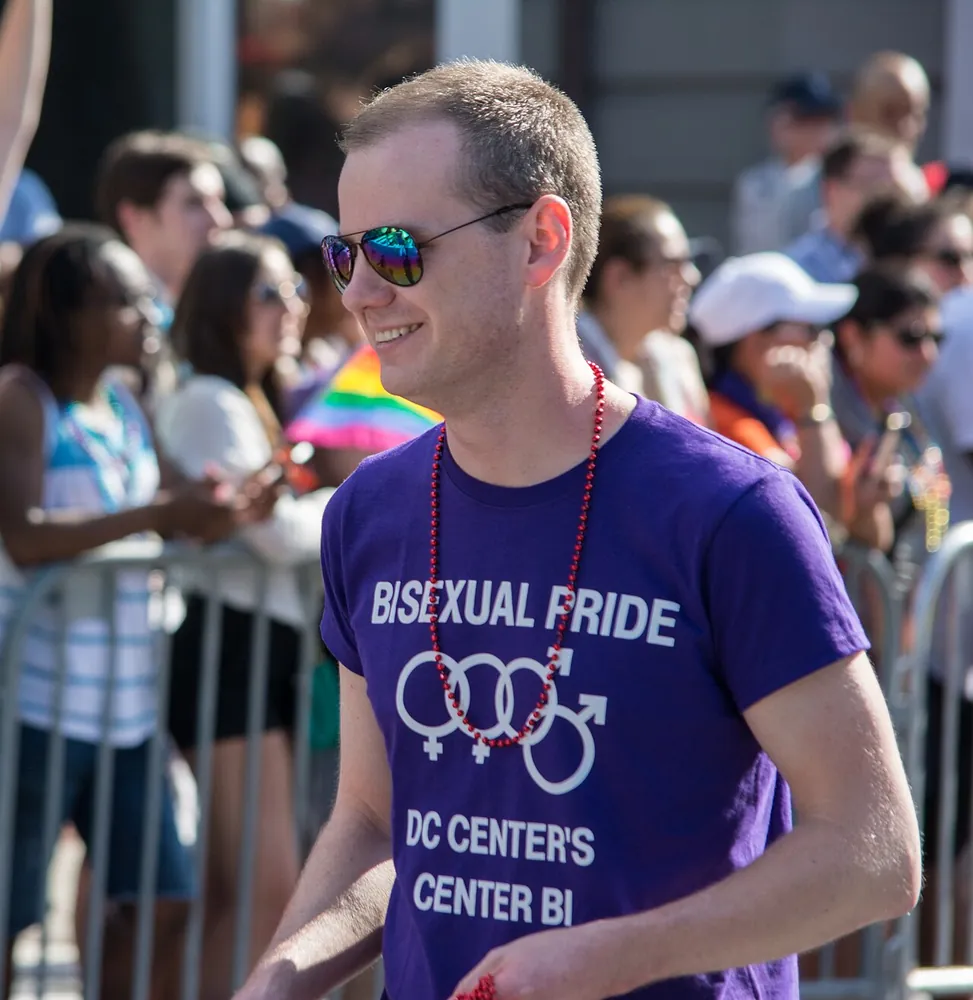
The flag in use, sixteen years on: a marcher in the Capital Pride parade, Washington, D.C., June 7, 2014. Tim Evanson, via Wikimedia Commons. CC BY-SA 2.0.
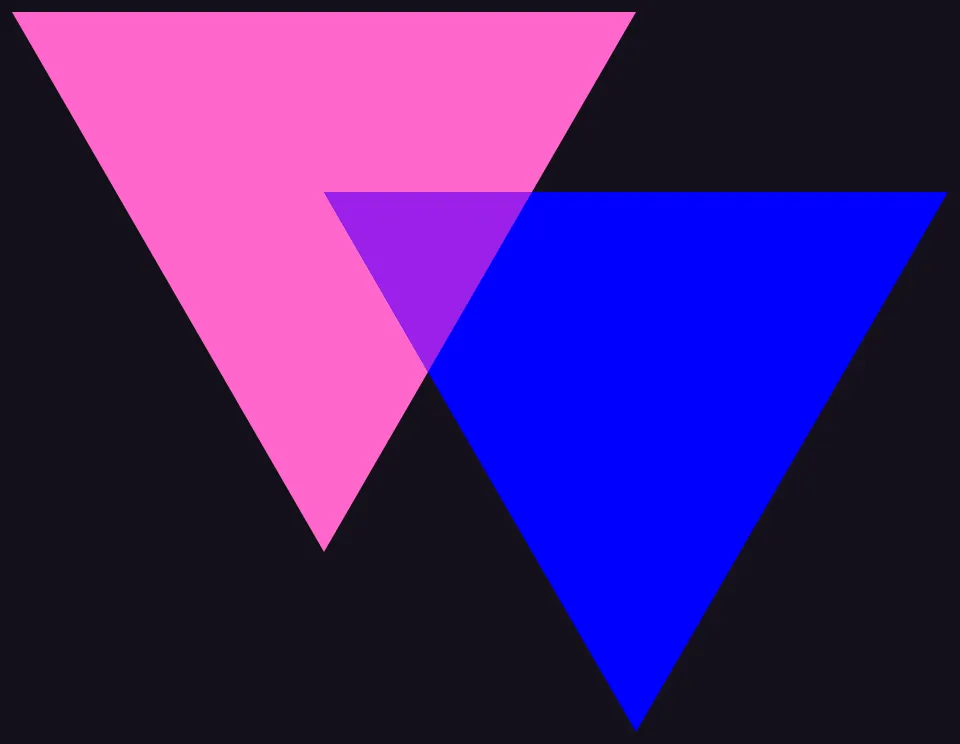
Page did not invent the colors. He wrote that he "selected the colors and overlap pattern of the bi angles symbol," the two overlapping triangles, pink and blue with a lavender overlap, that the artist Liz Nania says she created in 1985, and Nania's own site says "the three colors of the Biangles became the basis for the bisexual flag." Both accounts agree, from opposite ends. Verified
The biangles, the overlapping triangles whose three colors Page carried into the flag. Design by Liz Nania, 1985; this rendering by Fibonacci, released to the public domain, via Wikimedia Commons.
Two details often attached to the flag are not on Page's page. One is that it was unveiled at the first anniversary party of BiCafe, an online community; the archived text gives only the date. The other is any claim of trademark, which Page explicitly disclaimed. The flag on this page is drawn in CSS to his 40, 20, 40 proportions, and it is drawn rather than photographed because the museum has no photograph of it that it has cleared, and because, as Page wrote, the flag is for free public use. BiCafe detail corroborated only
Sources: biflag.com, "Activism" page, archived August 1, 2001; liznania.com, early work; the Boston City Council's 2025 resolution, which credits Page with the flag.
Chapter VII
September 23, 1999
September 23, 1999: the day
Three BiNet USA volunteers, sitting around at a convention, decided the community needed a party instead of another protest. One of them told the story fourteen years later, in a regional newsletter, and hers is the only first-hand account of why the date is the date.
BiNet USA's own timeline is the plainest statement of who and when: "SEPT 1999 - BiNet USA coordinators Michael Page, Gigi Raven Wilbur, and Wendy Curry organized the first Celebrate Bisexuality Day." The Bisexual Resource Center gives the same three names and year, and the Boston City Council's 2025 resolution adds where they were from: "Wendy Curry of Maine, Michael Page of Florida (also known for creating the Bisexual Pride flag), and Gigi Raven Wilbur of Texas." Verified
Wendy Curry, interviewed by Br. Michael C. Oboza, "Our Fence," BiNet USA Chicago, Celebrate Bisexuality Day issue, 2013
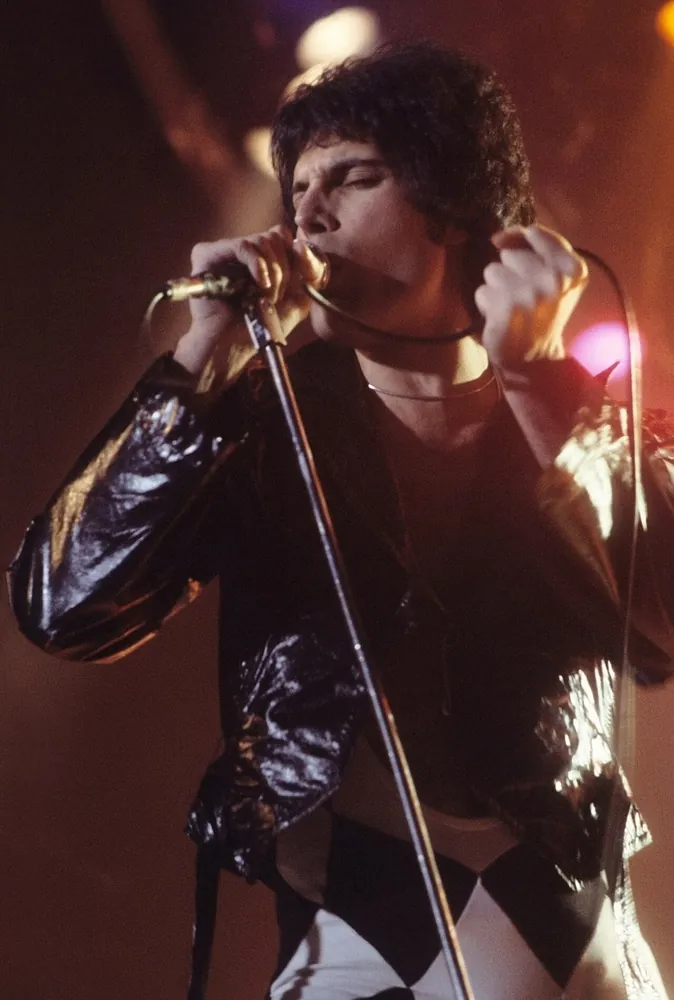
"We were sitting around a one of the annual bi conventions, venting and someone. I think it was Gigi said we should have a party. We all loved the great bisexual, Freddie Mercury. His birthday was in September, so why not Sept? We wanted a weekend day to ensure the most people would do something. Gigi's birthday was Sept 23rd. It fell on a weekend day, so poof! We had a day."
"Pride is an outward act, letting the world know we were not ashamed of who we were. CBD was meant to be an inward act. Getting our community together to celebrate who were we and how privileged we were to be who we are... There were 364 other days of the year where we can grovel for the B in LGBT. The one day was just for us."
Reproduced as printed, including the newsletter's typographical slips, from the archived PDF. This is Curry's recollection fourteen years after the fact; it is the source behind every popular retelling. Verified as her account
The reason it is September: Freddie Mercury, born September 5, 1946, at the New Haven Coliseum, November 16, 1977. Carl Lender, via Wikimedia Commons. CC BY-SA 3.0.
The same newsletter quotes Curry from closer to the time, in the Boston publication Bi Women for December 1999 to January 2000: the day was "a way to get bisexuals together for something other than a protest or a support group. We were looking for a way to unite with a positive message. 'We are wonderful just as we are!'" We have that quotation only at second hand, from the 2013 newsletter's citation of it, and the Bi Women issue itself sits in Harvard's Schlesinger scans. Corroborated
Gigi Raven Wilbur, whose birthday gave the day its date, put the reason more sharply in 2013: "Ever since the Stonewall rebellion, the gay and lesbian community has grown in strength and visibility. The bisexual community also has grown in strength but in many ways we are still invisible." Corroborated
Three things the popular story gets wrong, or cannot prove
September 23, 1999 was a Thursday. Curry's "it fell on a weekend day" describes the planning conversation, not the first observance. Corrected
The editor's letter in the same 2013 newsletter says the first day was in 1998. Every other source, including BiNet USA's own timeline, says 1999, and the flag in Chapter VI was not unveiled until December 1998, so 1999 is the only year that fits. Corrected
The Johannesburg story is unproven. The day is widely said to have been first marked at the ILGA world conference in Johannesburg. ILGA's own report confirms that conference ran September 19 to 26, 1999, so the date fits, but the report never mentions a bisexuality celebration, and Curry's own account does not mention South Africa. The claim traces to a 2008 newspaper piece. We show the dates and stop there. Unverified
Sources: BiNet USA history timeline, archived 2017; biresource.org, "Celebrate Bisexuality+ Day 2025"; Boston City Council, resolution of September 2025 (Legistar); "Our Fence," BiNet USA Chicago, Celebrate Bisexuality Day 2013 issue, archived PDF; HuffPost, September 24, 2013 (Wilbur quotation); ILGA, "Conference Report from ILGA Bulletin: XIX ILGA World Conference, Johannesburg, September 19-26 1999"; Long Beach Post, September 23, 2008; bivisibilityday.com, "About."
Chapter VIII
1990 to 2014
From a day to a week
Cities proclaimed it, then a national media organization built a week around it. The dates of the week have moved three times, which is the kind of detail a museum notes and a greeting card does not.
Recognition, in order
June 23, 1990San Francisco
The mayor declares "Bisexual Pride Day" during the first National Bisexual Conference.
Corroborated, BiNet timeline, quoted by Boston's 2025 resolution
Sept 23, 1999
First Celebrate Bisexuality Day. Chapter VII.
Verified
2012Berkeley, Calif.
Berkeley becomes, by BiNet USA's account, the first city to officially recognize September 23.
Corroborated, BiNet president's own column
Sept 2014
First Bisexual Awareness Week. GLAAD: "In 2014, GLAAD co-founded and co-led the first #BiWeek with BiNet USA." That year it ran September 23 to 29.
Verified
2016
Third annual week runs September 19 to 26.
Verified
Now
GLAAD, the Bisexual Resource Center, and Still Bisexual mark the week September 16 to 23, "culminating in Celebrate Bisexuality+ Day on September 23."
Verified
Sept 20, 2024Boston
The City of Boston recognizes September 23 as Bisexuality Visibility Day and calls it "the 25th anniversary of the tradition."
Verified
Sept 17, 2025Boston
City Council resolution. Chapter XI.
Verified
The week's partner has changed as well as its dates: GLAAD's original co-founder was BiNet USA; its current listed partners are the Boston-based Bisexual Resource Center and Still Bisexual.
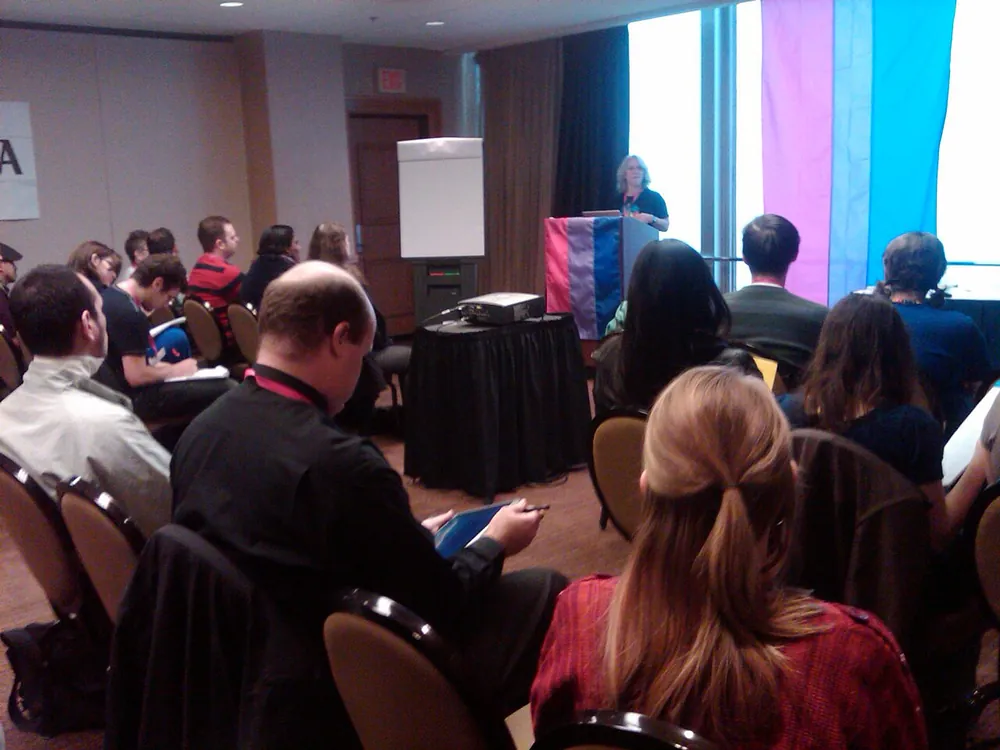
Between the day and the week: Robyn Ochs addresses the Bisexual, Fluid, Pansexual, Queer-identified and Allies Organizing Institute at the Creating Change conference, Dallas, February 4, 2010, the flag behind her. BiNet USA, via Wikimedia Commons. CC BY-SA 2.0.
The arithmetic of the week matters for one reason. Between 2014 and now the week moved from starting on the day to ending on it, so that September 23 became the climax rather than the opening. Nobody we found has written down why. We note it because a reader in 2040 checking an old flyer against a new one should not conclude that one of them is wrong. Reason for the move: not recorded
Sources: glaad.org/biweek; GLAAD press release, "GLAAD Celebrates Third Annual Bisexual Awareness Week," 2016; Autostraddle, September 22, 2014; Faith Cheltenham, The Advocate, September 22, 2012; BiNet USA history timeline; boston.gov, "September 23rd: Bisexuality Visibility Day," 2024.
Chapter IX
Gallup, 2025 data, published February 2026
The biggest letter
The largest group under the LGBTQ+ umbrella, by a wide margin and in every age band, is bisexual people. In Massachusetts high schools the margin is wider still.
9%
Of U.S. adults identify as LGBTQ+.
Gallup, 13,454 adults interviewed in 2025, margin of error one point. Verified
5.3%
Of all U.S. adults identify as bisexual, up from 3.1 percent in 2020.
Gallup, same survey. Verified
58.6%
Of LGBTQ+ adults identify as bisexual. Gay 17.4, lesbian 16.0, transgender 12.1.
Gallup, data table embedded in the report. Verified
16.1%
Of all adults aged 18 to 29 identify as bisexual. Transgender 3.0, lesbian 2.9, gay 2.5.
Gallup, same survey. Verified
12.4%
Of Massachusetts public high school students said they were bisexual in 2021. Gay or lesbian: 3.0. Transgender: 2.6.
Of Massachusetts high school girls said they were bisexual. Boys: 5.1 percent.
Same survey. Verified
Gallup's own words: "The largest share of LGBTQ+ adults say they are bisexual, representing more than half of the subgroup," and "bisexual identification far outpaces gay and lesbian identification among younger adults." The 58.6 figure is not in the running text; it is in the data table that the report embeds, and we read it there. Verified
The Massachusetts figure deserves a second look. In a Commonwealth public high school in 2021, for every student who said they were gay or lesbian there were four who said they were bisexual. That ratio is the reason this exhibit exists. Any teacher, coach, or youth worker on the South Coast who pictures "the LGBTQ+ kids" as the gay and lesbian kids is picturing the smaller part. Verified
Two figures that look like they disagree, and do not
Pew Research in 2019 said bisexual people "account for about four-in-ten LGBT adults." Gallup in 2026 says 58.6 percent. Both are right for their year and their survey: Gallup's own trend shows the bisexual share of all adults rising from 3.1 percent in 2020 to 5.3 in 2025, and the surveys ask the question differently. Separately, UCLA's Williams Institute, working from a different federal survey, estimates 5.5 percent of U.S. adults are LGBT in total, lower than Gallup's 9. We print each number with its source and do not average them. Verified
The state has not published a newer bisexual figure. The 2023 Massachusetts survey's data tables carry no table on sexual orientation identity at all, and its methodology note says comparative estimates "are not presented here." The Massachusetts Commission on LGBTQ Youth, working from preliminary 2023 data, reports that "approximately 25% of high school aged youth, or 1 in 4, identify as LGBTQ," without a bisexual breakout. So 12.4 percent, from 2021, is the newest number the Commonwealth has put on paper. Verified
Sources: Gallup, "LGBTQ+ Identification Holds at 9% in U.S.," February 16, 2026, including its embedded data tables; Gallup, "LGBTQ+ Identification in U.S. Rises to 9.3%," February 20, 2025; Massachusetts Department of Elementary and Secondary Education, 2021 Youth Risk Behavior Survey data tables and report, and 2023 data tables and methodology; Massachusetts Commission on LGBTQ Youth, FY2026 Annual Recommendations; Williams Institute, "Adult LGBT Population in the United States," December 2023; Pew Research Center, June 18, 2019.
Chapter X
The least seen
The biggest group is the least out, the least separately studied, and on several measures the worst off. This chapter holds those numbers with their sources, and it begins with where to turn if they land hard.
Support, before the numbers
This chapter reports statistics on suicide, intimate partner violence, and sexual violence. If you need someone now, call or text 988, the Suicide and Crisis Lifeline. The Trevor Project is at 1-866-488-7386 for LGBTQ+ young people. The National Domestic Violence Hotline is at 1-800-799-7233. The South Coast LGBTQ+ Network is at 774-775-2656.
Out to almost no one
Pew Research, analyzing survey data from Stanford University in 2019, found that "only 19% of those who identify as bisexual say all or most of the important people in their lives are aware of their sexual orientation. In contrast, 75% of gay and lesbian adults say the same." And: "About one-quarter of bisexual adults (26%) are not 'out' to any of the important people in their lives, compared with 4% of gay and lesbian adults." Pew notes its bisexual sample was too small to split by gender. Verified
19%
Of bisexual adults say all or most of the important people in their lives know. Gay and lesbian adults: 75 percent.
Pew Research Center, 2019. Verified
26%
Of bisexual adults are out to none of the important people in their lives. Gay and lesbian adults: 4 percent.
Pew Research Center, 2019. Verified
Not separately counted
In 2018 a research team led by Lori E. Ross published a systematic review and meta-analysis of depression and anxiety among bisexual people in the Journal of Sex Research. Of 1,074 full-text studies they reviewed, 1,023 could not be used, "predominantly because they did not report separate data for bisexual people (n = 562 studies)." From the 52 that could be pooled, the authors found "a consistent pattern of lowest rates of depression and anxiety among heterosexual people, while bisexual people exhibit higher or equivalent rates in comparison to lesbian/gay people," and they named as likely contributors "experiences of sexual orientation-based discrimination, bisexual invisibility/erasure, and lack of bisexual-affirmative support." The abstract gives no pooled percentage and the full paper is behind a paywall, so this exhibit prints the finding in words and no number. Verified
Five hundred sixty-two studies of LGBTQ+ mental health that never separated out the largest group in the population they studied. That figure is not a mental health statistic. It is a visibility statistic, and it is the clearest one in this exhibit.
What the young people's survey shows, honestly
The Trevor Project's 2025 national survey, published in May 2026, reached 16,667 LGBTQ+ young people aged 13 to 24, of whom 24 percent were bisexual, the largest single group in the sample. Among bisexual respondents, 36 percent had seriously considered suicide in the past year and 9 percent had attempted it, against 36 and 10 percent for the sample as a whole. Sixty percent reported symptoms of anxiety and 45 percent of depression, against 62 and 47 overall. In this survey, in other words, bisexual young people sit at the LGBTQ+ average, and the highest figures belong to pansexual and questioning young people. A widely repeated claim that bisexual youth are several times more likely than heterosexual youth to attempt suicide does not come from this survey, and we could not trace it to any source we could read, so it is not here. VerifiedPopular claim unverified
Intimate partner and sexual violence
The Centers for Disease Control and Prevention's National Intimate Partner and Sexual Violence Survey interviewed 16,507 adults in 2010 and published its findings by sexual orientation in January 2013. It remains the federal government's benchmark on the question.
61.1%
Of bisexual women had experienced rape, physical violence, and/or stalking by an intimate partner in their lifetime. Lesbian women 43.8, heterosexual women 35.0.
CDC NISVS 2010, published 2013. The bisexual figure is the statistically significant difference; lesbian versus heterosexual was not. Verified
37.3%
Of bisexual men, on the same measure. Gay men 26.0, heterosexual men 29.0.
Same report, which states the differences among men were not statistically significant. Verified
46.1%
Of bisexual women had experienced rape by any perpetrator in their lifetime. Lesbian women 13.1, heterosexual women 17.4.
Same report. Verified
57.4%
Of bisexual women who experienced intimate partner violence reported at least one negative impact from it. Lesbian women 33.5, heterosexual women 28.2.
Same report. Verified
Poverty
The Williams Institute at UCLA, using federal health survey data from 35 states between 2014 and 2017, found that "LGBT people collectively have a poverty rate of 21.6%, which is much higher than the rate for cisgender straight people of 15.7%," and that "bisexual cisgender women (29.4%) and men (19.5%) had higher poverty rates than cisgender straight women and men, respectively." The rate for bisexual cisgender women was the highest of any sexual orientation group in the study and equal to the rate for transgender people. A 2023 update puts bisexual cisgender women's poverty at 30 percent in 2020 and 20 percent in 2021. Verified
Set the chapters side by side. The largest group in the community is the group least likely to be out, the group most often left out of the research, and, among women, the group most exposed to violence and poverty. None of those facts is a coincidence, and the researchers who study them say so. What a reader does with them is the subject of the next chapter.
Sources: Pew Research Center, "Bisexuals less likely than gay men, lesbians to be 'out' to people in their lives," June 18, 2019; Ross LE et al., Journal of Sex Research 55(4-5), 2018, PubMed 29099625; The Trevor Project, 2025 U.S. National Survey on the Mental Health of LGBTQ+ Young People, report PDF pages 4 and 7; CDC, "The National Intimate Partner and Sexual Violence Survey: 2010 Findings on Victimization by Sexual Orientation," CDC Stacks 12362; Williams Institute, "LGBT Poverty in the United States," October 2019, and the February 2023 update page.
Chapter XI
Boston, May 17, 2004 and September 17, 2025
Boston, 2025, and the South Coast gap
A bisexual woman was among the first people in American history to marry a same-sex partner legally, and it happened in Massachusetts. Twenty-one years later, Boston's city council read her definition of the word into its record. Then the trail goes cold at the South Coast, and this museum says so.
On May 17, 2004, the first day the Commonwealth issued marriage licenses to same-sex couples after the Goodridge decision, Robyn Ochs, the bisexual activist of Chapters I, III, and IV, was among those who married. Her own biography records it; the Washington Post reported it the same day. So a bisexual woman was in the first day's wave of legal same-sex marriages in the United States, which is the reason this exhibit sits beside Seven Couples in the museum. Whether she was the first openly bisexual person to marry that day is a claim no source makes, and this exhibit does not make it either. Verified"First": not claimed
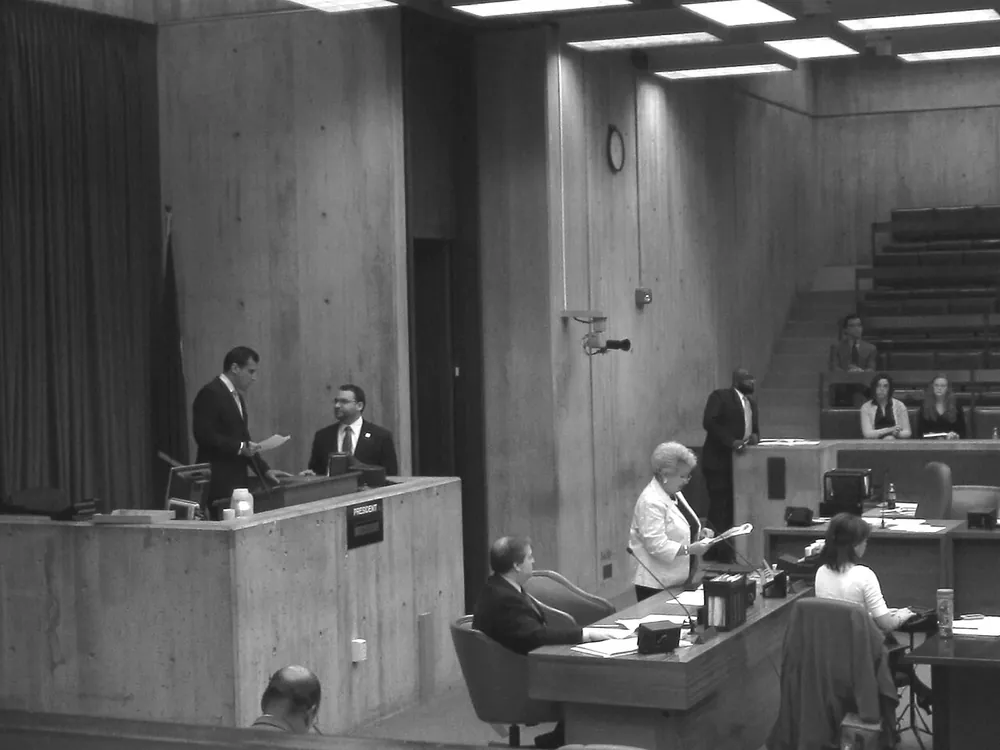
On September 17, 2025, the Boston City Council adopted a resolution "Recognizing September 23, 2025 as International Celebrate Bisexuality Day and Bi+ Visibility Day," offered by Councilor Henry Santana with Councilors Breadon, FitzGerald, Louijeune, Pepen, and Weber. The resolution names the three founders of the day, credits Michael Page with the flag, cites San Francisco's 1990 proclamation, and quotes Ochs's definition. Verified
The Christopher A. Iannella Council Chamber, Boston City Hall, where the resolution was adopted. Photographed in 2010. M2545, via Wikimedia Commons. Public domain.
Boston has always prided itself on being a city of progress, a city of firsts. Let it also be the city that refuses to leave its majority in the shadow.Bailey Merlin, board member, Bisexual Resource Center, to the Boston City Council, September 17, 2025. Reported by the Daily Free Press.
"Its majority" is the number from Chapter IX, spoken aloud in a council chamber. It is also, so far as we can find, the only time a Massachusetts government body has been told it. We searched for a proclamation of Bi Visibility Day by the Governor or the General Court and found none. That is a verified absence, not an oversight in our reading, and if one exists we would like to be shown it. State proclamation: none found
The South Coast gap
What this museum does not hold, checked rather than assumed
No documented bisexual organization, group, or newsletter on the South Coast. The Boston groups in Chapters III and IV published member and chapter directories for years, and the Bisexual Resource Guide ran from 1990 to 2002; whether any of them lists a New Bedford, Fall River, or Taunton group is a question that can only be answered by opening those directories at Northeastern, which we have not done.
No South Coast newspaper coverage of Celebrate Bisexuality Day that we could locate, in any year since 1999.
No record of a bisexual-specific program in the South Coast LGBTQ+ Network's own history, and this museum prints no count of bisexual members of its groups, because the Network does not ask and would not publish it if it did.
No oral history. Nobody has yet sat down with a South Coast resident who was out as bisexual in the 1980s or 1990s and recorded what that was like here.
We do not believe those absences mean nothing happened. Twelve percent of the students in the Commonwealth's high schools say they are bisexual today, and it would be strange if their counterparts forty years ago had no one to talk to. We believe the record was never made, or was made and never kept. Either way the fix is the same, and it is not something a museum can do alone.
If you hold a piece of this
If you were in a bisexual group anywhere on the South Coast, if you kept a flyer or a newsletter or a Bisexual Resource Guide with a local listing in it, if you remember a meeting in a church basement or a table at a Pride, or if you were simply out as bisexual here before it was common and would tell us what that was like, we would like to keep it, sourced and with care and entirely on your terms. Nothing you give us is published without your consent, and nothing names you unless you ask it to.
Sources: robynochs.com, biography; Washington Post, May 17, 2004, as cited; Boston City Council, Legistar record of the September 2025 resolution, and boston.gov, "Bisexuality and Bi Visibility Day"; Daily Free Press, "City Council discusses ensuring access to resources for LGBTQ, passes resolution recognizing International Celebrate Bisexuality Day," September 17, 2025; searches of mass.gov and malegislature.gov for a state proclamation, September 2026, none found.
Chapter XII
How we know, and what is missing
Every figure in this exhibit was read on the page that produced it, and every quotation was taken from the document that first printed it or is marked as second-hand. Here is what we could not settle, what we corrected, and where the record is thin.
Corrections this exhibit makes to the popular record
The first Celebrate Bisexuality Day was on a ThursdayCorrected
September 23, 1999 fell on a Thursday. The founders' wish for a weekend day describes their planning, not the outcome.
The Bisexual Manifesto does not mention fence-sitting or a trinaryCorrected
Neither word is in the text. It does say, in 1991, "don't assume that there are only two genders."
Brenda Howard did not single-handedly create PrideQualified
She helped plan the 1970 march and built the bisexual movement afterward. Eight Gay Liberation Front members dispute the larger claim in writing, and the primary archive names no one.
The manifesto's magazine launched in 1991, not 1990Corrected
BiNet USA's own timeline dates Anything That Moves to winter 1991. Many retellings say 1990.
Bisexual youth are not the highest-risk group in the Trevor Project's 2025 surveyCorrected
They sit at the survey's average. Pansexual and questioning young people report the highest rates. Any figure claiming bisexual youth attempt suicide several times more often than heterosexual youth does not come from this survey.
Facts we did not resolve, and did not hide
Whether the first day was marked at the ILGA conference in JohannesburgUnresolved
The conference ran September 19 to 26, 1999. Its own report says nothing about it, and neither does the founder who told the story.
The year the Bisexual Resource Center took its nameUnresolved
Northeastern's finding aid says 1993. The Center says the mid-1990s. Both are printed.
Gigi Raven Wilbur's birthdayUnresolved
September 23 rests on Wendy Curry's recollection. We found no document with the date.
Whether Newsweek called bisexuals "the ultimate pariahs of the AIDS crisis" in 1987Unresolved
Attributed through a 1995 book. Issue and page not found.
Whether Liz Nania, who drew the biangles, was working in BostonUnresolved
Her site confirms the symbol and the year. It does not say where.
Why Bisexual Awareness Week moved from starting on September 23 to ending on itNot recorded
Nobody wrote it down.
Who first called Brenda Howard the Mother of PrideUnresolved
Every source uses the title. None says where it came from.
Where our own record is thin
Three archives would each improve this exhibit and each is within a day's drive. The Bi Women run at Northeastern and the Schlesinger, 1983 onward, which almost certainly contains the first printed account of the first Celebrate Bisexuality Day and may contain South Coast listings. The Bisexual Resource Guides, 1990 to 2002, which are the only directories that would show whether a New Bedford, Fall River, or Taunton group ever existed. And Bay Windows for September 1999 and the Septembers after it, which would show whether Boston's LGBTQ+ press noticed the day when it was new.
This exhibit holds eight photographs, and each one carries a license we read on its source page: public domain, or a Creative Commons license that permits reuse with credit, which every caption gives. The flag itself is drawn to its maker's stated proportions rather than photographed, because he put it in the public domain and wrote the proportions down. Two subjects have no free photograph anywhere we could find. One is Brenda Howard, whose chapter says so on its face. The other is any bisexual contingent at a Boston Pride march, in any year, which is its own small piece of evidence for Chapter XI. The photographs are served from the Network's own web host rather than packed into the museum, so that the museum's size limit did not decide which pictures you see.
Support
If any part of this exhibit has been hard to carry, you can call or text 988, the Suicide and Crisis Lifeline, at any hour. The Trevor Project is at 1-866-488-7386 for LGBTQ+ young people. Trans Lifeline is at 877-565-8860. The National Domestic Violence Hotline is at 1-800-799-7233. The South Coast LGBTQ+ Network is at 774-775-2656, and the Bisexual Resource Center in Boston has been answering the phone for bisexual people since 1985.
There were 364 other days of the year where we can grovel for the B in LGBT. The one day was just for us.Wendy Curry, 2013, on why September 23 exists. This exhibit is named for the second sentence.
Method: two parallel research passes on September 13, 2026, one on the history and one on the statistics, each instructed to prefer primary sources, to quote verbatim, to tag every fact as verified, corroborated, or unverified, and never to state a figure it had not read on a page. Their reports, with every source address, are held in this museum's research record as two dossiers. Every correction above was made by reading the original document rather than by preferring one outlet to another, and every unresolved fact is listed so that someone can resolve it.

 Museum