From a banned "Gay Olympics" to a record 182 out athletes at one Games.
Span 1920s–todayArenas Tennis, baseball, football, diving, the OlympicsReach Global, with honest gaps marked
Chapter 0
The starting line
For most of sporting history, being out cost you everything: your endorsements, your career, sometimes your life. This is the history of the people who paid it, and of the rules still being argued over today.
We move from the closeted champions of the 1920s, through the athletes who came out at the peak of their game and lost millions for it, to the trans and intersex athletes at the center of sport's most contested modern debate. We tell each story only as far as the record supports it, and we keep the hard distinctions visible rather than smoothing them over.
Two careful distinctions
Living athletes appear here on the basis of public, documented facts only, and a living person's public self-identification is not the same as their consent to appear in this museum; that consent is a separate gate before publication. And intersex athletes such as Caster Semenya are not labeled "LGBTQ+"; they are included because their cases are inseparable from the sex-eligibility history this exhibit documents. We keep that line visible throughout.
Chapter I
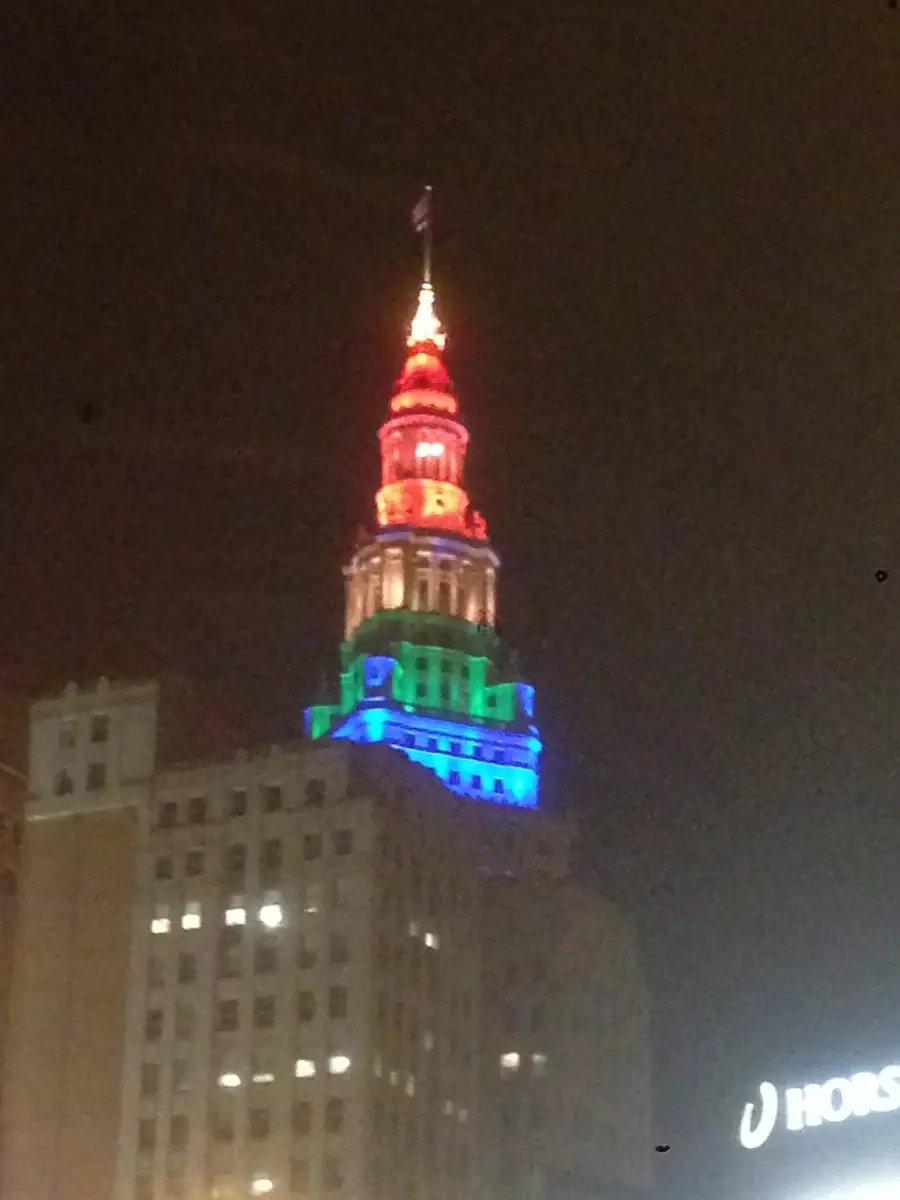
Opening ceremonies of the 2014 Gay Games in Cleveland, with the Terminal Tower behind. The movement Tom Waddell founded in 1982 grew into a global multi-sport gathering. Photo by The Zender Agenda, CC BY 2.0, via Wikimedia Commons. CC BY 2.0.
The Gay Games
Before there were out superstars, there was a doctor who built an Olympics of his own, and a government that took the word "Olympic" away from him.
Tom Waddell (1937–1987), born Thomas Flubacher, was a physician and decathlete who placed sixth of thirty-three in the decathlon at the 1968 Mexico City Olympics. He conceived the quadrennial Gay Games as an inclusive, participation-first alternative to elite international sport. The first Games opened in San Francisco on August 28, 1982, with roughly 1,350 competitors from over 170 cities and some 10,000 attendees across nine days. Waddell lived to compete in Gay Games II in 1986, winning gold in the javelin, and died of AIDS-related complications on July 11, 1987, weeks after the Supreme Court ruled against his organization. Verified
It was meant to be the "Gay Olympic Games." Just nineteen days before it opened, the U.S. Olympic Committee, armed by the Amateur Sports Act of 1978 with exclusive control of the word "Olympic," secured an injunction forcing the word off the event. In San Francisco Arts & Athletics, Inc. v. USOC, 483 U.S. 522, the Supreme Court ruled 5–4 on June 25, 1987 that Congress had granted that exclusive control without any need to prove consumer confusion, and declined to reach the discrimination claim because the USOC was found not to be a state actor, even though "Special Olympics," "Police Olympics," and many other "_____ Olympics" went unchallenged. Verified
The four dissenters, including Brennan and Marshall, argued a quasi-governmental body had been allowed to suppress a politically disfavored group's speech. The "Gay Olympics" name was the one singled out.
On SFAA v. USOC (1987)
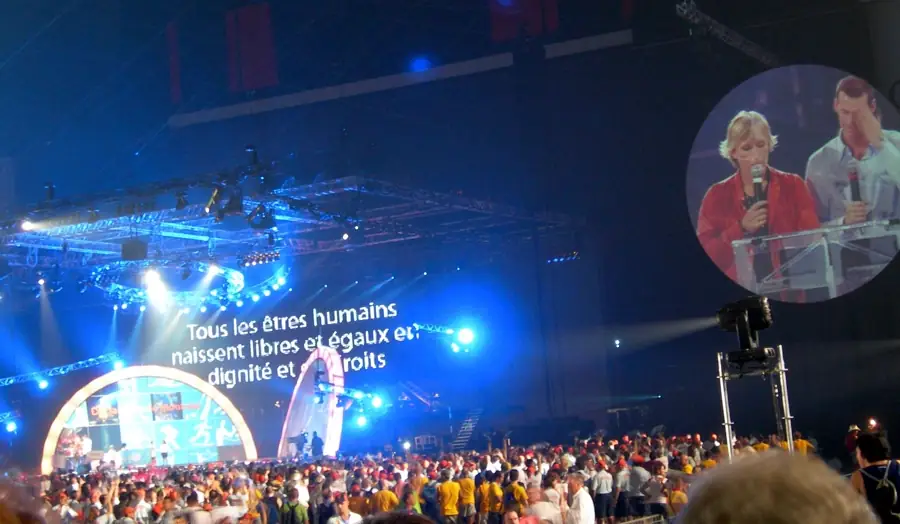
The committee reorganized in 1989 as the Federation of Gay Games, the movement's standing international governing body, and the common shorthand "founded 1982" conflates that 1989 incorporation with the original organizing committee; we state both precisely. The Games grew fast: Vancouver 1990 drew some 7,300 athletes across 27 sports; New York 1994, timed to Stonewall 25, opened with a speech by Greg Louganis; Amsterdam 1998 reported 14,000-plus athletes from around 73 countries. We also record, honestly, that a 2006 schism over host selection produced a rival movement, the World OutGames under GLISA (Montréal 2006), which later collapsed financially, a thread we are still sourcing from primary records. CorroboratedOutGames schism: to verify
Jun 15, 1980
The committee forms
The Gay Olympic Committee is founded, later the San Francisco Arts & Athletics.
Verified
Aug 28, 1982
Gay Games I
~1,350 athletes in San Francisco, after the word "Olympic" is stripped 19 days before opening.
Verified
Jun 25, 1987
The Supreme Court rules 5–4
The USOC keeps exclusive control of "Olympic"; Waddell dies weeks later.
Verified
1989
The Federation of Gay Games
The movement reorganizes into its standing international governing body.
Corroborated
Sources: Gay Games organization history, "Our Founder," and "Previous Editions"; San Francisco Arts & Athletics, Inc. v. USOC, 483 U.S. 522 (Justia; Wikipedia); SFPL Federation of Gay Games finding aid.
Chapter II
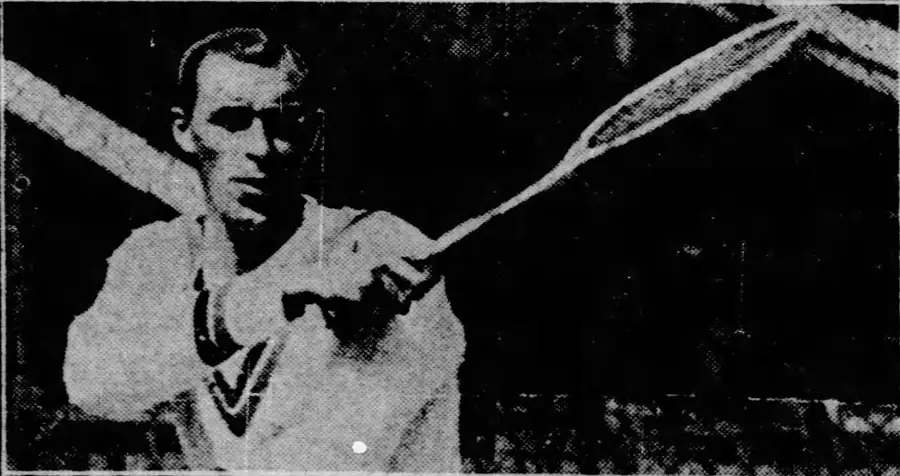
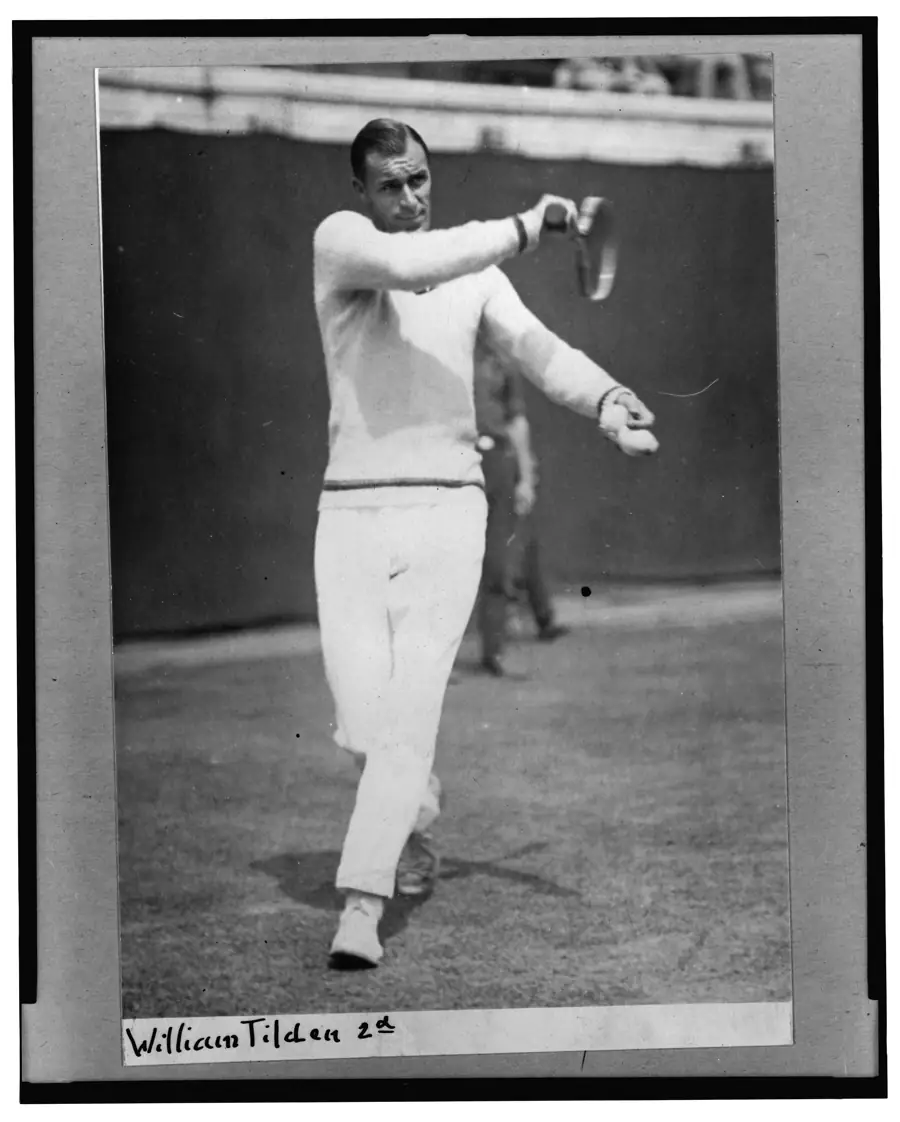
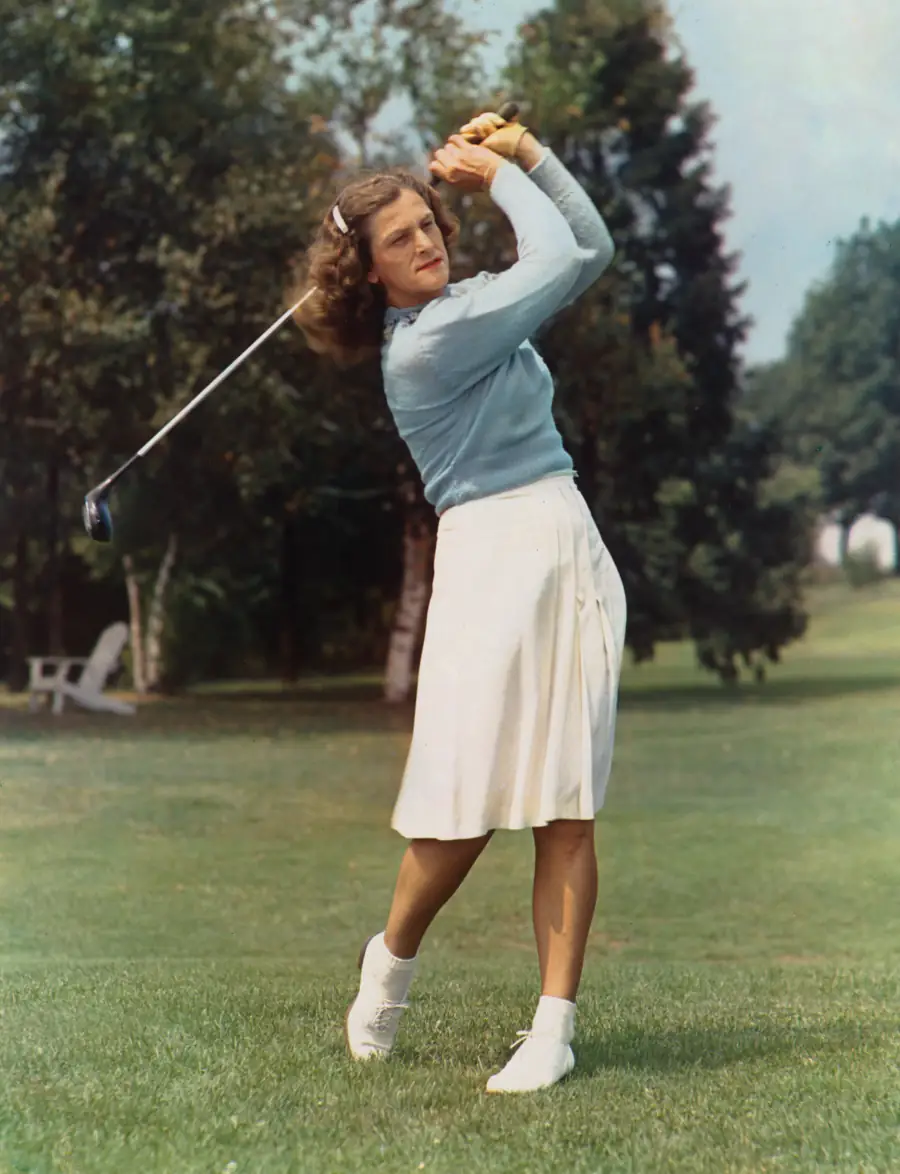
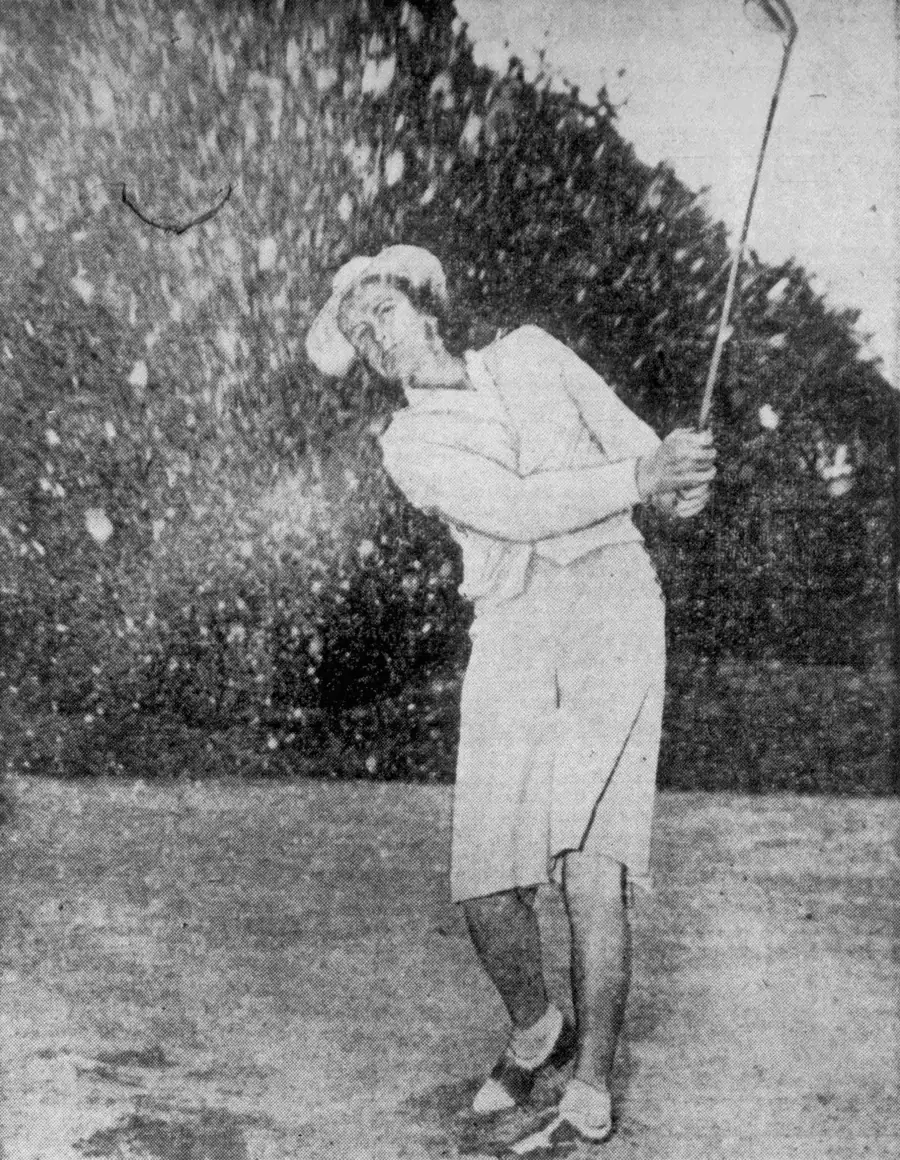
Bill Tilden at a July 1924 match in Skokie, Illinois. He was world No. 1 from 1920 to 1925 and the dominant player of the decade. Chicago Tribune, July 21, 1924; public domain, via Wikimedia Commons. Public domain.Bill Tilden, full-length portrait on a tennis court with his racket, about 1925. Library of Congress, Miscellaneous Items in High Demand; public domain, via Wikimedia Commons. Public domain.Babe Didrikson Zaharias in a 1947 color carbro portrait. She won two golds and a silver in track and field at the 1932 Olympics, then dominated golf and co-founded the LPGA. Harry Warnecke, Robert F. Cranston and Gus Schoenbaechler, 1947; National Portrait Gallery, Smithsonian Institution (NPG.97.211), CC0. CC0.Babe Didrikson Zaharias in 1945, during her dominant golf years. Los Angeles Daily News, 1945; public domain, via Wikimedia Commons. Public domain.
The closeted century
Before anyone could come out and keep their career, there were champions whose private lives were known, undiscussed, and career-ending if exposed.
Glenn Burke (1952–1995) was an outfielder for the Dodgers and Athletics in the mid-to-late 1970s who was out to teammates and management during his career and publicly afterward, generally recognized as the first MLB player to be out as gay both during and after playing. He co-originated the high five with Dusty Baker at Dodger Stadium on October 2, 1977. His career ended at 27 amid hostility; per his 1995 autobiography Out at Home, Dodgers GM Al Campanis offered to pay for a honeymoon if Burke married a woman. He died of AIDS-related complications in 1995 and was an inaugural inductee of the National Gay and Lesbian Sports Hall of Fame on August 2, 2013. Verified
Babe Didrikson Zaharias (1911–1956) was among the greatest all-around athletes of the century, two golds and a silver in track and field at the 1932 Los Angeles Olympics, then a dominant golf career and co-founder of the LPGA. From 1950 she lived with golfer Betty Dodd for the last six years of her life, and has since been described as "the first lesbian gold medalist." Her biographer Susan Cayleff presents that relationship as romantic and sexual; Didrikson publicly denied it her whole life, the two never used the word "lesbian," and some who knew her disputed the reading. We present her LGBTQ+ identity as scholarly interpretation, openly contested, with the dissent shown, not as a settled self-identification. Athletic record verified; identity contested
A case we handle with care
Tennis champion Bill Tilden (1893–1953) was the dominant player of the 1920s, world No. 1 from 1920–25, ranked No. 1 nationally a record ten straight times, with seven U.S. and three Wimbledon singles titles; a 1950 Associated Press poll named him the greatest tennis player of the first half of the twentieth century, and he entered the International Tennis Hall of Fame in 1959. His relationships with men were known but undiscussed in his era. He was also arrested in 1946 and 1949 for offenses involving teenage boys, was incarcerated, and was afterward shunned, his club membership revoked, his portrait removed. We name both facts and refuse to fold them together: his crimes were crimes, separate from his orientation. Conflating the two is exactly the homophobic logic this exhibit exists to counter, and we will not reproduce it.
Sources: Wikipedia, Britannica, and EBSCO on Tilden; Susan Cayleff, Babe: The Life and Legend of Babe Didrikson Zaharias, and Wikipedia on Didrikson; Wikipedia, Out at Home, and ESPN's The High Five coverage on Glenn Burke.
Chapter III
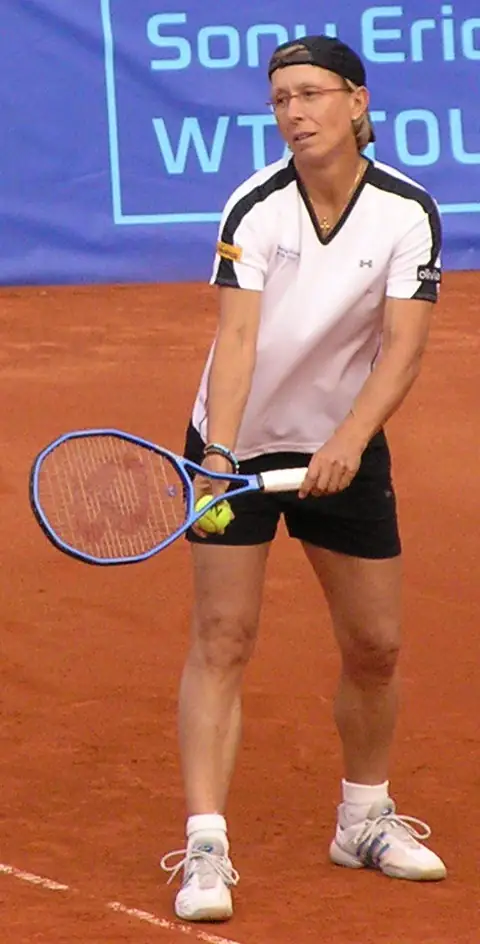
Billie Jean King during the Irish Championships at Fitzwilliam Lawn Tennis Club, Dublin, in the 1960s. Photo by Peter Clarke, CC BY 3.0, via Wikimedia Commons. CC BY 3.0.Martina Navratilova serving at the Prague Open in 2006. She won 59 Grand Slam titles and was among the first superstar athletes publicly known to be gay while still at the top. Photo by Michal Pohorelsky, cropped by Vanjagenije, CC BY-SA 3.0, via Wikimedia Commons. CC BY-SA 3.0.Martina Navratilova and Mark Tewksbury read the Declaration of Montreal at the opening of the first World OutGames, July 29, 2006. Photo by Atilin, CC BY 1.0, via Wikimedia Commons. CC BY 1.0.
Coming out at the top
Two tennis champions changed what was possible, not by retiring quietly, but by being known to be gay while they were still the best in the world.
Billie Jean King (b. 1943) had already won 39 Grand Slam titles and beaten Bobby Riggs in the "Battle of the Sexes" on September 20, 1973, a landmark for women's sport, when a palimony suit from former partner Marilyn Barnett outed her over April 28–May 1, 1981. She held a press conference confirming the relationship, among the first prominent athletes to acknowledge a same-sex relationship publicly, and lost most of her endorsements almost overnight. She described herself as bisexual in 1981 and later as gay, and we represent that evolution accurately; she went on to become a leading advocate and received the Presidential Medal of Freedom in 2009. Verified
Martina Navratilova (b. 1956), winner of 59 Grand Slam titles across disciplines, had defected from communist Czechoslovakia in 1975 at age 18. In a 1981 New York Daily News interview she discussed a relationship with author Rita Mae Brown; the story ran before she was ready, making her one of the first superstar athletes publicly known to be gay while still at the top of her sport. She estimates she lost millions in endorsements. VerifiedLiving people · public facts only · consent gate
Representing later controversy honestly
Navratilova has taken publicly contested positions on trans athletes in women's sport since around 2018–2019. If a fuller build covers that advocacy, it must be represented accurately, neutrally, and sourced, the same standard we apply to everyone here, rather than omitted or editorialized.
Sources: Tennis Majors and EBSCO on King's outing and palimony case; UPI archive on the 1982 ruling; Wikipedia, the WTA ("the 90 days that shook women's tennis"), and OUTinPerth on Navratilova.
Chapter IV
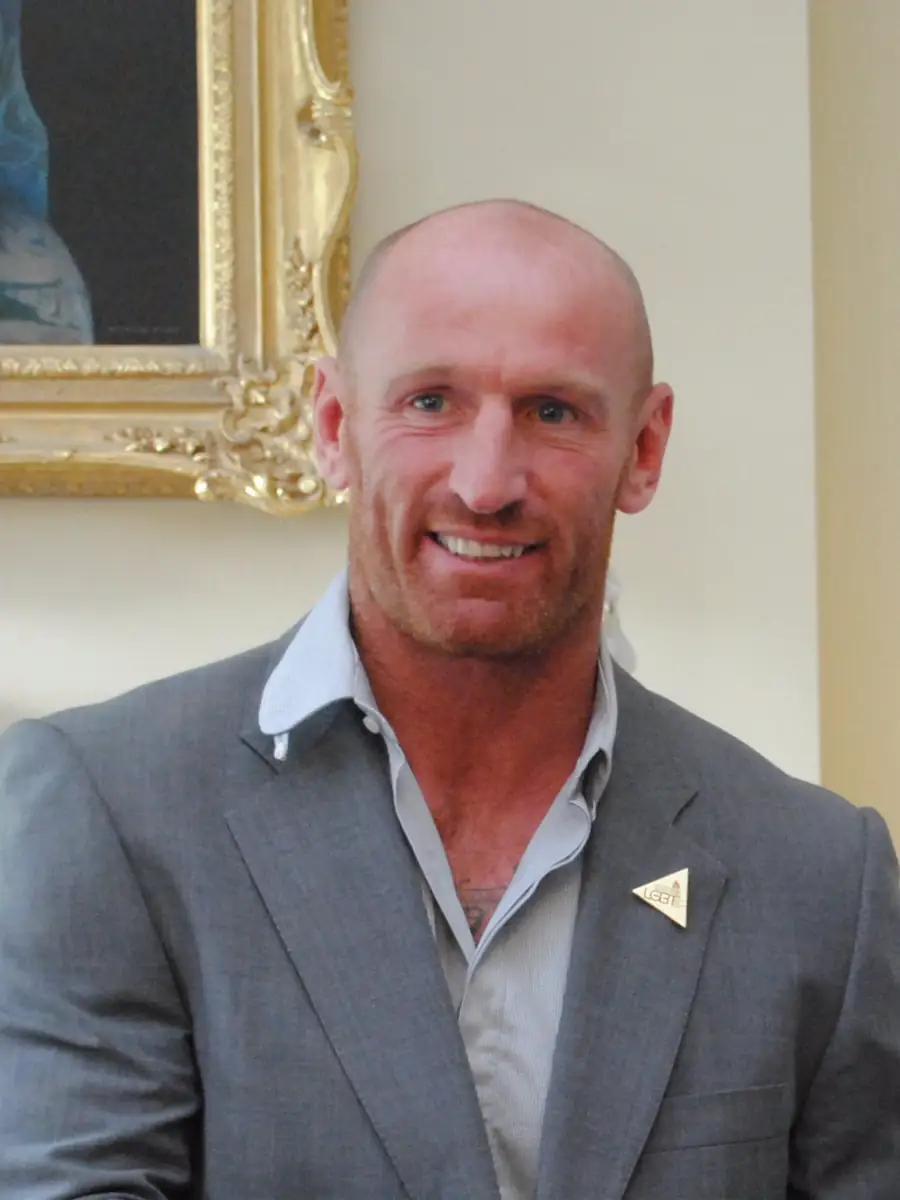
Gareth Thomas at a 2011 reception to launch a campaign against homophobia and transphobia in sport. The Welsh rugby international came out in 2009. UK Home Office, 2011, CC BY 2.5, via Wikimedia Commons. CC BY 2.5.
The men's game, and the cost
In men's team sport the price of visibility was highest, and in the highest-profile men's sport of all it has barely been paid even now.
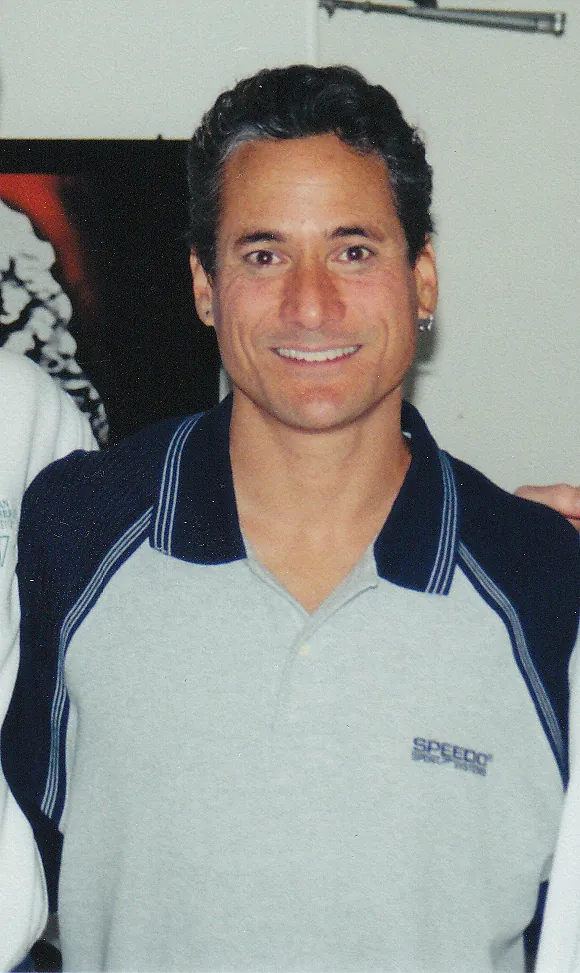
Greg Louganis, 2010. Photo by Alan Light, CC BY 2.0, via Wikimedia Commons.
Greg Louganis (b. 1960) is the greatest diver in history, with gold in springboard and platform at both the 1984 Los Angeles and 1988 Seoul Olympics. At Seoul, on September 19, 1988, he struck his head on the springboard during a preliminary, gashing it, then came back the next day to win gold; he had been diagnosed HIV-positive six months earlier. He came out as gay at the 1994 Gay Games and disclosed his HIV status in 1995, in his memoir Breaking the Surface and a Barbara Walters interview, forcing a national conversation about HIV stigma. Verified
Justin Fashanu (1961–1998) was the first footballer to command a £1 million transfer fee (Norwich City to Nottingham Forest, 1981). On October 22, 1990, ahead of a planned tabloid exposé, he sold his story to The Sun, becoming the world's first openly gay professional footballer. He faced intense homophobia, including from his own brother, and a collapsing career; in 1998, accused of assault in Maryland and fearing he could not get a fair trial as a gay man, he fled to London and died by suicide on May 2, 1998. He was inducted into England's National Football Museum Hall of Fame in 2020. We handle his death trauma-informed, and we name the still-near-total absence of out men in top-flight men's football decades later as absence-as-data. Verified
Gareth Thomas (b. 1974), a Welsh rugby international with more than 100 union caps, came out in December 2009 as the first openly gay professional rugby union player, and in 2019 publicly disclosed he is HIV-positive, after a journalist threatened to out his status to his parents, becoming a major HIV-stigma campaigner. The Louganis and Thomas threads rhyme: both turned a forced or feared disclosure into public education. VerifiedLiving people · public facts only · consent gate
Sources: Wikipedia, History.com, and Olympics.com on Louganis; Wikipedia, Britannica, and the National Football Museum on Fashanu; Wikipedia and LGBT History UK on Thomas.
Chapter V
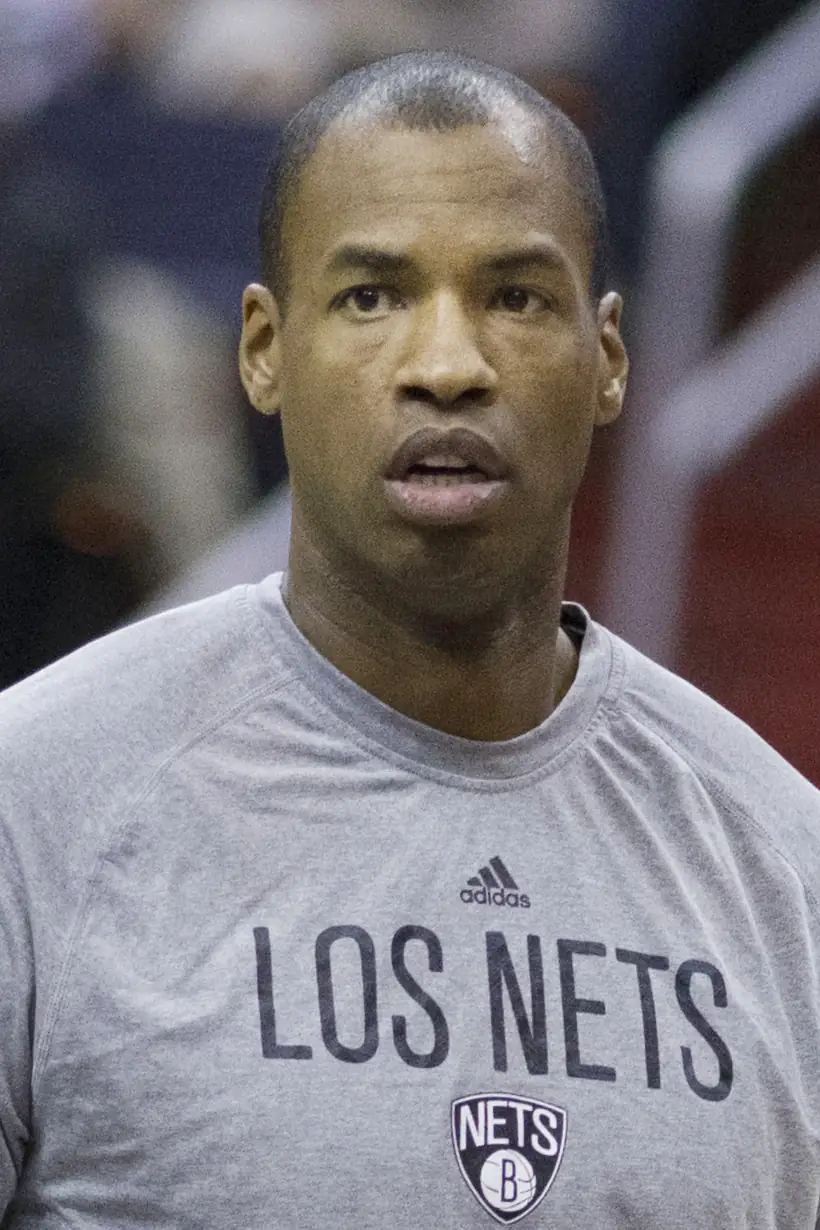
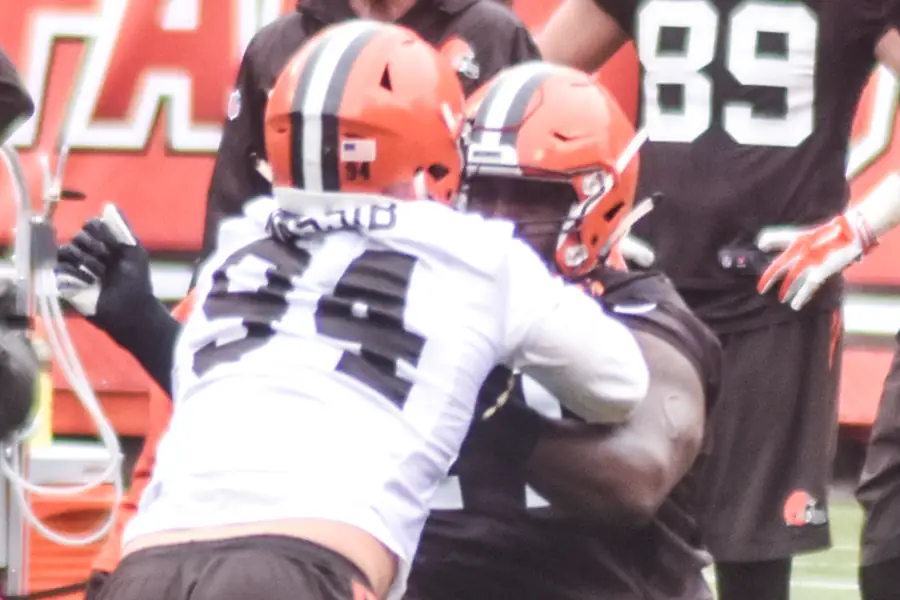
Jason Collins with the Brooklyn Nets in 2014, the year he became the first openly gay athlete to play in a big-four North American league game. Photo by Keith Allison, cropped by UCinternational, CC BY-SA 2.0, via Wikimedia Commons. CC BY-SA 2.0.Carl Nassib at Cleveland Browns training camp, 2016. In 2021 he became the first openly gay player to appear in an NFL regular-season game. Photo by Erik Drost, CC BY 2.0, via Wikimedia Commons. CC BY 2.0.
The big leagues break
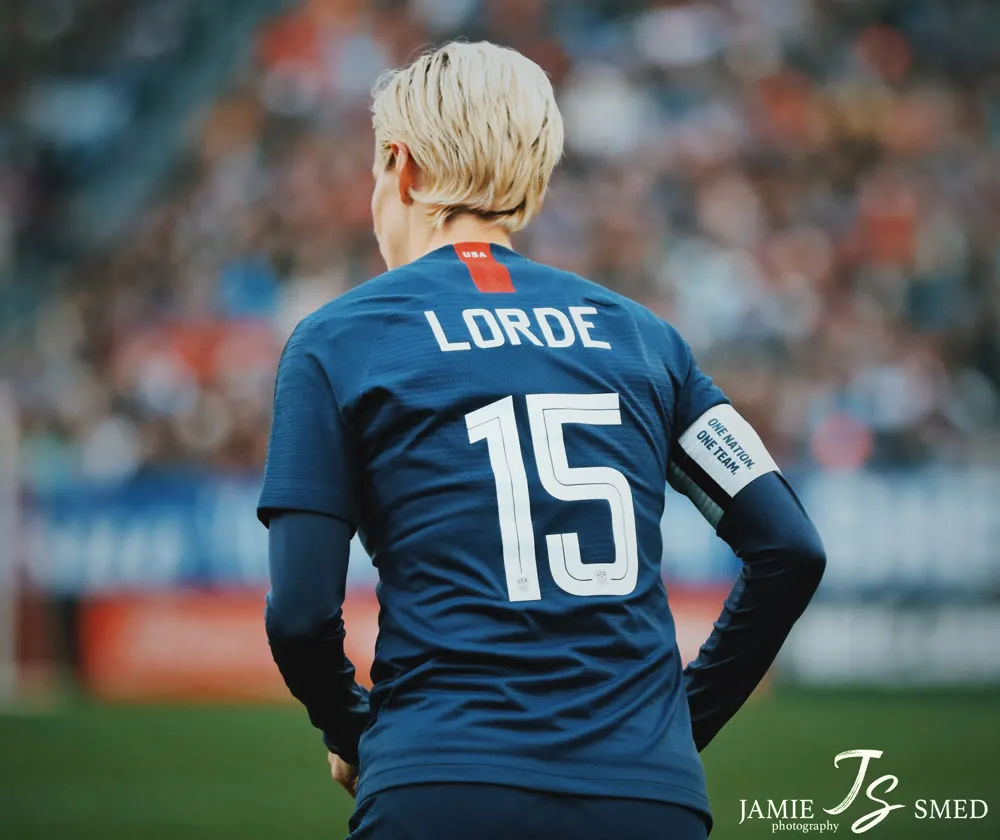
Megan Rapinoe, 2019. Photo by Jamie Smed, CC BY 2.0, via Wikimedia Commons.
Jason Collins (1978–2026) came out in a first-person Sports Illustrated cover story posted April 29, 2013, the first active male athlete in any of the four major North American team sports to do so. On February 23, 2014 he signed with the Brooklyn Nets and played that night against the Lakers, becoming the first openly gay athlete to play in a big-four league game. He died of a brain tumor in May 2026 at age 47; we hold his memory with dignity and note his family is living. Verified
Michael Sam (b. 1990) was SEC Co-Defensive Player of the Year at Missouri and came out before the 2014 NFL Draft, where the St. Louis Rams selected him in the seventh round (249th overall), the first openly gay player drafted by an NFL team; his on-camera kiss with partner Vito Cammisano was a widely broadcast first. He was cut before the regular season and never appeared in a regular-season game, a reminder that a "first" can also mark how far there was still to go. Carl Nassib (b. 1993) came out via Instagram on June 21, 2021, and in the Raiders' opener became the first openly gay player to appear in an NFL regular-season game, recording a strip-sack in overtime; his jersey is displayed at the Smithsonian. Verified
Megan Rapinoe (b. 1985) came out in the July 2012 issue of Out, just before the London Olympics, for a time the only out player on the USWNT. She won World Cups in 2015 and 2019 and Olympic gold in 2012, and as a lead plaintiff in the USWNT equal-pay litigation helped win a landmark settlement guaranteeing equal pay. VerifiedLiving people · public facts only · consent gate
Sources: Wikipedia and ESPN on Collins and Sam; NFL.com on Nassib; Wikipedia, Britannica, and Olympics.com on Rapinoe; ESPN and NPR obituaries for Jason Collins (2026).
Chapter VI
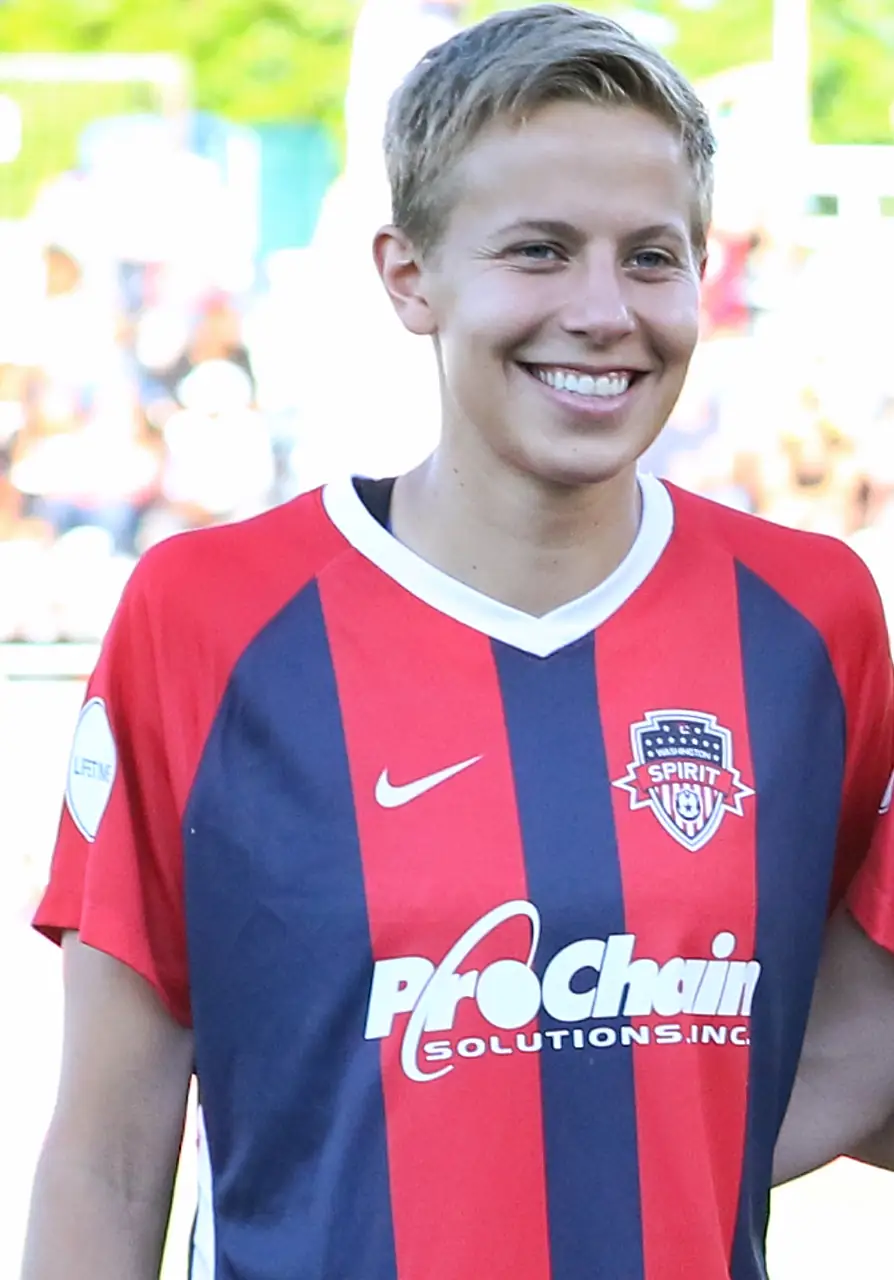
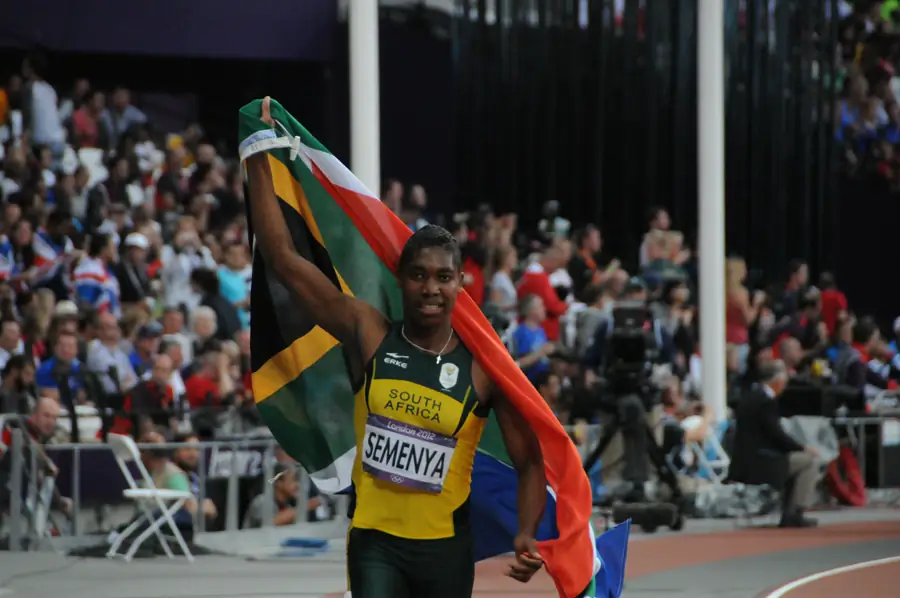
Quinn playing for the Washington Spirit in June 2018. At Tokyo 2020 Quinn became the first openly transgender and nonbinary athlete to win an Olympic medal. Photo by Jamie Smed, CC BY 2.0, via Wikimedia Commons. CC BY 2.0.Caster Semenya at the London 2012 Olympics, where she won silver in the 800 meters. Her case is the central modern reference point in sport's sex-eligibility debate. Photo by Tab59, CC BY-SA 2.0, via Wikimedia Commons. CC BY-SA 2.0.
Trans, nonbinary & intersex in sport
This is sport's most contested modern debate. We do not adjudicate it; we document who the people are, what the rules have been, and where the science and ethics are disputed.
The Tokyo 2020 Games, held in 2021, were the first at which openly trans athletes competed, roughly seventeen years after the IOC first allowed trans athletes under conditions. Laurel Hubbard (b. 1978), a New Zealand weightlifter, became the first openly transgender woman to compete at an Olympics. Quinn (b. 1995), a Canadian soccer player, became the first openly transgender and nonbinary athlete to compete at, and win a medal at (gold, women's football), the Games. Layshia Clarendon (b. 1991) is the WNBA's first openly transgender and nonbinary player, and in 2021 the first WNBA player publicly known to have had top surgery. VerifiedLiving people · public facts only · consent gate
An earlier landmark belongs here too: Renée Richards (b. 1934), barred from the 1976 U.S. Open when the USTA required a chromosome test, sued under New York's Human Rights Law and won on August 16, 1977, when a judge called the requirement "grossly unfair, discriminatory and inequitable" and held "this person is now a female." She competed at the 1977 U.S. Open, losing to Virginia Wade in singles and reaching the women's doubles final, played professionally until 1981, and later coached Navratilova. Richards has expressed complicated, sometimes ambivalent views about being a trans symbol, and we represent her in her own documented words. Verified
An important distinction: Caster Semenya
Caster Semenya (b. 1991), the two-time Olympic 800m champion, has a 46,XY difference of sex development that produces naturally elevated testosterone. The 2019 World Athletics rules require athletes like her to medically suppress that testosterone to compete in 400m–1500m women's events; on May 1, 2019 the Court of Arbitration for Sport upheld the rules as discriminatory but, in its words, "necessary, reasonable and proportionate," and she has refused suppression and pursued further legal challenges, including before the European Court of Human Rights. On July 10, 2025, the Grand Chamber of that court ruled in her favor on narrow grounds, finding that Switzerland had denied her a fair hearing under Article 6 of the European Convention on Human Rights, while declining to decide her discrimination and privacy claims. She is intersex, not trans, and not labeled "LGBTQ+" by self-identification. She is here because her case is the central modern reference point for the same sex-eligibility machinery that governs trans inclusion.
The policy record
2003
The IOC "Stockholm Consensus"
First framework allowing trans athletes; required gender-confirmation surgery, legal recognition, and about two years of hormone therapy.
Verified
2015
Surgery requirement dropped
The IOC removed the surgery rule and, for trans women, set a testosterone threshold below 10 nmol/L for at least 12 months.
Verified
2021
"No presumption of advantage"
The IOC moved away from a single threshold and devolved eligibility decisions to each sport's federation.
Verified
2023–
Federations diverge
World Athletics and World Aquatics, among others, adopted markedly more restrictive rules effectively barring trans women who went through male puberty from elite women's events. The science, ethics, and politics are disputed; we present multiple sourced positions rather than adjudicate.
Verifying specifics
Sources: GLAAD and CNN on Hubbard and Quinn; Wikipedia and ESPN on Clarendon; Quimbee and HISTORY on Richards v. USTA (1977); Wikipedia and CAS ruling coverage on Semenya, and the 2025 European Court of Human Rights Grand Chamber judgment (Semenya v. Switzerland); the IOC consensus documents (2003, 2015, 2021).
Chapter VII
The numbers as history
Visibility is something you can count. The count is the argument.
~56
publicly out LGBTQ athletes at Rio 2016
~182
publicly out LGBTQ athletes at Tokyo 2020 (held 2021), a record
19+
medals won by out athletes at those Games
The roughly three-fold jump from Rio to Tokyo in a single Olympic cycle is this exhibit's closing argument. Against the near-silence of Tilden's and Burke's eras, when exposure ended careers, visibility became a measurable historical trend, and Tokyo was also the first Games at which openly trans athletes competed. Verified as a widely reported recordExact tallies vary by outlet
Sources: Outsports and NBC News counts, via GLAAD coverage. Tallies differ slightly between outlets and are tagged accordingly.
Chapter VIII
Gaps, and how we know
This record is Anglo-American-heavyFinding
Out athletes and policy histories across Africa, Asia, Latin America, and the Middle East are thin here, including the reality that criminalization, vivid around the Qatar 2022 World Cup, makes being out impossible in many places. We mark that as a finding to research, not an absence of history.
Women's sport beyond tennis and soccerFinding
Lesbian and women's-sport history in softball, basketball, and post-Babe LPGA golf is under-covered here and deserves a dedicated pass.
Men's team sports' near-silenceDocumented
Decades after Fashanu, elite men's football still has essentially zero out active players at the top level. We name the silence rather than paper over it.
Image rights and consentVerifying
The iconic sports photographs, the first high five, the 1977 U.S. Open, the 2014 draft kiss, are agency-held and require licensing; Tom Waddell and Gay Games imagery likely sits with the GLBT Historical Society and the Federation archives, a genuine partnership opportunity. The portraits shown here are Creative Commons, credited. Living athletes are gated for consent before any public launch.
If you hold a piece of this
A team photo, a Gay Games memory, a local out athlete the record forgot? Help us keep it, sourced and with care.
Key sources: the Gay Games and Federation of Gay Games archives; the U.S. Supreme Court record; Outsports; GLAAD; the IOC; and the per-figure citations above. Full citations are held in the museum's research record.

 Museum