
 Museum
Coming soon · New Bedford & the sea
A Wide Sea
The queer history of the New Bedford whaling world
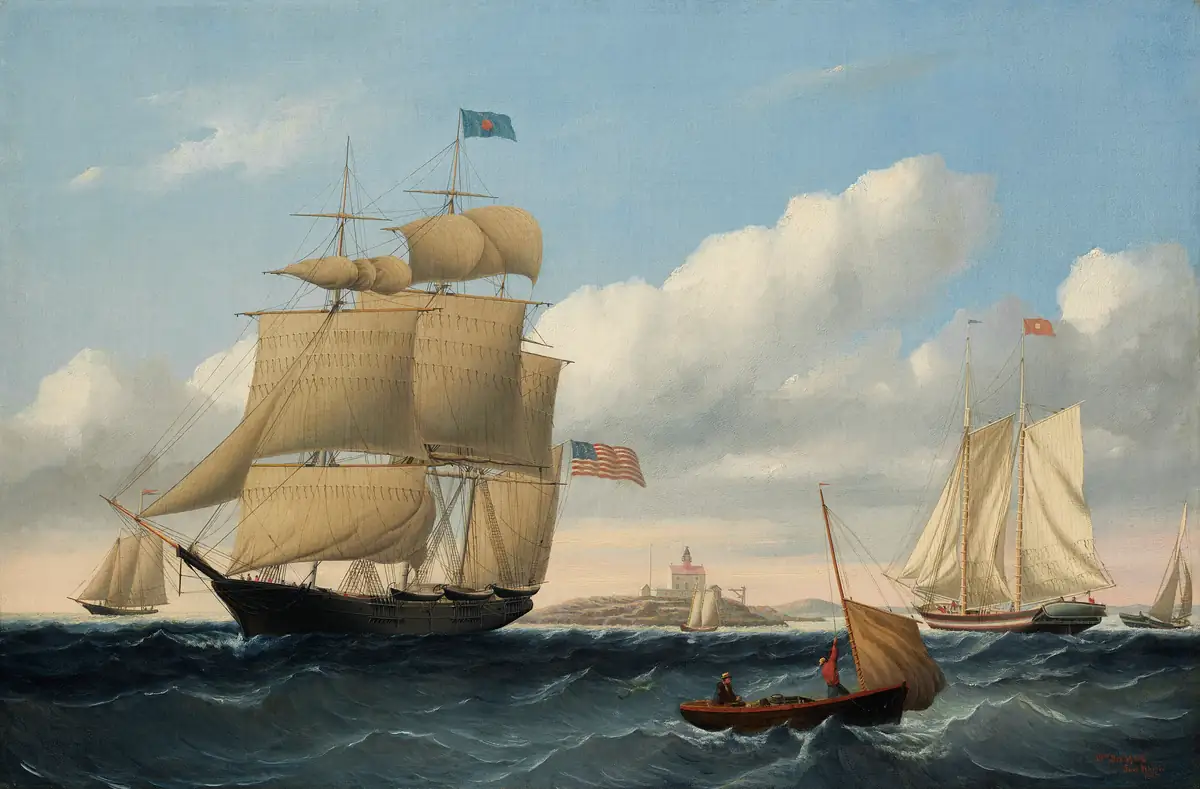
For most of the nineteenth century, New Bedford was the whaling capital of the world, and the ships that left this harbor carried more than oil. They carried people who loved, lived, and crossed lines of gender in ways the records only half remember. A Wide Sea is a new exhibit, now in development, that gathers what can be honestly documented about queer life in the whaling world, and says plainly where the record goes quiet.
It begins where Moby-Dick begins. Herman Melville came to New Bedford in the winter of 1840 and shipped out from Fairhaven, just across the harbor, on the whaler Acushnet. Ten years later he opened his great novel right here, in a crowded inn where the narrator Ishmael shares a bed with the harpooner Queequeg and wakes to find Queequeg's arm thrown over him "in the most loving and affectionate manner." We start with the words on the page, and with what generations of readers and scholars have made of them.
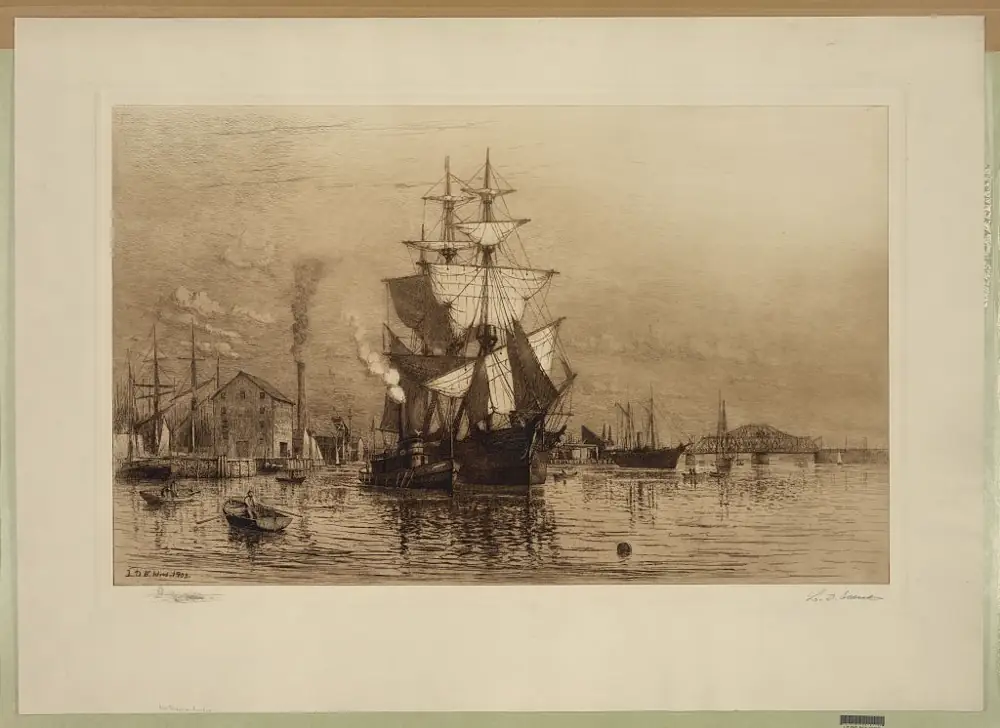
“Squeeze! squeeze! squeeze! all the morning long; I squeezed that sperm till I myself almost melted into it… let us squeeze ourselves universally into the very milk and sperm of kindness.”
Herman Melville, Moby-Dick, chapter 94, “A Squeeze of the Hand,” 1851
Later in the novel, Melville gives the whaling world its most openly tender scene, and sets it in the labor itself. Squeezing cooled lumps of spermaceti back into oil, a real task aboard a whaleship, Ishmael finds himself squeezing his shipmates' hands, and tips into a reverie of love for them. Readers and scholars have read the passage as frankly homoerotic for generations. It sits near the heart of the most famous book the whaling world produced, right there in print.
What you'll find inside
Six rooms, drawn from the sources. Here is a first look.
I
Before you read these walls
How to read the evidence before you meet it. The people in these rooms did not use the words we use today, so we say what someone did in the language the record supports, and we credit every modern label to the historian who argues for it.
II
The squeeze of the hand
The headline room. Moby-Dick opens in New Bedford and Fairhaven, with two men who share a bed and whom the narrator calls "married," a word Melville pairs in the same breath with "bosom friends." We show the passages, the 1840 crew list that put Melville aboard a whaler, and the long argument over what it all means.
III
Shipped as a man
People who lived and worked as men aboard regional whalers, discovered only by accident, months out to sea. We tell their stories in the words the documents preserve, and we keep separate the lives that popular retellings have wrongly merged into one.
IV
The town the voyages built
With the men gone three and four years at a stretch, women ran the households, the shops, and the business of the whaling ports, often working around laws that barred them from owning property or signing a contract. A history of gender written on land.
V
A wide, multiethnic ocean
Whaling was a Pacific labor system long before it was a Yankee legend. Native Hawaiian and other Pacific Islander whalers crewed these ships, and one chapter follows a law against same-sex intimacy, drafted for Massachusetts, that became law in Hawaiʻi instead. We want this told with the communities whose history it is, not just about them.
VI
What the record will and won't bear
The honest room. Much of what survives about sex at sea comes from punishment records, so the archive often shows what was policed, not what was lived. We mark that difference, correct the myths gently, and point you to the libraries where the originals still rest.
A first look inside
Found out at sea
Of the six rooms, the one visitors ask about first is the one about sailors who shipped as men. Two of their voyages survive in enough detail to tell honestly. They belong to two different people, on two different ships, more than a decade apart, and popular retellings long ago folded them into a single legend. We keep them apart, because the records do.
George Johnson · the Christopher Mitchell, 1849
In 1848, a young sailor signed aboard the Nantucket whaler Christopher Mitchell under the name George Johnson and sailed for the Pacific. Months into the voyage, near the Peruvian port of Paita, the crew learned that the shipmate they knew as George was a woman, and the captain put the sailor ashore in July 1849.
The closest thing to an eyewitness is a letter from the ship's first officer, Mr. Wood, printed that summer in the Nantucket Inquirer. It is plain and unsentimental, and it records the reason the sailor gave for going to sea.
“[She] gives as a reason for coming to sea, that she was told she would get some money in that business.”
First officer of the Christopher Mitchell, in the Nantucket Inquirer, 1849
The newspapers called her Ann Johnson, nineteen. The Nantucket Historical Association, which holds the surviving papers, files them under Rebecca Ann Johnson, a fuller name that never appears in the 1849 press. The real name is not settled, and neither is the motive: other coverage dropped the officer's matter-of-fact “for the money” and told it as a morality tale, a seduced and abandoned girl. A newspaper notice that winter then describes a “masculine looking woman” arrested in New York under the names Shorty and Rough and Ready, who said she had shipped from Nantucket as George Johnson. It is very likely the same person, though it cannot be proven, and if it is, it undoes the tidy ending of a girl who went home repentant.
George Weldon · the bark America, 1863
More than a decade later, a sailor who had signed onto the whaling bark America out of Holmes Hole, on Martha's Vineyard, under the name George Weldon, was found out the same way, far out at sea. The captain, John A. Luce, recorded it in the ship's logbook in one plain sentence.
“This day found out George Weldon to be a Woman the first I ever suspected of such a thing.”
Logbook of the bark America, Capt. John A. Luce, January 1863
What Luce did next is part of why the story survives. He did not turn the sailor out. He reassigned Weldon to cabin-boy duty, kept on with the voyage, and arranged the sailor's passage onward from Mauritius. Weldon, whose name was Georgiana Leonard, gave the crew a startling account of an earlier life, claiming to have served as a Confederate cavalryman before going to sea. The case is kept today in a dedicated dossier at the Martha's Vineyard Museum and was pieced together in maritime scholarship decades ago. It is one of the best-documented passing voyages in American whaling.
Set side by side, the two records agree on what these people did and stay quiet on why. They worked as men, sometimes for the length of a brutal multi-year voyage, and at least one seems to have gone on living as a man after the voyage was over. The honest caution holds: the sources never use today's words. Historian Jen Manion, whose book Female Husbands: A Trans History includes the Johnson case, writes about lives like these as something a person did rather than a label we can pin on from a distance, using the verb “transed gender” to describe the action and leaving the inner life where the record leaves it, unanswered. We can tell you what the logbook says, who wrote it, and where it rests. The rest, we hold open.
Both voyages are independently confirmed in the American Offshore Whaling Voyages database, a project of Mystic Seaport Museum and the New Bedford Whaling Museum. Sources include the Nantucket Historical Association (Rebecca Ann Johnson Papers), the 1849-1850 press transcribed with citations by Pat Pflieger, the logbook of the bark America, and the Martha's Vineyard Museum (George Weldon dossier). Modern framing: Jen Manion, Female Husbands: A Trans History (Cambridge University Press, 2020).
Also inside
The women who ran it
The whaling world is usually told as a story of men at sea. It was also, just as much, a story of women: the ones who held the ports and the households together for the years the fleet was gone, and the few who went to sea and helped sail the ship.
On land: a history of gender
For three and four years at a stretch the fleet was gone, and New Bedford and Nantucket were kept running by women, the households, the shops, the courts, and the business of the ports. Under the common law of the day a married woman could not own property, sign a contract, or sue in her own name. Whaling wives ran things anyway, through a workaround built for the fishery: the mariner's power of attorney, by which an absent husband signed his legal self over to his wife. Historian Lisa Norling calls the women left behind the "Cape Horn widows," and the record of how they held an economy together is thick where the record of the men at sea goes thin.
At sea: the sister sailors
By one estimate, by 1850 nearly one in six American whaleships carried the captain's wife. A few of these "sister sailors" did far more than keep house on a rolling deck. Mary Chipman Lawrence filled a journal aboard the New Bedford whaler Addison. Honor Matthews Earle learned navigation aboard the Charles W. Morgan, the last wooden whaleship in the world. Marian Shaw Smith, a New Bedford captain's wife, could take the bark Josephine's position herself, and her papers survive in the Whaling Museum's own library.
We tell this as what it is: not a love story we can name, but a record of women moving through a man's world and reshaping it. The scholarship on same-sex life among these women is genuinely silent, and we say so plainly, the way we do everywhere the record goes quiet.
Lisa Norling, Captain Ahab Had a Wife: New England Women and the Whalefishery (University of North Carolina Press, 2000); Joan Druett, Petticoat Whalers (1991); Mary L. Heen, "Agency: Married Women Traders of Nantucket, 1765-1865" (Georgetown Journal of Gender and the Law, 2019); Laurel Seaborn, "Gamming Chairs and Gimballed Beds" (Journal of Maritime Archaeology, 2017). Marian Smith Papers, New Bedford Whaling Museum, Mss 174.
Also inside
The word and the law
The whaling Pacific was not an empty ocean. From 1819 on, the ships that sailed from this harbor carried Native Hawaiian crews, and this room follows two crossings of the same wide water: a Hawaiian word for intimacy between men that the ships met when they arrived, and a New England law that sailed the other way.
Joe Bal and Jack Ena · the ship Balaena, 1819
In the fall of 1819 the New Bedford ship Balaena, under Captain Edmund Gardner, was one of the first two Yankee whaleships ever to reach Hawaiʻi. At Maui that October, two Hawaiian men joined the crew, sailed the rest of the voyage, and came home with the ship to New Bedford: the first Native Hawaiians documented aboard a Yankee whaler. No record preserves their Hawaiian names. Gardner's journal preserves what the ship called them instead.
“Their names were Joe Bal and Jack Ena, the two names comprising that of my ship Balaena.”
Journal of Capt. Edmund Gardner, published 1958; the original rests in the New Bedford Whaling Museum Research Library
On a later voyage Gardner carried both men back to Maui, “they preferring to stay at their own Island.” Behind them came thousands. By NOAA's account, Native Hawaiians came to make up nearly one fifth of the sailors in the Pacific whaling fleet, and by 1871 almost half the crews whaling in Alaskan waters. When ice trapped and wrecked that fleet off Alaska in 1871, twenty-two of the thirty-three abandoned ships were New Bedford vessels; all 1,219 people were brought out alive, and some five hundred of them were Hawaiian and Pacific Islander seamen. None of it was an unregulated drain: under its laws of 1839 to 1842, the Kingdom of Hawaiʻi governed the leaving of its seamen as a sovereign state, requiring a whaling master to carry the island governor's written permission, signed Hawaiian Shipping Articles, and a bond pledging to bring each man home.
Aikāne · the journals of Cook's third voyage, 1779
Forty years before the whalers, the journals kept aboard the first European ships to reach Hawaiʻi recorded a word: aikāne, intimate male companions who held open, honored places at the courts of the chiefs, among them Kalaniʻōpuʻu, then the paramount chief of the island of Hawaiʻi. The officers wrote the word down again and again, and the surgeon David Samwell recorded that Hawaiians assumed the visitors' floating world must work the same way.
“[I]t is an office that is esteemed honourable among them & they have frequently asked us on seeing a handsome young fellow if he was not an Ikany to some of us.”
David Samwell, surgeon of the Discovery, January 1779; reproduced in Robert J. Morris, Journal of Homosexuality, 1990
Ikany is Samwell's ear-spelling of aikāne. Scholar Robert J. Morris gathered these passages a generation ago. Scholar Noenoe K. Silva, whose own glossary renders aikāne as “friend, also lover of the same sex,” documents what happened to the word afterward: modern dictionaries keep only “friend,” while nineteenth-century Hawaiian-language sources could use it, and moe aikāne, frankly and without condemnation. The honest boundary holds here as everywhere in this exhibit: the documented aikāne of the contact era are men of the chiefly courts, and no known surviving record names an aikāne bond aboard a New England whaler. What sailed with the Hawaiian crews was the word, and the world it named.
Moe aikāne · the Penal Code of 1850
Then a law crossed the water behind the ships. In 1850 the Kingdom of Hawaiʻi adopted a Penal Code built on a New England model; legal scholar Aleardo Zanghellini traces its provisions to a criminal code proposed for Massachusetts a few years earlier, a code Massachusetts itself never enacted. Its sodomy section criminalized what the English text called
“the crime against nature, either with mankind or any beast”
Penal Code of the Hawaiian Islands, 1850, chapter XIII; an excerpt
To render “with mankind,” the statute's Hawaiian text reached for the old word: moe aikāne, in Robert J. Morris's translation “one who sleeps with a lover of the same sex.” A word the record shows carrying honor at a chief's court in 1779 was, within a lifetime, written into a criminal statute drafted on a New England pattern. New Bedford's fleet tied our coast to the islands, and the law followed the ships.
The asymmetry in this room is the point. The statute survives complete, word for word; the lives mostly do not, because archives keep what was policed more carefully than what was lived. We can document the men, the word, and the law. We cannot document a single aikāne bond aboard a whaler, and we will not pretend to: absence of records is never absence of people. More than any other room, this one we intend to build with Native Hawaiian scholars and community voices rather than about them, and until that work is done, these walls hold only what the named record supports.
Edmund Gardner, journal, in John M. Bullard, ed., Captain Edmund Gardner of Nantucket and New Bedford (1958); original held by the New Bedford Whaling Museum Research Library. Susan A. Lebo, “A Local Perspective of Hawaii's Whaling Economy” (Coriolis, 2010) and “Native Hawaiian Whalers in Nantucket, 1820-60” (Nantucket Historical Association). Hans Van Tilburg, “Native Hawaiians and the 1871 Whaling Fleet Disaster” (NOAA Office of Ocean Exploration, 2015); Alexander Starbuck, History of the American Whale Fishery (1878); ship counts per the New Bedford Whaling Museum. David Samwell and James King, in J. C. Beaglehole, ed., The Journals of Captain James Cook (Hakluyt Society, 1967); Robert J. Morris, Journal of Homosexuality 19 (1990) and Yale Journal of Law and the Humanities 8 (1996). Noenoe K. Silva, Aloha Betrayed (Duke University Press, 2004). Sally Engle Merry, Colonizing Hawaiʻi (Princeton University Press, 2000). Aleardo Zanghellini, “Sodomy Laws and Gender Variance in Tahiti and Hawaiʻi” (Laws, 2013).

How we are building this
This exhibit follows the same rule as every other room in the museum. We do not invent. We lead with what the published record and named scholars can support, we attribute every modern word to the person who uses it, and we say out loud where the evidence is thin or silent. The whaling record is genuinely sparse on these lives, and part of the work is being honest about that. We are also reaching out to the communities whose histories it holds, including Wampanoag, Cape Verdean, and Native Hawaiian voices, to build it in conversation with them, in keeping with how the best maritime museums have done this work before us.
Help us bring it ashore
If your family has whaling-era letters, photographs, logbooks, or stories, or if you would like to help with community review, we would love to hear from you. A museum like this one is built by the people who remember.
A Wide Sea is in development and does not have an opening date yet. We would rather take the time to get it right.